Vaccine Research Center, National Institute of Allergy and Infectious Diseases, Bethesda, Maryland, United States of America.
Department of Pharmaceutical Chemistry, The University of Kansas, Lawrence, Kansas, United States of America.
PLoS One. 2022 May 24;17(5):e0268767. doi: 10.1371/journal.pone.0268767. eCollection 2022.
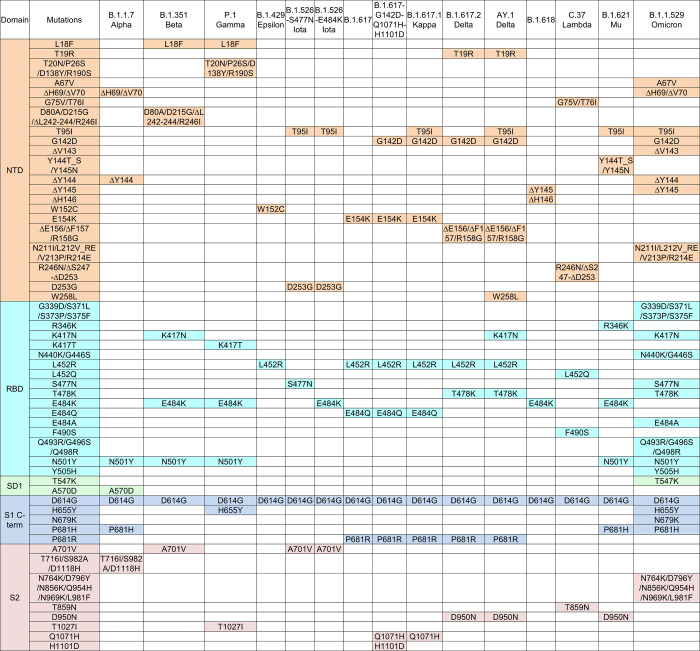
Since the outbreak of the COVID-19 pandemic, widespread infections have allowed SARS-CoV-2 to evolve in human, leading to the emergence of multiple circulating variants. Some of these variants show increased resistance to vaccine-elicited immunity, convalescent plasma, or monoclonal antibodies. In particular, mutations in the SARS-CoV-2 spike have drawn attention. To facilitate the isolation of neutralizing antibodies and the monitoring of vaccine effectiveness against these variants, we designed and produced biotin-labeled molecular probes of variant SARS-CoV-2 spikes and their subdomains, using a structure-based construct design that incorporated an N-terminal purification tag, a specific amino acid sequence for protease cleavage, the variant spike-based region of interest, and a C-terminal sequence targeted by biotin ligase. These probes could be produced by a single step using in-process biotinylation and purification. We characterized the physical properties and antigenicity of these probes, comprising the N-terminal domain (NTD), the receptor-binding domain (RBD), the RBD and subdomain 1 (RBD-SD1), and the prefusion-stabilized spike ectodomain (S2P) with sequences from SARS-CoV-2 variants of concern or of interest, including variants Alpha, Beta, Gamma, Epsilon, Iota, Kappa, Delta, Lambda, Mu, and Omicron. We functionally validated probes by using yeast expressing a panel of nine SARS-CoV-2 spike-binding antibodies and confirmed sorting capabilities of variant probes using yeast displaying libraries of plasma antibodies from COVID-19 convalescent donors. We deposited these constructs to Addgene to enable their dissemination. Overall, this study describes a matrix of SARS-CoV-2 variant molecular probes that allow for assessment of immune responses, identification of serum antibody specificity, and isolation and characterization of neutralizing antibodies.
自 COVID-19 大流行爆发以来,广泛的感染使 SARS-CoV-2 在人类中进化,导致多种循环变异株的出现。其中一些变异株对疫苗诱导的免疫、恢复期血浆或单克隆抗体表现出更高的耐药性。特别是,SARS-CoV-2 刺突中的突变引起了关注。为了方便分离针对这些变异株的中和抗体并监测疫苗的有效性,我们设计并生产了基于结构的构建设计的带有生物素标记的变异 SARS-CoV-2 刺突及其亚结构域的分子探针,该设计包括一个 N 端纯化标签、一个用于蛋白酶切割的特定氨基酸序列、基于变异刺突的感兴趣区域和一个针对生物素连接酶的 C 端序列。这些探针可以通过一步法使用过程中的生物素化和纯化来生产。我们对这些探针的物理性质和抗原性进行了表征,包括 N 端结构域(NTD)、受体结合域(RBD)、RBD 和亚结构域 1(RBD-SD1)以及预融合稳定的刺突外结构域(S2P),这些探针的序列来自关注或感兴趣的 SARS-CoV-2 变异株,包括 Alpha、Beta、Gamma、Epsilon、Iota、Kappa、Delta、Lambda、Mu 和 Omicron 变异株。我们使用表达一组九种 SARS-CoV-2 刺突结合抗体的酵母对探针进行了功能验证,并使用来自 COVID-19 恢复期供体的血浆抗体文库对酵母进行了变体探针的分选能力验证。我们将这些构建体存入 Addgene 以促进其传播。总的来说,这项研究描述了一组 SARS-CoV-2 变异分子探针,可用于评估免疫反应、鉴定血清抗体特异性以及分离和表征中和抗体。