Division of Gastroenterology, Department of Medicine, Kurume University School of Medicine, 67 Asahi-machi, Kurume, Fukuoka, 830-0011, Japan.
Department of Diagnostic Pathology, Kurume University Hospital, Kurume, Fukuoka, Japan.
Sci Rep. 2022 May 24;12(1):8759. doi: 10.1038/s41598-022-12762-9.
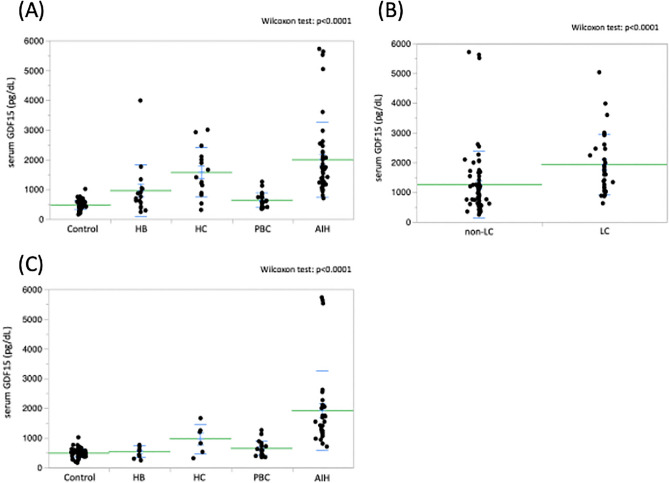
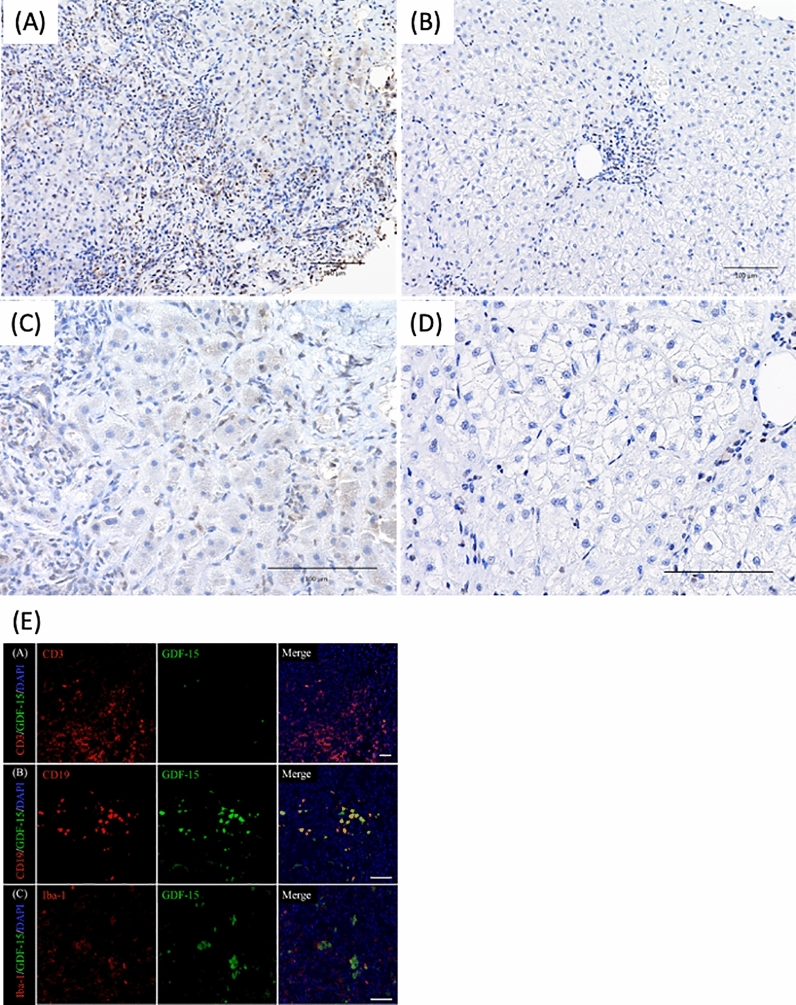
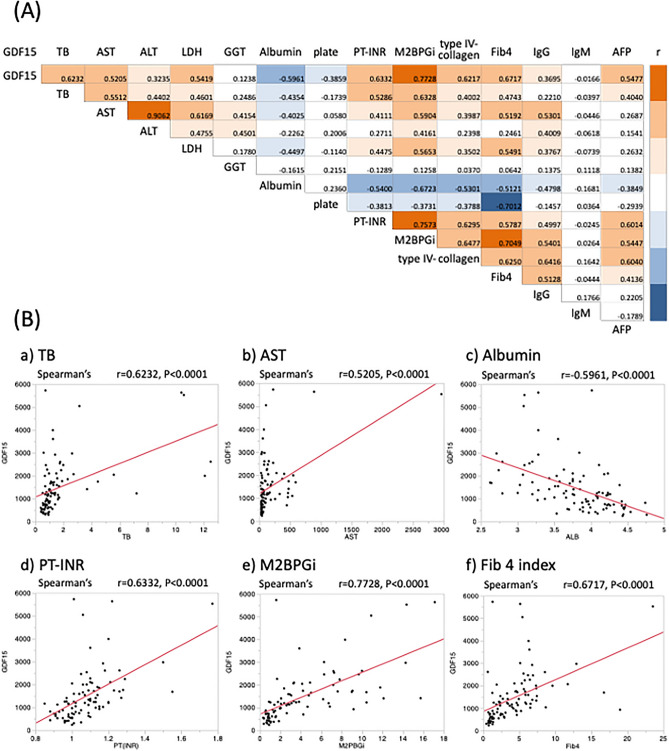
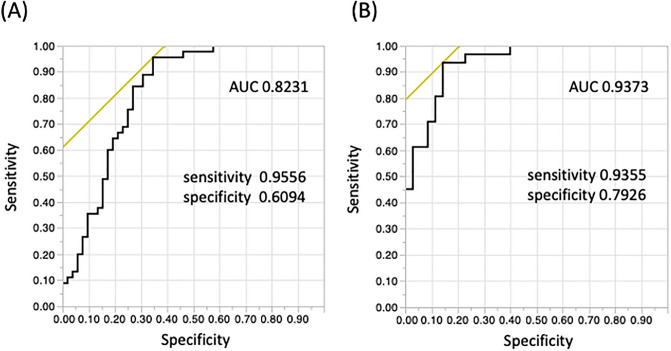
Growth differentiation factor 15 (GDF15) has been reported to be associated with fibrosis and cancer in liver disease. Diagnosis of autoimmune hepatitis (AIH) is often difficult because of the lack of specific markers. We investigated whether GDF15 is useful for diagnosing AIH and determined its therapeutic effects. We enrolled 171 Japanese patients as follows: AIH (n = 45), hepatitis B (HB) (n = 17), hepatitis C (HC) (n = 15), primary biliary cholangitis (PBC) (n = 20), and 74 healthy controls. Serum GDF15 levels were measured, and immunohistological analyses of GDF15 were performed using liver tissue of AIH patients. (1) GDF15 levels (pg/ml) were higher in AIH (1994.3 ± 1258.0) and HC (1568.0 ± 822.3) than in HB (953.2 ± 871.4), PBC (643.9 ± 247.0), and controls (475.3 ± 145.3) (p < 0.0001), as well as in cirrhosis patients (n = 31) than in non-cirrhosis patients (n = 66) (1926.6 ± 1026.0 vs. 1249.1 ± 1124.1, p < 0.0001). In non-cirrhosis patients, GDF15 levels were higher in AIH (1914.0 ± 1327.2) than in HC (955.7 ± 502.7), HB (519.3 ± 197.5), and PBC (643.9 ± 247.0) (p < 0.0001). (2) GDF15 was positively correlated with M2BPGi (r = 0.7728), total bilirubin (r = 0.6231), and PT-INR (r = 0.6332). (3) GDF15 levels could be used to distinguish AIH from other liver diseases in non-cirrhosis patients, with an area under the curve of 0.9373 (sensitivity 93.6%, specificity 79.3%, cut-off value 931.3). (4) GDF15 in AIH decreased after treatment. (5) Immunohistological analyses in AIH liver tissues revealed that GDF15 was strongly expressed in inflammatory cells, hepatic cytoplasm, and sinusoidal endothelial cells, but decreased after treatment. GDF15 is a novel diagnostic marker for AIH and is also expected to be a therapeutic marker for AIH.Clinical Trials Registration: The study protocol was approved by the institutional review board of Kurume University (Approval No.: 19049).
生长分化因子 15(GDF15)已被报道与肝脏疾病中的纤维化和癌症有关。由于缺乏特异性标志物,自身免疫性肝炎(AIH)的诊断常常很困难。我们研究了 GDF15 是否可用于诊断 AIH,并确定其治疗效果。我们招募了 171 名日本患者,如下所示:AIH(n=45)、乙型肝炎(HB)(n=17)、丙型肝炎(HC)(n=15)、原发性胆汁性胆管炎(PBC)(n=20)和 74 名健康对照者。测量了血清 GDF15 水平,并使用 AIH 患者的肝组织进行了 GDF15 的免疫组织化学分析。(1)GDF15 水平(pg/ml)在 AIH(1994.3±1258.0)和 HC(1568.0±822.3)中高于 HB(953.2±871.4)、PBC(643.9±247.0)和对照组(475.3±145.3)(p<0.0001),以及肝硬化患者(n=31)高于非肝硬化患者(n=66)(1926.6±1026.0 vs. 1249.1±1124.1,p<0.0001)。在非肝硬化患者中,GDF15 水平在 AIH(1914.0±1327.2)中高于 HC(955.7±502.7)、HB(519.3±197.5)和 PBC(643.9±247.0)(p<0.0001)。(2)GDF15 与 M2BPGi(r=0.7728)、总胆红素(r=0.6231)和 PT-INR(r=0.6332)呈正相关。(3)GDF15 水平可用于区分非肝硬化患者中的 AIH 与其他肝病,曲线下面积为 0.9373(灵敏度 93.6%,特异性 79.3%,临界值 931.3)。(4)AIH 治疗后 GDF15 水平下降。(5)AIH 肝组织的免疫组织化学分析显示,GDF15 在炎症细胞、肝细胞质和窦内皮细胞中强烈表达,但治疗后减少。GDF15 是 AIH 的一种新型诊断标志物,也有望成为 AIH 的治疗标志物。
该研究方案获得了久留米大学机构审查委员会的批准(批准号:19049)。