Divisão de Endocrinologia, Escola Paulista de Medicina - Universidade Federal de São Paulo (Unifesp), São Paulo, SP, Brasil,
Divisão de Geriatria, Escola Paulista de Medicina - Universidade Federal de São Paulo (Unifesp), São Paulo, SP, Brasil.
Arch Endocrinol Metab. 2022 May 25;66(3):333-344. doi: 10.20945/2359-3997000000488.
The fibroblast growth factor 23 (FGF23) has been related to biological aging, but data in elderly individuals are scant. We determined the profile of serum FGF23 levels in a population of very-old individuals and studied their correlations with parameters of bone metabolism and health markers, as functional performance.
This cross-sectional study was performed on 182 community dwellers aged ≥ 80 years. Serum levels of FGF23, PTH, calcium, albumin, phosphorus, creatinine, bone markers, and bone mineral density data were analyzed. Physical performance was evaluated with the stationary march (Step), Flamingo, and functional reach tests, along with questionnaires to assess falls and fractures in the previous year, energy expenditure (MET), and the Charlson index (CI). Physical activity was evaluated with the International Physical Activity Questionnaire (IPAQ).
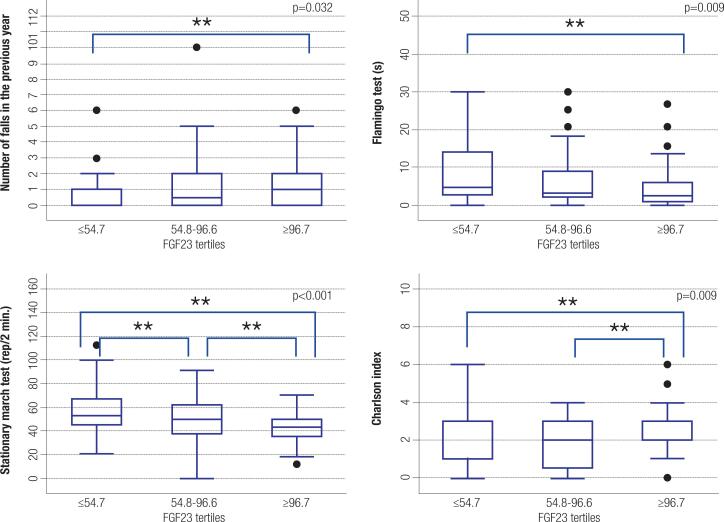
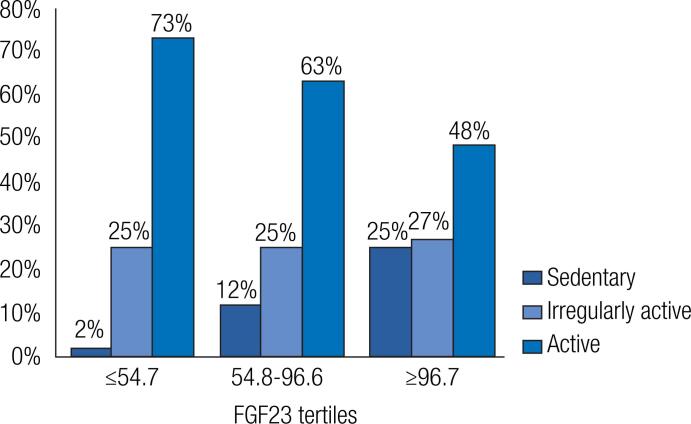
Most participants (75%) had FGF23 levels between 30-120 RU/mL (range: 6.0-3,170.0 RU/mL). FGF23 levels correlated with estimated glomerular filtration rate (eGFR; r = -0.335; p = 0.001) and PTH (r = 0.318; p < 0.0001). Individuals with FGF23 in the highest tertile had more falls in the previous year (p = 0.032), worse performance in the Flamingo (p = 0.009) and Step (p < 0.001) tests, worse CI (p = 0.009) and a trend toward sedentary lifestyle (p = 0.056). On multiple regression, FGF23 tertiles remained significant, independently of eGFR, for falls in the previous year, performance in the Flamingo and stationary march tests, lean mass index, and IPAQ classification.
In a population of very elderly individuals, FGF23 levels were inversely associated with neuromuscular and functional performances. Higher concentrations were related to more falls, lower muscle strength and aerobic capacity, and poorer balance, regardless of renal function, suggesting a potentially deleterious role of high FGF23 concentrations in musculoskeletal health.
成纤维细胞生长因子 23(FGF23)与生物衰老有关,但老年人的数据很少。我们确定了非常老的人群中血清 FGF23 水平的特征,并研究了它们与骨代谢和健康标志物参数的相关性,如功能表现。
这项横断面研究在 182 名年龄≥80 岁的社区居民中进行。分析了血清 FGF23、甲状旁腺激素、钙、白蛋白、磷、肌酐、骨标志物和骨密度数据。通过站立式行军(步行)、火烈鸟和功能伸展测试评估身体表现,同时通过问卷评估前一年的跌倒和骨折、能量消耗(MET)和 Charlson 指数(CI)。通过国际体力活动问卷(IPAQ)评估体力活动。
大多数参与者(75%)的 FGF23 水平在 30-120 RU/mL 之间(范围:6.0-3170.0 RU/mL)。FGF23 水平与估算肾小球滤过率(eGFR;r=-0.335;p=0.001)和甲状旁腺激素(PTH;r=0.318;p<0.0001)相关。FGF23 水平最高的三分之一个体在前一年有更多的跌倒(p=0.032),在火烈鸟(p=0.009)和步行测试(p<0.001)中的表现更差,CI 更差(p=0.009),并且倾向于久坐的生活方式(p=0.056)。在多元回归中,FGF23 三分位在独立于 eGFR 的情况下,仍然与前一年的跌倒、火烈鸟和步行测试的表现、瘦体重指数和 IPAQ 分类有关。
在一个非常老的人群中,FGF23 水平与神经肌肉和功能表现呈负相关。较高的浓度与更多的跌倒、较低的肌肉力量和有氧能力以及较差的平衡有关,无论肾功能如何,这表明高浓度的 FGF23 可能对肌肉骨骼健康有害。