Cutrupi Francesca, Cadonna Maria, Manara Serena, Postinghel Mattia, La Rosa Giuseppina, Suffredini Elisabetta, Foladori Paola
Department of Civil, Environmental and Mechanical Engineering, University of Trento, via Mesiano 77, 38123 Trento, Italy.
ADEP, Agenzia per la Depurazione (Wastewater Treatment Agency), Autonomous Province of Trento, via Gilli 3, 38121 Trento, Italy.
Environ Technol Innov. 2022 Nov;28:102667. doi: 10.1016/j.eti.2022.102667. Epub 2022 May 21.
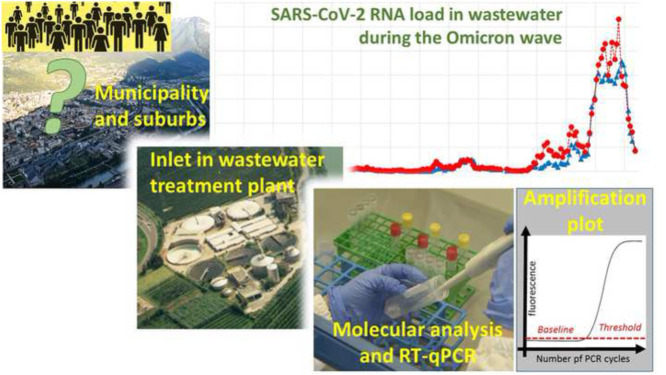
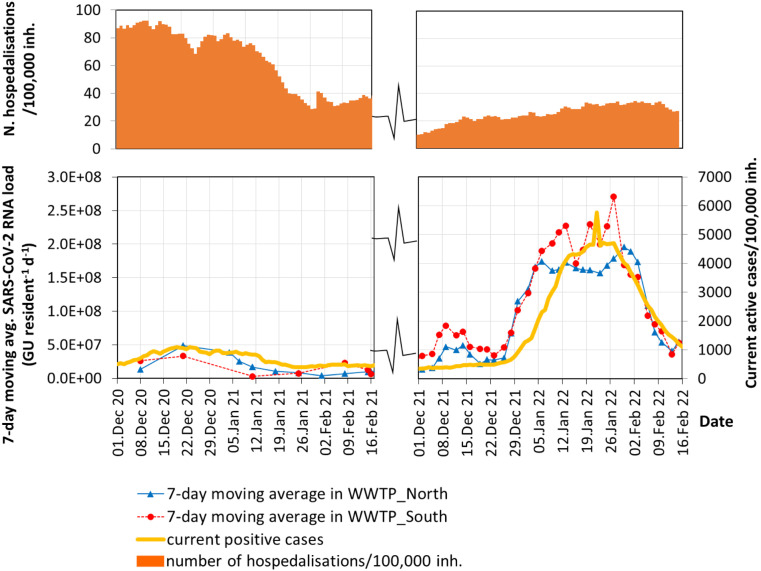
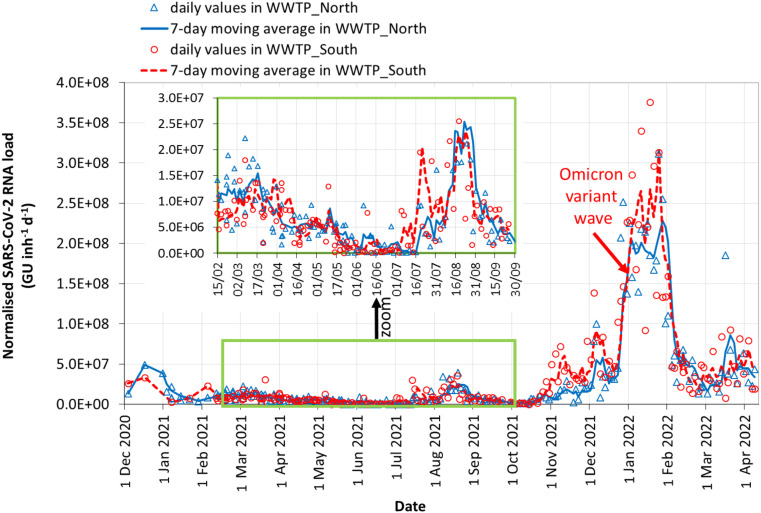
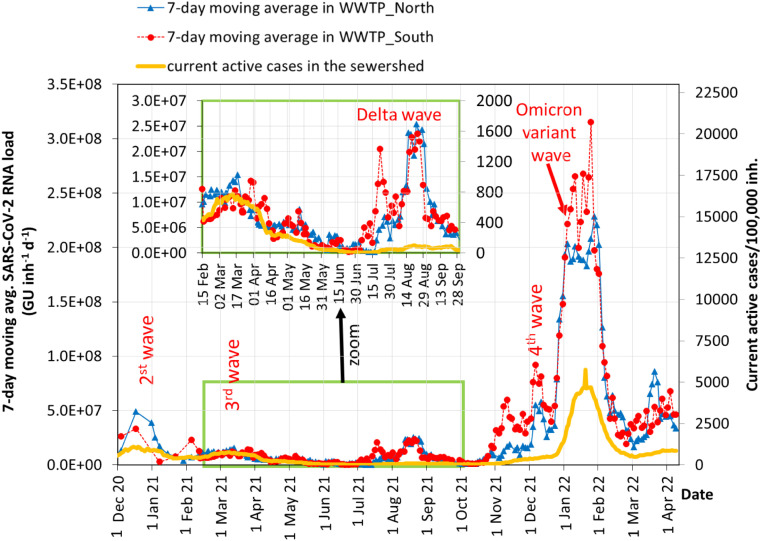
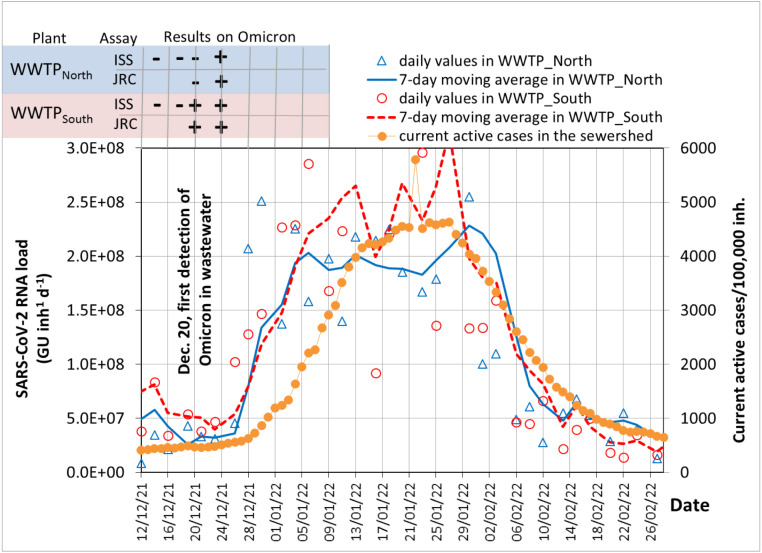
This paper highlights the extraordinarily rapid spread of SARS-CoV-2 loads in wastewater that during the Omicron wave in December 2021-February 2022, compared with the profiles acquired in 2020-21 with 410 samples from two wastewater treatment plants (Trento+suburbs, 132,500 inhabitants). Monitoring of SARS-CoV-2 in wastewater focused on: (i) 3 samplings/week and analysis, (ii) normalization to calculate genomic units (GU) inh d; (iii) calculation of a 7-day moving average to smooth daily fluctuations; (iv) comparison with the 'current active cases'/100,000 inh progressively affected by the mass vaccination. The time profiles of SARS-CoV-2 in wastewater matched the waves of active cases. In February-April 2021, a viral load of 1.0E+07 GU inh d corresponded to 700 active cases/100,000 inh. In July-September 2021, although the low current active cases, sewage revealed an appreciable SARS-CoV-2 circulation (in this period 2.2E+07 GU inh d corresponded to 90 active cases/100,000 inh). Omicron was not detected in wastewater until mid-December 2021. The Omicron spread caused a 5-6 fold increase of the viral load in two weeks, reaching the highest peak (2.0-2.2E+08 GU inh d and 4500 active cases/100,000 inh) during the pandemic. In this period, wastewater surveillance anticipated epidemiological data by about 6 days. In winter 2021-22, despite the 4-7 times higher viral loads in wastewater, hospitalizations were 4 times lower than in winter 2020-21 due to the vaccination coverage >80%. The Omicron wave demonstrated that SARS-CoV-2 monitoring of wastewater anticipated epidemiological data, confirming its importance in long-term surveillance.
本文强调了严重急性呼吸综合征冠状病毒2(SARS-CoV-2)病毒载量在废水中的传播速度极快,即在2021年12月至2022年2月的奥密克戎毒株流行期间,与2020 - 2021年从两个污水处理厂(特伦托及其郊区,132500名居民)采集的410个样本所获得的情况相比。对废水中SARS-CoV-2的监测重点在于:(i)每周3次采样及分析;(ii)标准化以计算每居民日基因组单位(GU/inh d);(iii)计算7天移动平均值以平滑每日波动;(iv)与受大规模疫苗接种逐步影响的“当前活跃病例数”/10万居民进行比较。废水中SARS-CoV-2的时间分布与活跃病例的波动情况相匹配。在2021年2月至4月,病毒载量为1.0E+07 GU/inh d对应700例活跃病例/10万居民。在2021年7月至9月,尽管当前活跃病例数较低,但污水中显示出SARS-CoV-2有明显传播(在此期间,2.2E+07 GU/inh d对应90例活跃病例/10万居民)。直到2021年12月中旬才在废水中检测到奥密克戎毒株。奥密克戎毒株的传播在两周内使病毒载量增加了5至6倍,达到了疫情期间的最高峰(2.0 - 2.2E+08 GU/inh d和4500例活跃病例/10万居民)。在此期间,废水监测比流行病学数据提前约6天。在2021 - 2022年冬季,尽管废水中病毒载量高出4至7倍,但由于疫苗接种覆盖率>80%,住院人数比2020 - 2021年冬季低4倍。奥密克戎毒株流行表明,对废水进行SARS-CoV-2监测可提前获得流行病学数据,证实了其在长期监测中的重要性。