O'Doherty Laura, Hendricken Phelan Stuart, Wood Nicole, O'Brien Sorcha, Sui Jacklyn, Mangan Cian, Howley Fergal, O'Regan Siobhan, Razif Noor Adeebah Mohamed, Conlan Ciara, Argue Ruth, Holohan Samuel, Dyer Adam, Salleh Fara, Townsend Liam, Hughes Gerard, Kerr Colm, Reidy Derval, Sanz Alberto, Connolly Emma, Kelly Andrea, Leacy Emma, Reddy Conor, Gargan Siobhan, Breen Eamon, Hawerkamp Heike, Dunne Jean, Martin-Loeches Ignacio, McLaughlin Anne Marie, Long Aideen, Shiels Orla, Fallon Padraic, Hennessy Martina, Romero-Ortuno Roman, Bannan Ciaran, Prior Anna Rose, Rakovac Ana, McCormack William, McManus Ross, Donnelly Seamus, Bergin Colm, Little Mark, Ní Cheallaigh Clíona, Conlon Niall
Department of Infectious Diseases, St. James's Hospital, Dublin, Dublin, Ireland.
Clinical Research Facility, St. James's Hospital, Dublin, Dublin, Ireland.
HRB Open Res. 2022 Mar 16;5:20. doi: 10.12688/hrbopenres.13498.1. eCollection 2022.
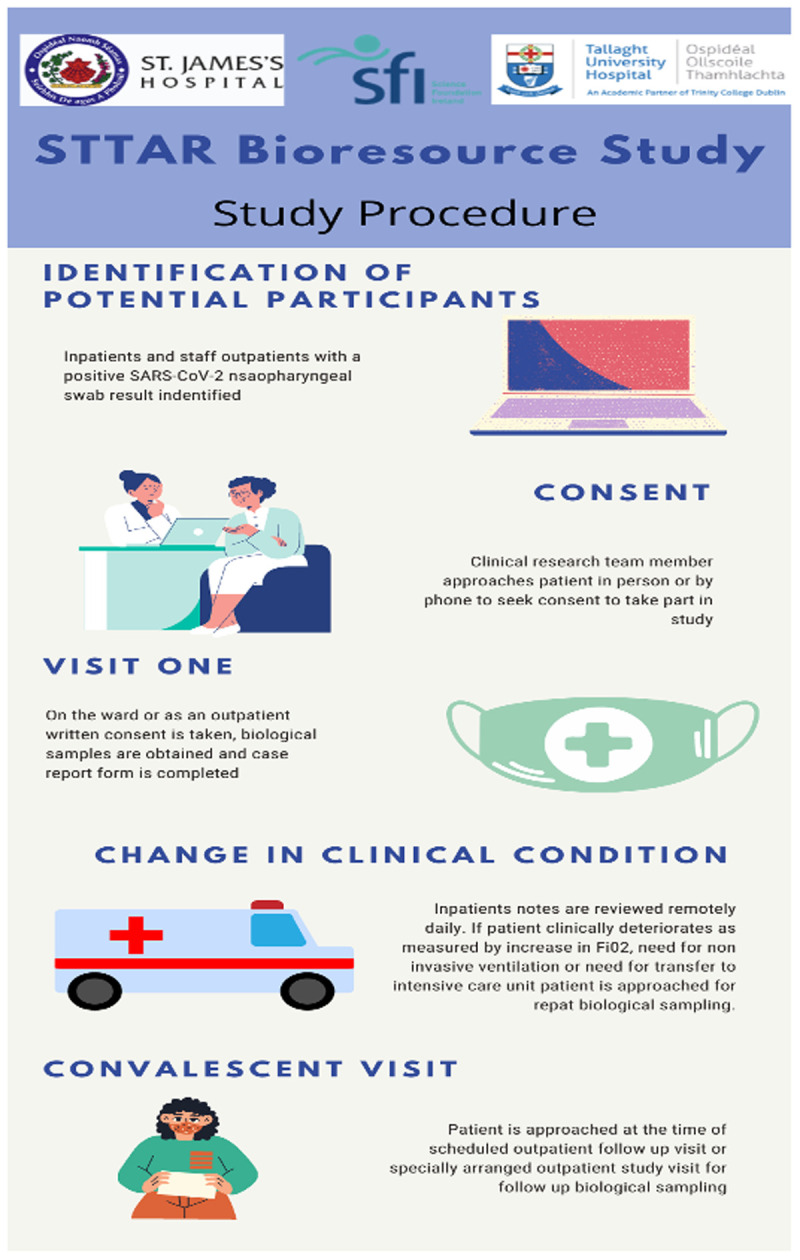
: The current coronavirus disease 2019 (COVID-19) pandemic began in Ireland with the first confirmed positive case in March 2020. In the early stages of the pandemic clinicians and researchers in two affiliated Dublin hospitals identified the need for a COVID-19 biobanking initiative to support and enhance research into the disease. Through large scale analysis of clinical, regional, and genetic characteristics of COVID-19 patients, biobanks have helped identify, and so protect, at risk patient groups The STTAR Bioresource has been created to collect and store data and linked biological samples from patients with SARS-CoV-2 infection and healthy and disease controls. : The primary objective of this study is to build a biobank, to understand the clinical characteristics and natural history of COVID-19 infection with the long-term goal of research into improved disease understanding, diagnostic tests and treatments. : This is a prospective dual-site cohort study across two tertiary acute university teaching hospitals. Patients are recruited from inpatient wards or outpatient clinics. Patients with confirmed COVID-19 infection as well as healthy and specific disease control groups are recruited. Biological samples are collected and a case report form detailing demographic and medical background is entered into the bespoke secure online Dendrite database. : The results of this study will be used to inform national and international strategy on health service provision and disease management related to COVID-19. In common with other biobanks, study end points evolve over time as new research questions emerge. They currently include patient survival, occurrence of severe complications of the disease or its therapy, occurrence of persistent symptoms following recovery from the acute illness and vaccine responses.
2019年冠状病毒病(COVID-19)大流行于2020年3月在爱尔兰出现首例确诊阳性病例后开始。在大流行的早期阶段,都柏林两家附属医院的临床医生和研究人员认识到需要开展一项COVID-19生物样本库计划,以支持和加强对该疾病的研究。通过对COVID-19患者的临床、区域和基因特征进行大规模分析,生物样本库有助于识别并保护高危患者群体。STTAR生物资源库的创建是为了收集和存储来自感染严重急性呼吸综合征冠状病毒2(SARS-CoV-2)的患者以及健康和疾病对照者的数据及相关生物样本。
本研究的主要目标是建立一个生物样本库,了解COVID-19感染的临床特征和自然史,其长期目标是深入了解疾病、改进诊断测试和治疗方法。
这是一项在两家三级急性大学教学医院进行的前瞻性双中心队列研究。患者从住院病房或门诊诊所招募。招募确诊的COVID-19感染患者以及健康和特定疾病对照组。收集生物样本,并将一份详细列出人口统计学和医学背景的病例报告表录入定制的安全在线Dendrite数据库。
本研究结果将用于为国家和国际上与COVID-19相关的卫生服务提供和疾病管理战略提供信息。与其他生物样本库一样,随着新研究问题的出现,研究终点会随时间而演变。目前的研究终点包括患者生存情况、疾病或其治疗的严重并发症的发生情况、急性疾病康复后持续症状的发生情况以及疫苗反应。