School of Medicine, Trinity Biomedical Sciences Institute, Trinity College Dublin, Dublin, Ireland.
Department of Medical Gerontology, School of Medicine, Trinity College Dublin, Dublin, Ireland.
Front Immunol. 2023 Mar 30;14:1170012. doi: 10.3389/fimmu.2023.1170012. eCollection 2023.
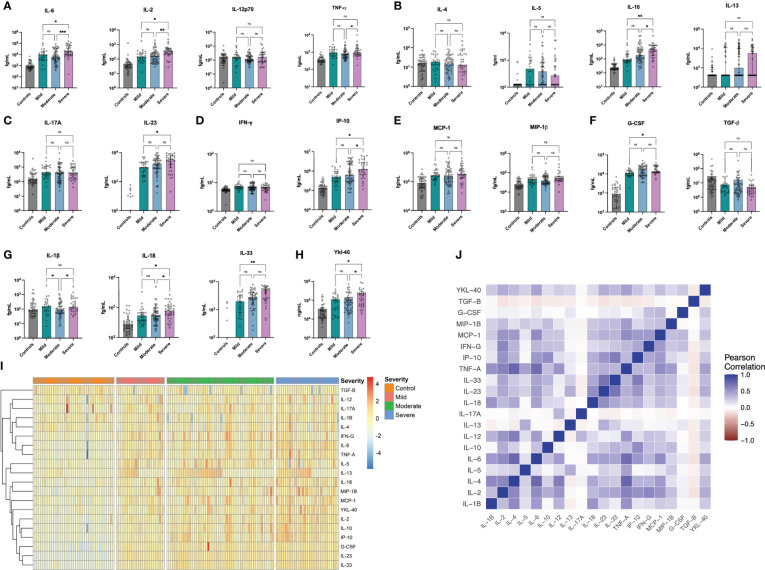
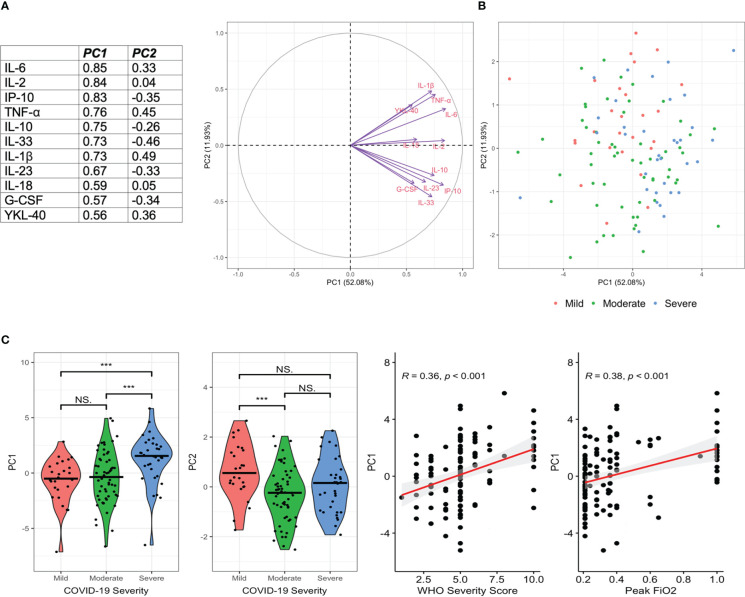
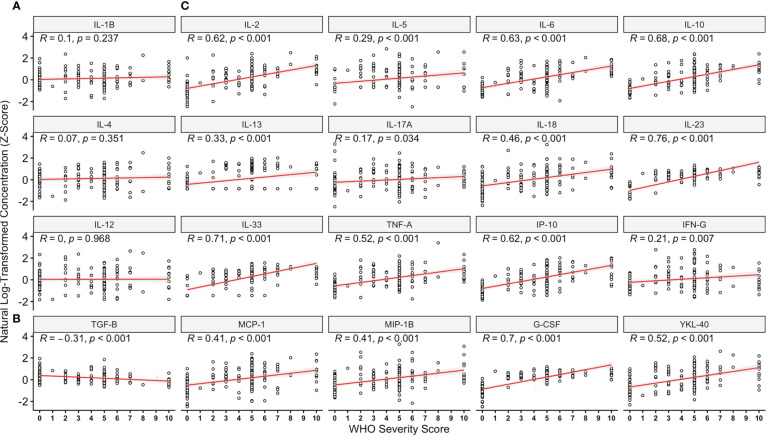
Clinical outcomes from infection with SARS-CoV-2, the cause of the COVID-19 pandemic, are remarkably variable ranging from asymptomatic infection to severe pneumonia and death. One of the key drivers of this variability is differing trajectories in the immune response to SARS-CoV-2 infection. Many studies have noted markedly elevated cytokine levels in severe COVID-19, although results vary by cohort, cytokine studied and sensitivity of assay used. We assessed the immune response in acute COVID-19 by measuring 20 inflammatory markers in 118 unvaccinated patients with acute COVID-19 (median age: 70, IQR: 58-79 years; 48.3% female) recruited during the first year of the pandemic and 44 SARS-CoV-2 naïve healthy controls. Acute COVID-19 was associated with marked elevations in nearly all pro-inflammatory markers, whilst eleven markers (namely IL-1β, IL-2, IL-6, IL-10, IL-18, IL-23, IL-33, TNF-α, IP-10, G-CSF and YKL-40) were associated with disease severity. We observed significant correlations between nearly all markers elevated in those infected with SARS-CoV-2 consistent with widespread immune dysregulation. Principal component analysis highlighted a pro-inflammatory cytokine signature (with strongest contributions from IL-1β, IL-2, IL-6, IL-10, IL-33, G-CSF, TNF-α and IP-10) which was independently associated with severe COVID-19 (aOR: 1.40, 1.11-1.76, p=0.005), invasive mechanical ventilation (aOR: 1.61, 1.19-2.20, p=0.001) and mortality (aOR 1.57, 1.06-2.32, p = 0.02). Our findings demonstrate elevated cytokines and widespread immune dysregulation in severe COVID-19, adding further evidence for the role of a pro-inflammatory cytokine signature in severe and critical COVID-19.
从导致 COVID-19 大流行的 SARS-CoV-2 感染中获得的临床结果差异很大,从无症状感染到严重肺炎和死亡不等。这种变异性的一个关键驱动因素是对 SARS-CoV-2 感染的免疫反应轨迹不同。许多研究都注意到,在严重的 COVID-19 中,细胞因子水平明显升高,尽管结果因队列、研究的细胞因子和使用的检测方法的灵敏度而异。我们通过测量 118 名未接种疫苗的急性 COVID-19 患者(中位年龄:70 岁,IQR:58-79 岁;48.3%为女性)和 44 名 SARS-CoV-2 未感染的健康对照者的 20 种炎症标志物,评估了急性 COVID-19 中的免疫反应。急性 COVID-19 与几乎所有促炎标志物的显著升高有关,而十一种标志物(即 IL-1β、IL-2、IL-6、IL-10、IL-18、IL-23、IL-33、TNF-α、IP-10、G-CSF 和 YKL-40)与疾病严重程度有关。我们观察到,感染 SARS-CoV-2 的患者中几乎所有升高的标志物之间存在显著相关性,这与广泛的免疫失调一致。主成分分析突出了一个促炎细胞因子特征(IL-1β、IL-2、IL-6、IL-10、IL-33、G-CSF、TNF-α和 IP-10 的贡献最大),该特征与严重 COVID-19 独立相关(OR:1.40,1.11-1.76,p=0.005)、有创机械通气(OR:1.61,1.19-2.20,p=0.001)和死亡率(OR 1.57,1.06-2.32,p = 0.02)。我们的发现表明,严重 COVID-19 中细胞因子升高和广泛的免疫失调,进一步证明了促炎细胞因子特征在严重和危急的 COVID-19 中的作用。