Faculty of Medicine, McGill University, Montreal, Quebec, Canada.
BC Women's Hospital and Health Service, Women's Health Research Institute, Box 42, Room H203G - 4500 Oak Street, Vancouver, BC, V6H 3N1, Canada.
Can J Public Health. 2022 Oct;113(5):776-785. doi: 10.17269/s41997-022-00648-2. Epub 2022 May 26.
The aim of this study was to explore the acceptability of bacterial STI vaccines among young HPV-vaccinated Canadian women to inform future vaccine program implementation.
A 20-item cross-sectional questionnaire was administered from June 2019 to June 2020 to HPV-vaccinated participants of the pan-Canadian QUEST cohort. Multivariable logistic regression models assessed interest in chlamydia, syphilis, and gonorrhea vaccines using a priori variables and factors significant in bivariate analysis.
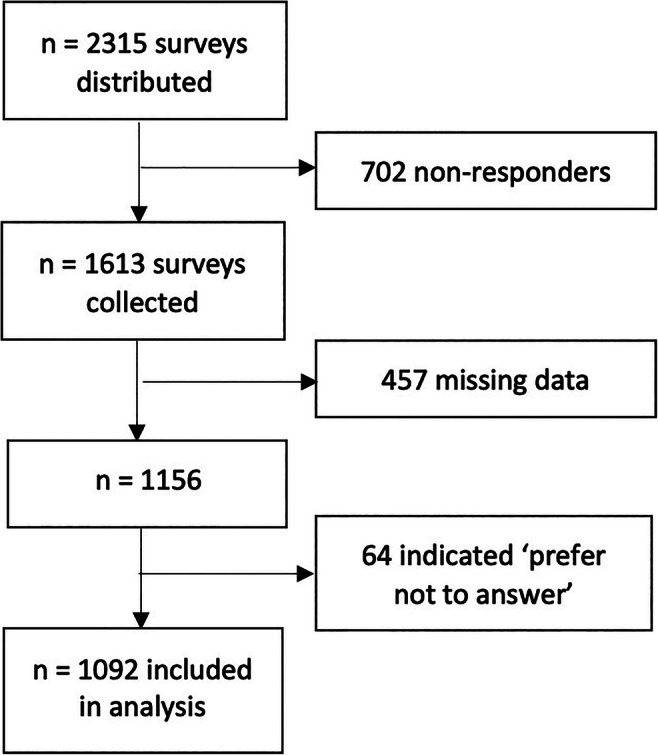
Of the 1092 respondents analyzed, 82% indicated interest in receiving one or more future STI vaccines. Respondents had a median age of 19.6 years (range 16.9-23.4), and 75% of respondents identified as white/European descent. In adjusted analyses, intent to engage in positive health behaviours was associated with vaccine interest for syphilis (OR = 5.76, 95% CI 4.03-8.27), chlamydia (OR = 5.27, 95% CI 3.66-7.63), and gonorrhea (OR = 5.96, 95% CI 4.15-8.60). Willingness to pay for an STI vaccine was also associated with vaccine interest for syphilis (OR = 2.02, 95% CI 1.29-3.19), chlamydia (OR = 2.41, 95% CI 1.50-3.90), and gonorrhea (OR = 2.29, 95% CI 1.44-3.63). Ever having sexual intercourse and identifying as LGBTQ were significantly associated with vaccine interest for all infections, while age and ever being immunosuppressed were not significant in any adjusted models.
Findings indicate over 80% of participants in a cohort of young HPV-vaccinated Canadian women are interested in receiving future bacterial STI vaccines. Further exploration of STI vaccine acceptability among diverse populations is required to inform future bacterial STI vaccine program implementation.
本研究旨在探讨加拿大 HPV 疫苗接种年轻女性对细菌性性传播感染疫苗的可接受性,以为未来疫苗规划的实施提供信息。
2019 年 6 月至 2020 年 6 月,对泛加 QUEST 队列的 HPV 疫苗接种参与者进行了一项 20 项的横断面问卷调查。采用事先确定的变量和双变量分析中具有统计学意义的因素,多变量逻辑回归模型评估了对衣原体、梅毒和淋病疫苗的兴趣。
在分析的 1092 名受访者中,82%的人表示有兴趣接种一种或多种未来的性传播感染疫苗。受访者的中位年龄为 19.6 岁(范围 16.9-23.4 岁),75%的受访者为白种/欧洲裔。在调整后的分析中,愿意采取积极的健康行为与对梅毒(OR=5.76,95%CI 4.03-8.27)、衣原体(OR=5.27,95%CI 3.66-7.63)和淋病(OR=5.96,95%CI 4.15-8.60)疫苗的接种意愿相关。愿意为性传播感染疫苗付费也与对梅毒(OR=2.02,95%CI 1.29-3.19)、衣原体(OR=2.41,95%CI 1.50-3.90)和淋病(OR=2.29,95%CI 1.44-3.63)疫苗的接种意愿相关。曾有过性行为和认定为 LGBTQ 与所有感染的疫苗接种意愿显著相关,而年龄和曾有免疫抑制则在任何调整后的模型中均不显著。
研究结果表明,在 HPV 疫苗接种的年轻加拿大女性队列中,超过 80%的参与者有兴趣接种未来的细菌性性传播感染疫苗。需要进一步探讨不同人群对性传播感染疫苗的可接受性,以为未来细菌性性传播感染疫苗规划的实施提供信息。