Université Paris-Saclay, CNRS, Ministère de la Culture, UVSQ, MNHN, IPANEMA, F-91192 Saint-Aubin, France.
Synchrotron SOLEIL, F-91192 Gif-sur-Yvette, France.
Proc Natl Acad Sci U S A. 2022 May 31;119(22):e2116021119. doi: 10.1073/pnas.2116021119. Epub 2022 May 26.
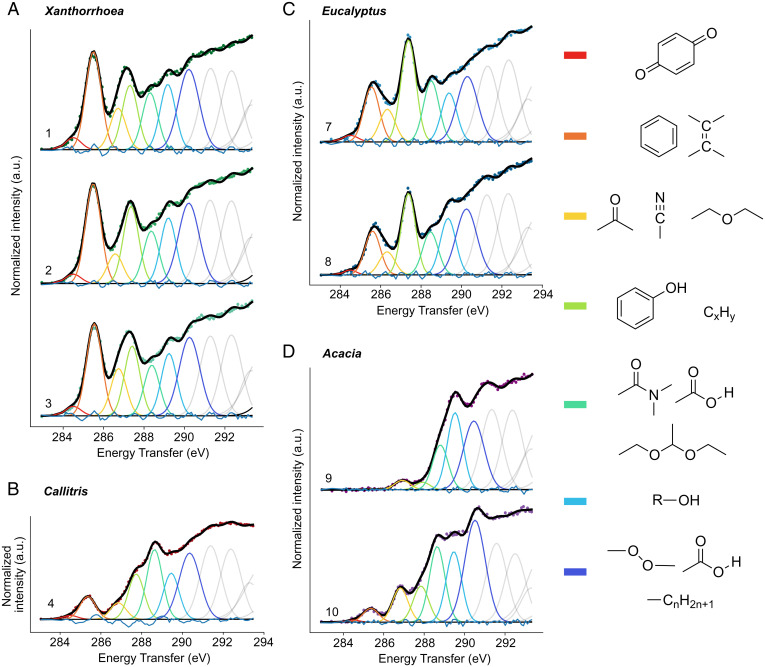
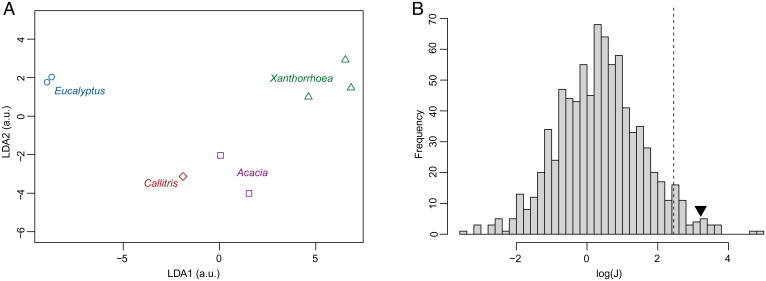
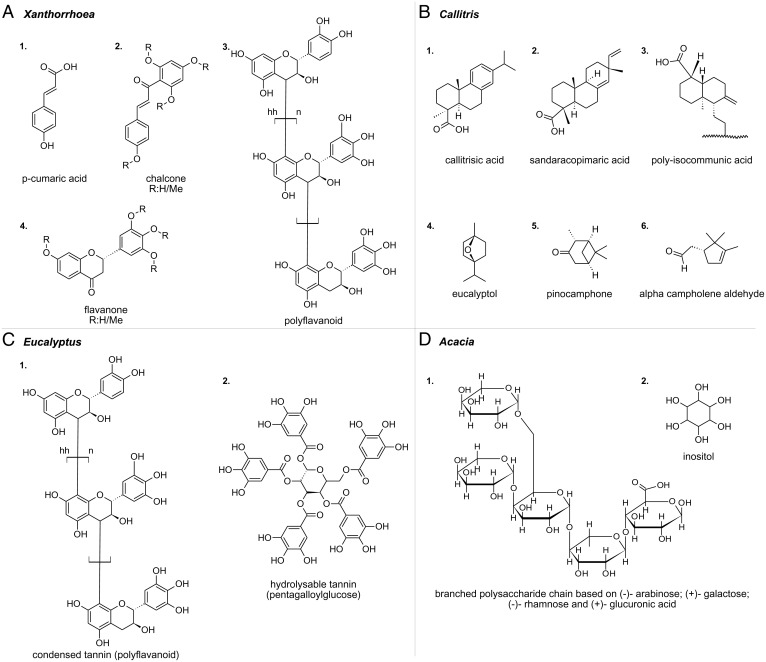
For thousands of years, the unique physicochemical properties of plant exudates have defined uses in material culture and practical applications. Native Australian plant exudates, including resins, kinos, and gums, have been used and continue to be used by Aboriginal Australians for numerous technical and cultural purposes. A historic collection of well-preserved native Australian plant exudates, assembled a century ago by plant naturalists, gives a rare window into the history and chemical composition of these materials. Here we report the full hierarchical characterization of four genera from this collection, Xanthorrhoea, Callitris, Eucalyptus, and Acacia, from the local elemental speciation, to functional groups and main molecular markers. We use high-resolution X-ray Raman spectroscopy (XRS) to achieve bulk-sensitive chemical speciation of these plant exudates, including insoluble, amorphous, and cross-linked fractions, without the limitation of invasive and/or surface specific methods. Combinatorial testing of the XRS data allows direct classification of these complex natural species as terpenoid, aromatic, phenolic, and polysaccharide materials. Differences in intragenera chemistry was evidenced by detailed interpretation of the XRS spectral features. We complement XRS with Fourier-transform infrared (FT-IR) spectroscopy, gas chromatography–mass spectrometry (GC-MS), and pyrolysis–GC-MS (Py-GC-MS). This multimodal approach provides a fundamental understanding of the chemistry of these natural materials long used by Aboriginal Australian peoples.
数千年来,植物渗出物的独特物理化学特性在物质文化和实际应用中定义了其用途。包括树脂、血竭和树胶在内的澳大利亚本土植物渗出物,一直被澳大利亚原住民用于许多技术和文化目的,并且这种情况还将继续。一个世纪前,植物学家收集了保存完好的澳大利亚本土植物渗出物的历史收藏,这为这些材料的历史和化学成分提供了难得的窗口。在这里,我们报告了从该收藏中四个属的完整层次特征,包括 Xanthorrhoea、Callitris、Eucalyptus 和 Acacia,从局部元素形态、官能团和主要分子标记物到整体。我们使用高分辨率 X 射线拉曼光谱(XRS)对这些植物渗出物进行批量敏感的化学形态分析,包括不溶性、无定形和交联部分,而不受侵入性和/或表面特异性方法的限制。XRS 数据的组合测试允许直接将这些复杂的天然物种分类为萜烯、芳烃、酚类和多糖材料。XRS 光谱特征的详细解释证明了属内化学的差异。我们用傅里叶变换红外(FT-IR)光谱、气相色谱-质谱(GC-MS)和热解-气相色谱-质谱(Py-GC-MS)对 XRS 进行补充。这种多模态方法提供了对这些长期以来被澳大利亚原住民使用的天然材料的化学性质的基本理解。