School of Population Health, Faculty of Medicine, University of New South Wales, Sydney, NSW, Australia.
The George Institute for Global Health, Faculty of Medicine, University of New South Wales, Sydney, NSW, Australia.
Front Public Health. 2022 May 10;10:766847. doi: 10.3389/fpubh.2022.766847. eCollection 2022.
The World Health Organization and International Union against Tuberculosis (TB) recommends screening patients with TB for Diabetes Mellitus (DM) at the initiation of treatment. There are few pilot studies which screen TB patients for DM, but none of them have documented the feasibility of managing TB patients with DM in the Indian healthcare setting. Operational research is needed to determine the best way to manage individuals with both conditions. This pilot study aimed to develop, and field test an integrated, multidisciplinary program addressing the management of individuals with TB and DM and other associated chronic conditions in the Indian primary healthcare setting.
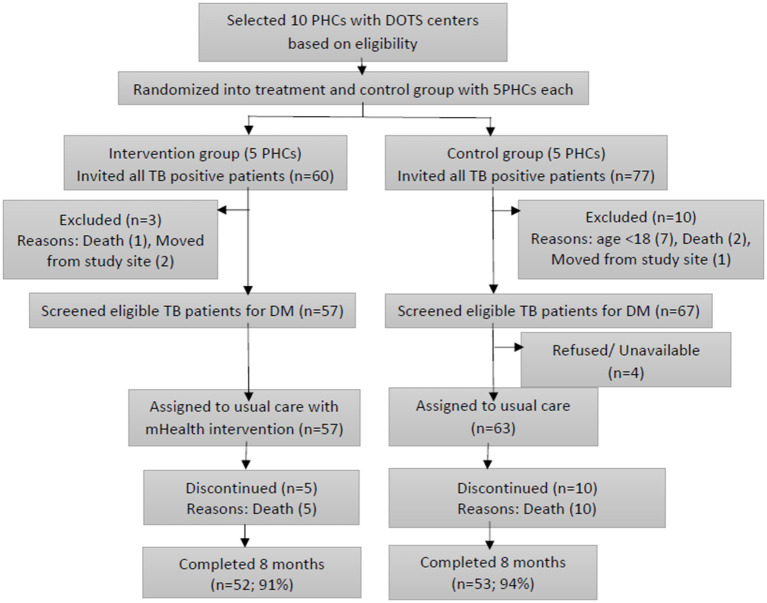
This pilot study used a randomized controlled trial design with mixed-methods evaluation and was conducted in Guntur district of Andhra Pradesh, a southern state of India. All the 120 patients newly diagnosed with TB from 10 participating villages were screened for DM and associated cardiovascular risk factors. Non-physician health workers were trained to follow-up patients for a period of 8 months to encourage treatment adherence, monitor treatment response including blood glucose levels and provide lifestyle advice.
The intervention was well-accepted by the providers and patients. However, there were no statistically significant variations observed for mean blood glucose levels (mean [SD]: 5.3 [-23.3 to 33.8]) of patients for both intervention and control group participants in this feasibility study. Awareness about diabetes and tuberculosis comorbidity and cardiovascular risk increased among the non-physician health workers in the intervention arm of the study.
The co-management of TB-DM is acceptable to both the health providers and patients. With appropriate training, availability of infrastructure and planned intervention implementation, it is feasible to co-manage TB-DM within the existing primary health care system in India.
世界卫生组织和国际防痨和肺病联合会建议在开始治疗时对结核病患者进行糖尿病筛查。有一些试点研究对结核病患者进行了糖尿病筛查,但没有一项研究记录了在印度医疗保健环境中管理糖尿病合并结核病患者的可行性。需要进行运营研究以确定管理两种疾病患者的最佳方法。这项试点研究旨在制定并现场测试一种综合的多学科方案,以管理印度初级保健环境中患有结核病和糖尿病及其他相关慢性疾病的个体。
这项试点研究采用随机对照试验设计,结合混合方法评估,并在印度南部安得拉邦贡土尔区进行。从 10 个参与村庄新诊断出的 120 例结核病患者均接受了糖尿病和相关心血管危险因素筛查。经过培训的非医师卫生工作者在 8 个月的时间里对患者进行随访,以鼓励治疗依从性,监测治疗反应,包括血糖水平,并提供生活方式建议。
该干预措施得到了提供者和患者的广泛认可。然而,在这项可行性研究中,干预组和对照组患者的平均血糖水平(平均值[标准差]:5.3[-23.3 至 33.8])均未观察到统计学显著差异。在研究的干预组中,非医师卫生工作者对糖尿病和结核病合并症以及心血管风险的认识有所提高。
结核病和糖尿病的共同管理得到了卫生提供者和患者的认可。通过适当的培训、基础设施的可用性和计划的干预实施,在印度现有的初级卫生保健系统中共同管理结核病和糖尿病是可行的。