Kim Sung-Woo, Park Hun-Young, Jung Hoeryong, Lim Kiwon
Physical Activity and Performance Institute, Konkuk University, Seoul, South Korea.
Department of Sports Medicine and Science, Graduate School, Konkuk University, Seoul, South Korea.
Front Physiol. 2022 May 10;13:896093. doi: 10.3389/fphys.2022.896093. eCollection 2022.
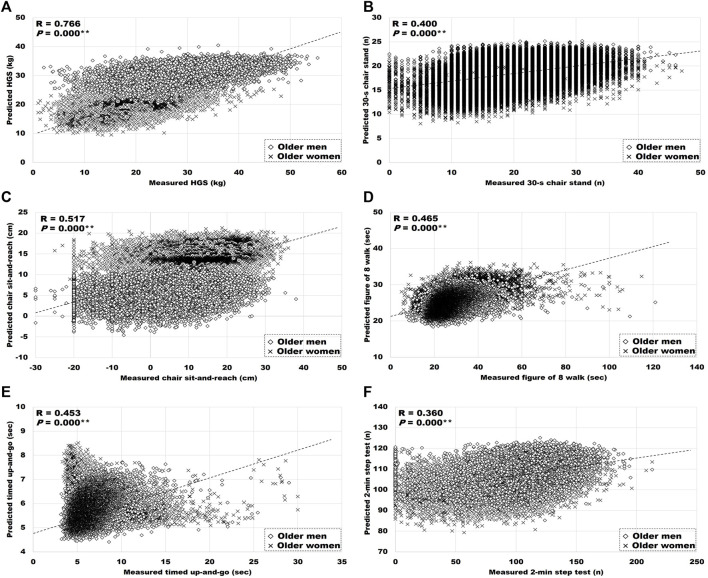
The main advantage of measuring functional fitness (FF) in older adults is that individual tests can estimate and track the rate of decline with age. This study aimed to develop a multiple linear regression model for predicting FF variables using easy-to-measure independent variables (e.g., sex, age, body mass index, and percent body fat) in Korean older adults. National Fitness Award datasets from the Republic of Korea were used in this analysis. The participants were aged ≥65 years and included 61,465 older men and 117,395 older women. The FF variables included the hand grip strength, lower body strength (30-s chair stand), lower body flexibility (chair sit-and-reach), coordination (figure of 8 walk), agility/dynamic balance (timed up-and-go), and aerobic endurance (2-min step test). An estimation multiple linear regression model was developed using a stepwise technique. In the regression model, the coefficient of determination in the hand grip strength test (adjusted R = 0.773, < 0.001) was significantly high. However, the coefficient of determination in the 30-s chair stand (adjusted R = 0.296, < 0.001), chair sit-and-reach (adjusted R = 0.435, < 0.001), figure of 8 walk (adjusted R = 0.390, < 0.001), timed up-and-go (adjusted R = 0.384, < 0.001), and 2-min step tests (adjusted R = 0.196, < 0.001) was significantly low to moderate. Our findings suggest that easy-to-measure independent variables can predict the hand grip strength in older adults. In future studies, explanatory power will be further improved if multiple linear regression analysis, including the physical activity level and nutritional status of older adults, is performed to predict the FF variables.
在老年人中测量功能性体能(FF)的主要优势在于,个体测试能够估计并追踪随年龄增长的衰退速率。本研究旨在建立一个多元线性回归模型,用于使用韩国老年人中易于测量的自变量(如性别、年龄、体重指数和体脂百分比)来预测FF变量。本分析使用了大韩民国的国民体能奖数据集。参与者年龄≥65岁,包括61465名老年男性和117395名老年女性。FF变量包括握力、下肢力量(30秒椅子站立测试)、下肢柔韧性(椅子坐立前屈测试)、协调性(8字步行测试)、敏捷性/动态平衡(计时起立行走测试)和有氧耐力(2分钟台阶测试)。使用逐步回归技术建立了一个估计多元线性回归模型。在回归模型中,握力测试的决定系数(调整R = 0.773,P < 0.001)显著较高。然而,30秒椅子站立测试(调整R = 0.296,P < 0.001)、椅子坐立前屈测试(调整R = 0.435,P < 0.001)、8字步行测试(调整R = 0.390,P < 0.001)、计时起立行走测试(调整R = 0.384,P < 0.001)和2分钟台阶测试(调整R = 0.196,P < 0.001)的决定系数显著较低至中等。我们的研究结果表明,易于测量的自变量能够预测老年人的握力。在未来的研究中,如果进行多元线性回归分析,包括老年人的身体活动水平和营养状况,以预测FF变量,解释力将得到进一步提高。