Department of Endocrinology and Diabetology, The Children's Memorial Health Institute, Warsaw, Poland.
Department of Diagnostic Imaging, The Children's Memorial Health Institute, Warsaw, Poland.
Pediatr Endocrinol Diabetes Metab. 2022;28(3):213-227. doi: 10.5114/pedm.2022.115202.
Pituitary stalk thickening (PST) is a rare abnormality in children, and it may be challenging due to its diverse clinical picture.
The aim of the study is to summarize the data on the causes and diagnostic procedures of PST.
Papers were searched in the PubMed database identifying published randomized clinical trials, reviews, systematic reviews, meta-analyses, and case reports.
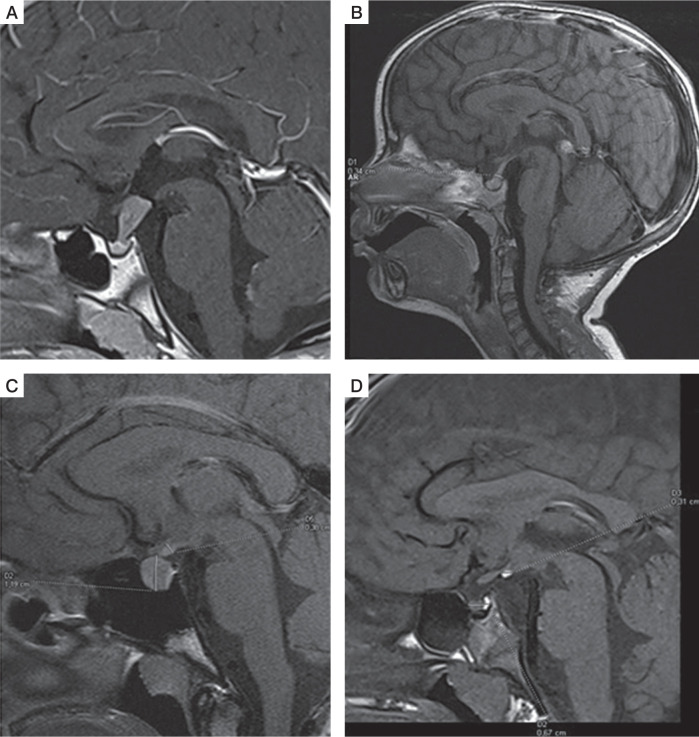
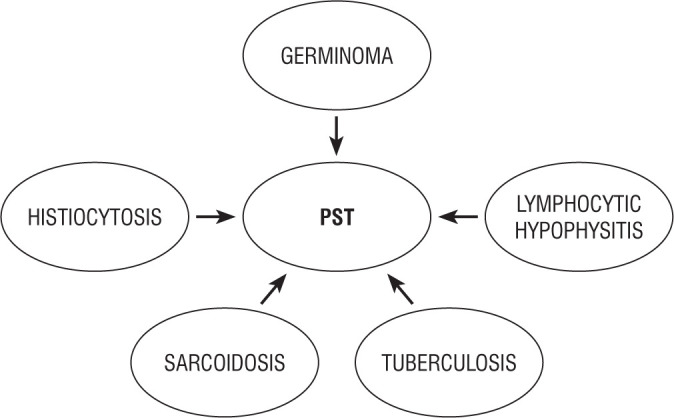
The most common causes of a thickened pituitary stalk in children are germ cell tumours (GCTs), Langerhans cell histiocytosis (LCH), and lymphocytic infundibulo-neurohypophysitis (LINH). Neurosarcoidosis, pituitary tuberculosis, granulomatosis, or specific inflammations were only reported in the paediatric population as case studies. PST mainly affects teenagers and is often detected with brain magnetic resonance imaging (MRI) in patients with central diabetes insipidus (CDI). It is not possible to differentiate the causes of PST with the use of the MRI image alone. Although various biochemical and oncological markers and other imaging tests are used, the diagnosis of PST remains a significant diagnostic challenge for clinicians. The final diagnosis is made based on histopathological examination. The indications for a biopsy are not uniform. Most experts, including the authors of the 2021 British consensus, recommend biopsy in the case of PST with a stalk lesion diameter ≥ 6.5-7 mm.
The differential diagnosis of PST is a challenge. The diagnostic and treatment strategy should be individually adapted. Patients should be diagnosed in large clinical centres with experience in this field.
垂体柄增粗(PST)在儿童中较为罕见,由于其临床表现多样,因此可能具有挑战性。
本研究旨在总结 PST 的病因和诊断程序的数据。
在 PubMed 数据库中搜索发表的随机临床试验、综述、系统评价、荟萃分析和病例报告,以确定相关文献。
儿童垂体柄增粗最常见的原因是生殖细胞瘤(GCT)、朗格汉斯细胞组织细胞增生症(LCH)和淋巴细胞漏斗神经垂体炎(LINH)。神经结节病、垂体结核、肉芽肿或特定炎症仅作为儿科病例研究报告。PST 主要影响青少年,且常因中枢性尿崩症(CDI)患者行脑磁共振成像(MRI)检查而被发现。仅凭 MRI 图像无法区分 PST 的病因。尽管使用了各种生化和肿瘤标志物及其他影像学检查,但 PST 的诊断仍然对临床医生具有重大诊断挑战。最终诊断基于组织病理学检查。活检的指征并不统一。包括 2021 年英国共识制定者在内的大多数专家建议,对于直径≥6.5-7mm 的 PST 行活检。
PST 的鉴别诊断具有挑战性。诊断和治疗策略应个体化适应。患者应在具有该领域经验的大型临床中心进行诊断。