Jadran-Galenski Laboratorij d.d., Svilno 20, 51000 Rijeka, Croatia.
Department of Otorhinolaryngology, Head and Neck Surgery, Sisters of Mercy University Hospital, 10000 Zagreb, Croatia.
Mar Drugs. 2022 May 17;20(5):330. doi: 10.3390/md20050330.
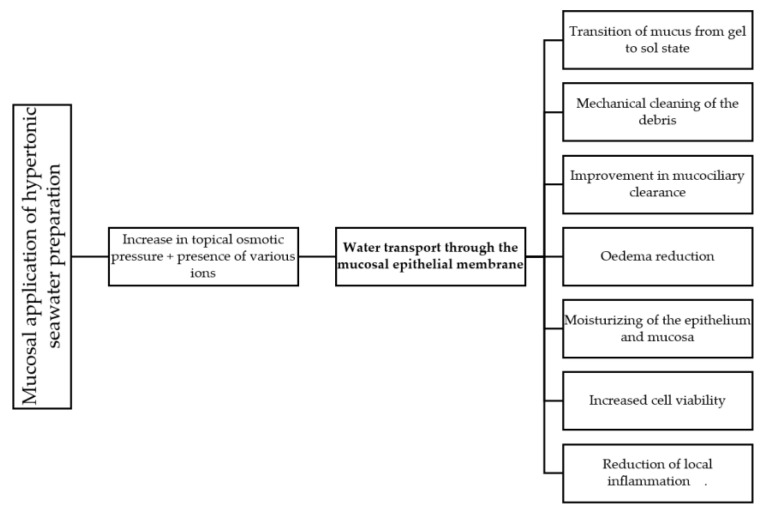
The history of saline nasal irrigation (SNI) is indeed a long one, beginning from the ancient Ayurvedic practices and gaining a foothold in the west at the beginning of the 20th century. Today, there is a growing number of papers covering the effects of SNI, from in vitro studies to randomized clinical trials and literature overviews. Based on the recommendations of most of the European and American professional associations, seawater, alone or in combination with other preparations, has its place in the treatment of numerous conditions of the upper respiratory tract (URT), primarily chronic (rhino)sinusitis, allergic rhinitis, acute URT infections and postoperative recovery. Additionally, taking into account its multiple mechanisms of action and mounting evidence from recent studies, locally applied seawater preparations may have an important role in the prevention of viral and bacterial infections of the URT. In this review we discuss results published in the past years focusing on seawater preparations and their use in clinical and everyday conditions, since such products provide the benefits of additional ions vs. saline, have an excellent safety profile and are recommended by most professional associations in the field of otorhinolaryngology.
盐水鼻腔冲洗(SNI)的历史确实非常悠久,可以追溯到古代的阿育吠陀医学实践,并于 20 世纪初在西方站稳脚跟。如今,越来越多的论文涵盖了 SNI 的效果,从体外研究到随机临床试验和文献综述。基于大多数欧洲和美国专业协会的建议,海水单独或与其他制剂一起,在治疗上呼吸道(URT)的许多疾病中占有一席之地,主要是慢性(鼻)鼻窦炎、过敏性鼻炎、急性 URT 感染和术后恢复。此外,考虑到其多种作用机制以及最近研究的大量证据,局部应用海水制剂在预防 URT 的病毒和细菌感染方面可能具有重要作用。在这篇综述中,我们讨论了过去几年发表的研究结果,重点是海水制剂及其在临床和日常条件下的使用,因为这些产品与盐水相比具有额外离子的优势,具有极好的安全性,并且被耳鼻喉科领域的大多数专业协会推荐。