Institut de Systématique, Evolution, Biodiversité (ISYEB), Muséum national d'Histoire naturelle, CNRS, SU, EPHE, UA, CP50, 57 rue Cuvier, 75005, Paris, France.
Terrestrial Ecology Group, Departamento de Ecología, Universidad Autónoma de Madrid, Carretera de Colmenar km15 C/Darwin, 2 (Biología building), 28049, Madrid, Spain.
Naturwissenschaften. 2022 May 27;109(3):29. doi: 10.1007/s00114-022-01800-1.
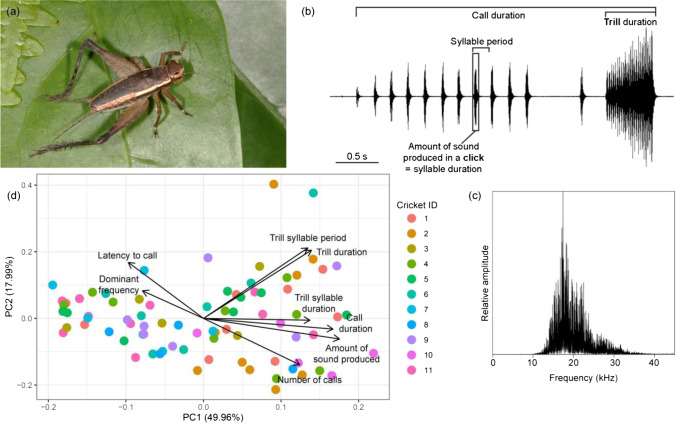
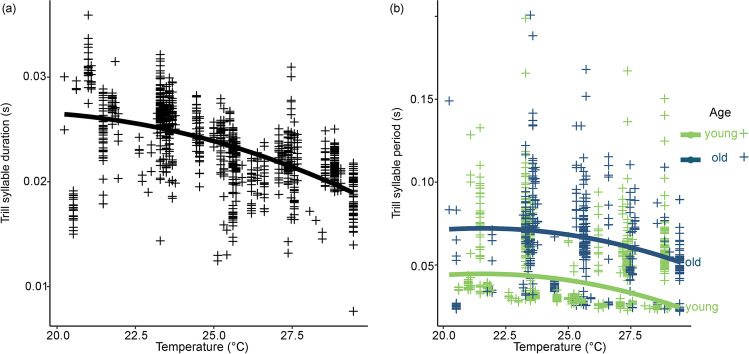
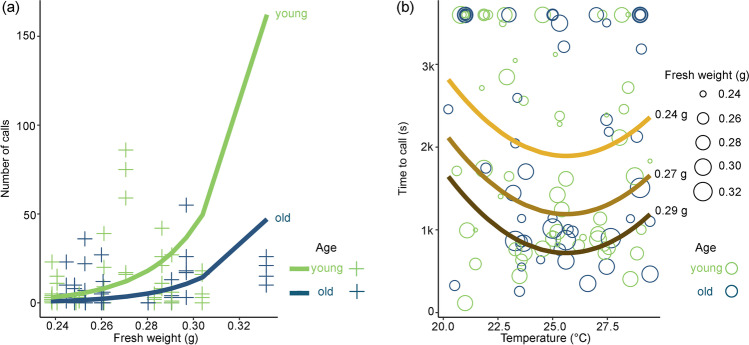
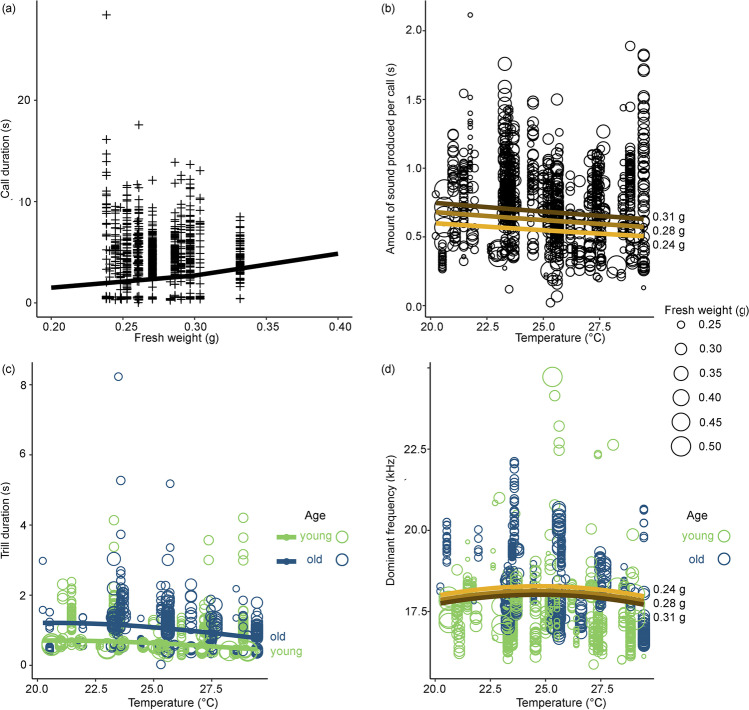
Driven by natural and sexual selection, calling behaviours and call parameters can vary within and between individuals. Phenotypic plasticity can be influenced by environmental conditions (e.g., temperature), size, body condition, and age. Crickets have been classic model organisms for studying the evolution of acoustic communication, but previous studies have focused on field crickets, for which males call at a low frequency, while females exhibit phonotaxis. This study holistically investigated the plasticity of calling behaviours and call parameters across a temperature gradient in a species of lebinthine crickets and examined plasticity between and within individuals. These crickets exhibit a unique communication system, including males calling at a near-ultrasonic frequency while actively searching for females. Ten recording assays at different temperatures were done on males of different sizes and body conditions, half of the assays when the males first became adults and another half 1 month later. Size, body condition, and age group of male crickets, as well as the ambient temperature, had different effects on different calling behaviours (e.g., number of songs produced) and call parameters (e.g., call duration, trill syllable period), even when the acoustic traits were correlated. The crickets also exhibited acclimatisation to the experimental conditions in their calling behaviours and acoustic traits to repeated assays. We also found that calling behaviours were less repeatable than temporal call parameters (e.g., call duration, trill duration), which in turn, were less repeatable than the spectral call parameter (dominant frequency).
在自然选择和性选择的驱动下,鸣叫行为和鸣叫参数在个体内部和个体之间可能会发生变化。表型可塑性可能会受到环境条件(例如温度)、体型、身体状况和年龄的影响。蟋蟀一直是研究声音通讯进化的经典模式生物,但以前的研究主要集中在田野蟋蟀上,雄性蟋蟀以低频鸣叫,而雌性蟋蟀则表现出趋声性。本研究全面调查了一种 lebinthine 蟋蟀在温度梯度下的鸣叫行为和鸣叫参数的可塑性,并研究了个体之间和个体内部的可塑性。这些蟋蟀表现出一种独特的通讯系统,包括雄性以近超声波频率鸣叫,同时积极寻找雌性。在不同的温度下对不同体型和身体状况的雄性蟋蟀进行了 10 次录音测定,其中一半是在雄性蟋蟀成年后的第一个月进行的,另一半是在 1 个月后进行的。蟋蟀雄性的体型、身体状况和年龄组,以及环境温度,对不同的鸣叫行为(例如鸣叫次数)和鸣叫参数(例如鸣叫持续时间、颤音音节周期)有不同的影响,即使这些声学特征是相关的。蟋蟀还表现出对其鸣叫行为和声学特征在重复测定中的适应能力。我们还发现,鸣叫行为的可重复性低于时间鸣叫参数(例如鸣叫持续时间、颤音持续时间),而时间鸣叫参数的可重复性又低于光谱鸣叫参数(主频)。