Clinical Neurosciences, University of Turku, FI-20014, Turku, Finland.
Neurocenter, Turku University Hospital, PO Box 52, FI-20521, Turku, Finland.
J Neural Transm (Vienna). 2022 Jul;129(7):895-904. doi: 10.1007/s00702-022-02517-1. Epub 2022 May 27.
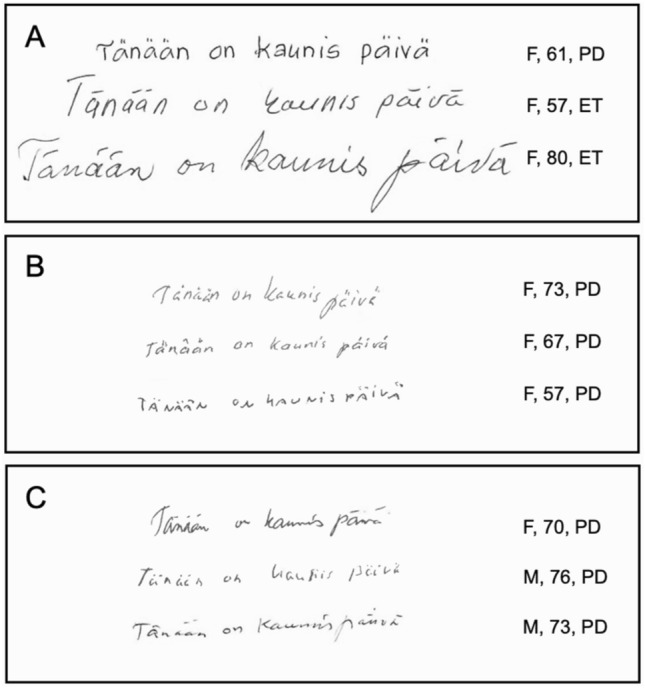
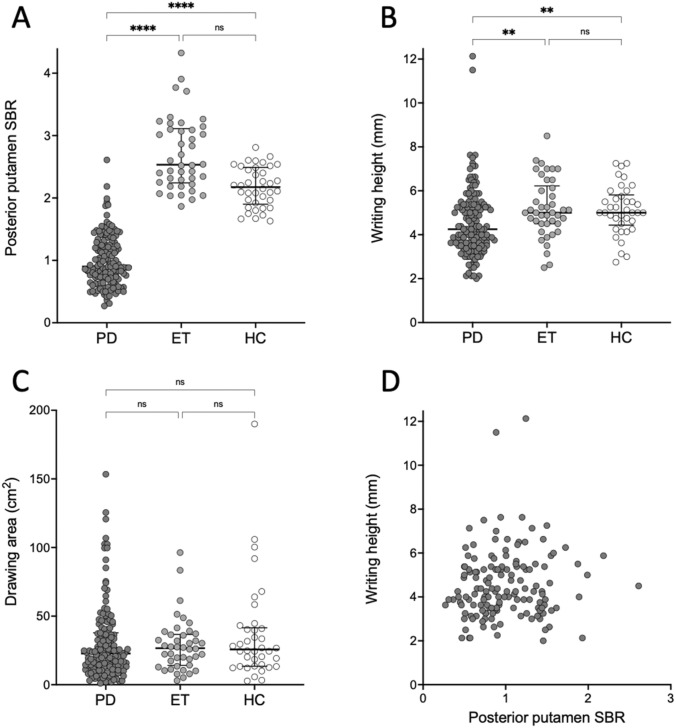
Micrographia is a common symptom of Parkinson's disease (PD), and it may precede other motor symptoms. Despite the high prevalence of micrographia in PD, its neurobiological mechanisms are not known. Given that levodopa may alleviate consistent micrographia and that nondopaminergic essential tremor (ET) is not associated with micrographia, micrographia could possibly be used as an ancillary diagnostic method that reflects nigrostriatal dopamine function. We evaluated the usefulness of micrographia as a simple one-sentence writing test in differentiating PD from ET. A total of 146 PD patients, 42 ET patients and 38 healthy controls provided writing samples and were scanned with brain [I]FP-CIT dopamine transporter (DAT) SPECT imaging with ROI-based and voxelwise analyses. The diagnostic accuracy of micrographia was evaluated and compared to that of DAT binding. Compared to ET and healthy controls, PD patients showed micrographia (consistent, 25.6% smaller area of handwriting sample in PD compared to ET, p = 0.002, and 27.2% smaller area of handwriting compared to healthy controls, p = 0.004). PD patients showed 133% more severe progressive micrographia compared with ET patients (median b = - 0.14 in PD, b = - 0.06 in ET, p = 0.021). In early unmedicated cognitively normal patients, consistent micrographia showed 71.2% specificity and 87.5% sensitivity in PD versus ET differentiation, but micrographia had no correlation with striatal or extrastriatal [I]FP-CIT binding in patients with PD. The one-sentence micrographia test shows moderately good accuracy in PD versus ET differentiation. The severity of micrographia has no relationship with DAT binding, suggesting nondopaminergic mechanism of micrographia in PD.ClinicalTrials.gov identifier: NCT02650843 (NMDAT study).
微观书写症是帕金森病 (PD) 的常见症状,且可能早于其他运动症状出现。尽管 PD 患者中微观书写症的患病率很高,但它的神经生物学机制尚不清楚。鉴于左旋多巴可能缓解持续的微观书写症,而非多巴胺能特发性震颤 (ET) 与微观书写症无关,微观书写症可能可用作反映黑质纹状体多巴胺功能的辅助诊断方法。我们评估了微观书写症作为一种简单的一句话书写测试在区分 PD 和 ET 中的作用。共有 146 名 PD 患者、42 名 ET 患者和 38 名健康对照者提供了书写样本,并进行了大脑 [I]FP-CIT 多巴胺转运体 (DAT) SPECT 成像的 ROI 分析和体素分析。评估了微观书写症的诊断准确性,并与 DAT 结合进行了比较。与 ET 和健康对照组相比,PD 患者出现微观书写症(一致的,与 ET 相比,PD 患者的手写样本面积小 25.6%,p=0.002,与健康对照组相比,PD 患者的手写样本面积小 27.2%,p=0.004)。与 ET 患者相比,PD 患者的进行性微观书写症严重程度高 133%(中位数 b=-0.14 在 PD 中,b=-0.06 在 ET 中,p=0.021)。在早期未用药认知正常的患者中,一致的微观书写症在 PD 与 ET 鉴别中具有 71.2%的特异性和 87.5%的敏感性,但微观书写症与 PD 患者的纹状体或纹状体外 [I]FP-CIT 结合无相关性。一句话微观书写症测试在 PD 与 ET 鉴别中具有中等准确性。微观书写症的严重程度与 DAT 结合无关,提示 PD 中的微观书写症存在非多巴胺能机制。临床试验.gov 标识符:NCT02650843 (NMDAT 研究)。