School of Instrument Science and Engineering, Southeast University, Nanjing 210096, China.
Division of Cardiology, The First Affiliated Hospital of Nanjing Medical University, Nanjing 210096, China.
Biosensors (Basel). 2022 May 20;12(5):355. doi: 10.3390/bios12050355.
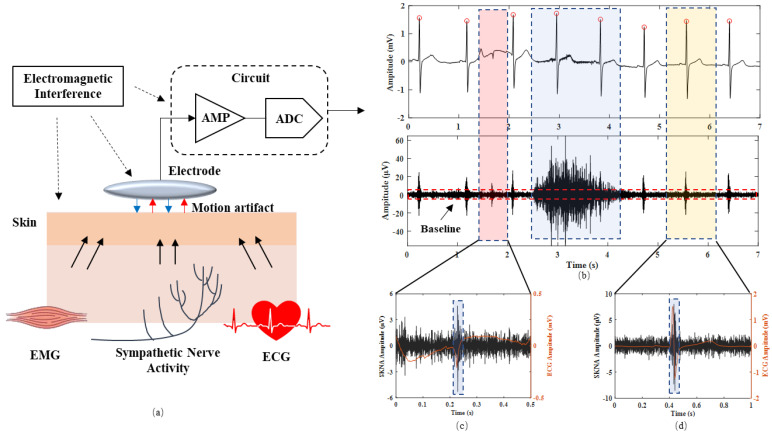
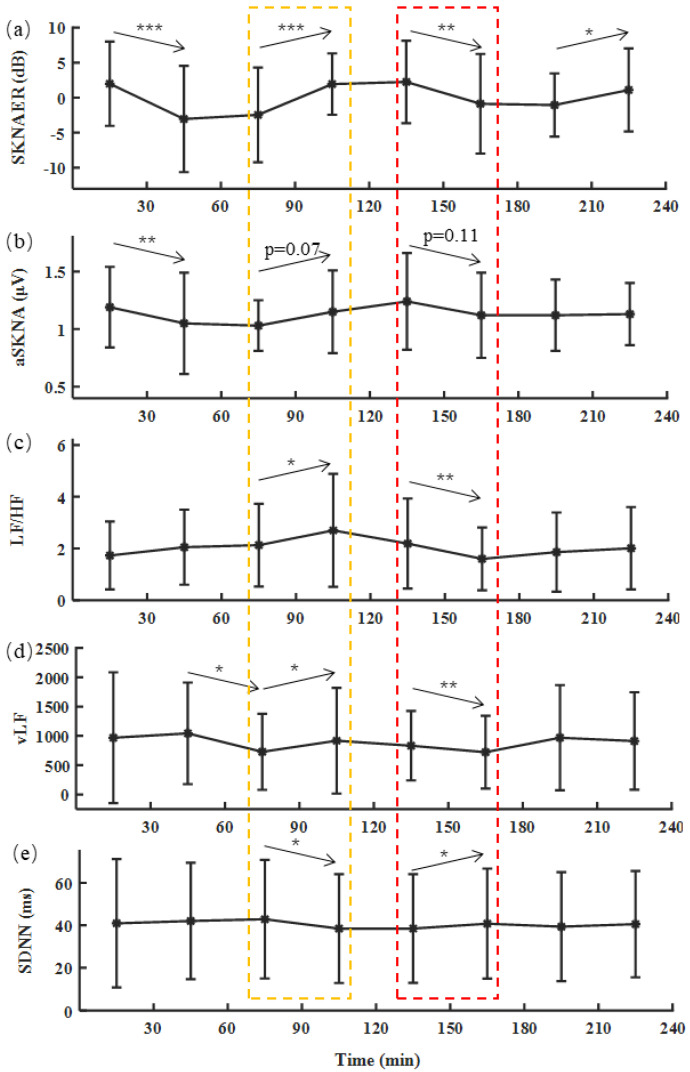
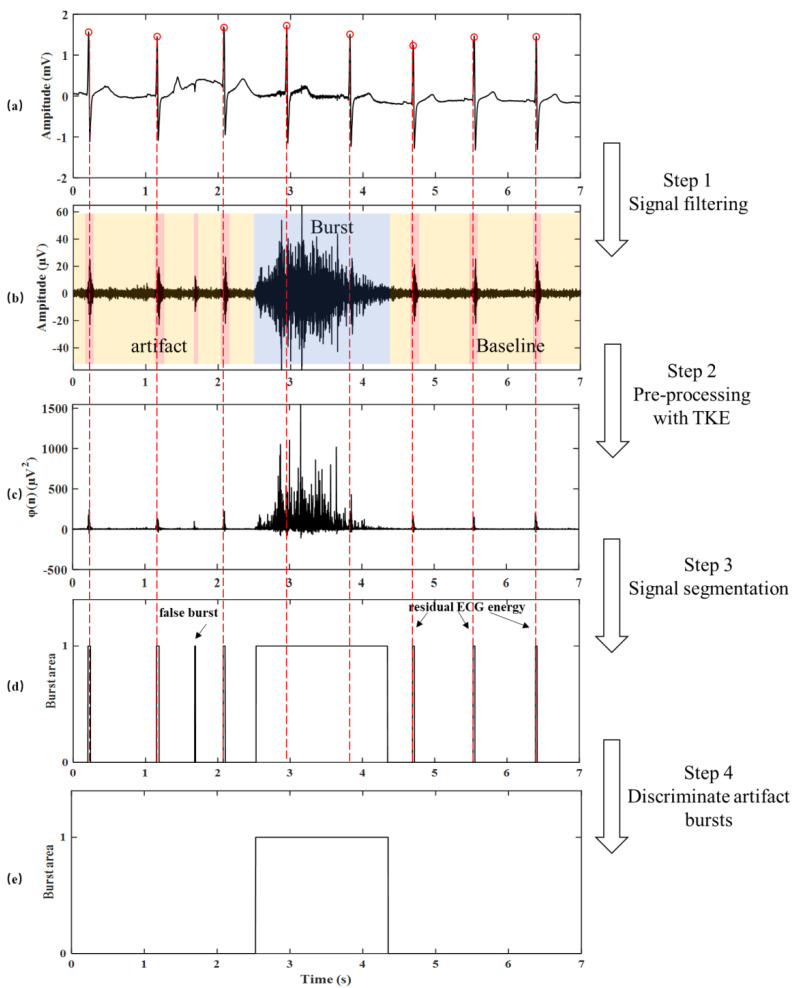
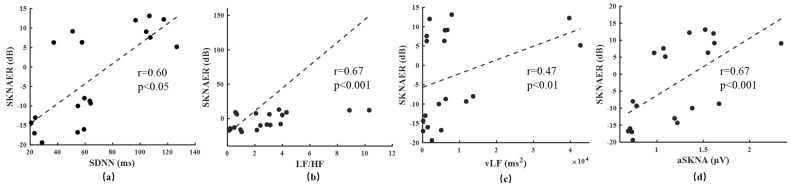
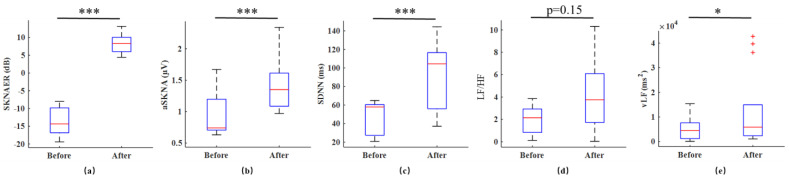
Evaluation of sympathetic nerve activity (SNA) using skin sympathetic nerve activity (SKNA) signal has attracted interest in recent studies. However, signal noises may obstruct the accurate location for the burst of SKNA, leading to the quantification error of the signal. In this study, we use the Teager−Kaiser energy (TKE) operator to preprocess the SKNA signal, and then candidates of burst areas were segmented by an envelope-based method. Since the burst of SKNA can also be discriminated by the high-frequency component in QRS complexes of electrocardiogram (ECG), a strategy was designed to reject their influence. Finally, a feature of the SKNA energy ratio (SKNAER) was proposed for quantifying the SKNA. The method was verified by both sympathetic nerve stimulation and hemodialysis experiments compared with traditional heart rate variability (HRV) and a recently developed integral skin sympathetic nerve activity (iSKNA) method. The results showed that SKNAER correlated well with HRV features (r = 0.60 with the standard deviation of NN intervals, 0.67 with low frequency/high frequency, 0.47 with very low frequency) and the average of iSKNA (r = 0.67). SKNAER improved the detection accuracy for the burst of SKNA, with 98.2% for detection rate and 91.9% for precision, inducing increases of 3.7% and 29.1% compared with iSKNA (detection rate: 94.5% (p < 0.01), precision: 62.8% (p < 0.001)). The results from the hemodialysis experiment showed that SKNAER had more significant differences than aSKNA in the long-term SNA evaluation (p < 0.001 vs. p = 0.07 in the fourth period, p < 0.01 vs. p = 0.11 in the sixth period). The newly developed feature may play an important role in continuously monitoring SNA and keeping potential for further clinical tests.
使用皮肤交感神经活动 (SKNA) 信号评估交感神经活动 (SNA) 在最近的研究中引起了关注。然而,信号噪声可能会阻碍 SKNA 爆发的确切位置,导致信号的量化误差。在这项研究中,我们使用 Teager-Kaiser 能量 (TKE) 算子对 SKNA 信号进行预处理,然后使用基于包络的方法对爆发区域的候选者进行分割。由于 SKNA 的爆发也可以通过心电图 (ECG) 的 QRS 复合体中的高频分量来区分,因此设计了一种策略来拒绝它们的影响。最后,提出了 SKNA 能量比 (SKNAER) 的特征来量化 SKNA。该方法通过交感神经刺激和血液透析实验与传统心率变异性 (HRV) 和最近开发的积分皮肤交感神经活动 (iSKNA) 方法进行了验证。结果表明,SKNAER 与 HRV 特征(NN 间隔标准差为 0.60,低频/高频为 0.67,极低频为 0.47)和 iSKNA 的平均值(r = 0.67)相关良好。SKNAER 提高了 SKNA 爆发的检测精度,检测率为 98.2%,精度为 91.9%,与 iSKNA 相比分别提高了 3.7%和 29.1%(检测率:94.5%(p<0.01),精度:62.8%(p<0.001))。血液透析实验的结果表明,在长期 SNA 评估中,SKNAER 比 aSKNA 具有更显著的差异(第四期 p<0.001 对 p=0.07,第六期 p<0.01 对 p=0.11)。新开发的特征可能在连续监测 SNA 方面发挥重要作用,并具有进一步临床测试的潜力。