Germande Ophélie, Ducret Thomas, Quignard Jean-Francois, Deweirdt Juliette, Freund-Michel Véronique, Errera Marie-Hélène, Cardouat Guillaume, Vacher Pierre, Muller Bernard, Berger Patrick, Guibert Christelle, Baudrimont Magalie, Baudrimont Isabelle
Université de Bordeaux, 146, Rue Léo Saignat, F-33076 Bordeaux, France.
Inserm U 1045, Centre de Recherche Cardio-Thoracique, Avenue du Haut Lêveque, F-33604 Pessac, France.
Antioxidants (Basel). 2022 Apr 26;11(5):847. doi: 10.3390/antiox11050847.
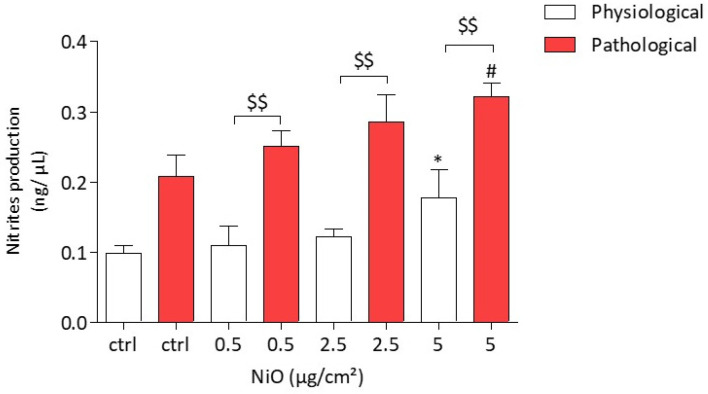
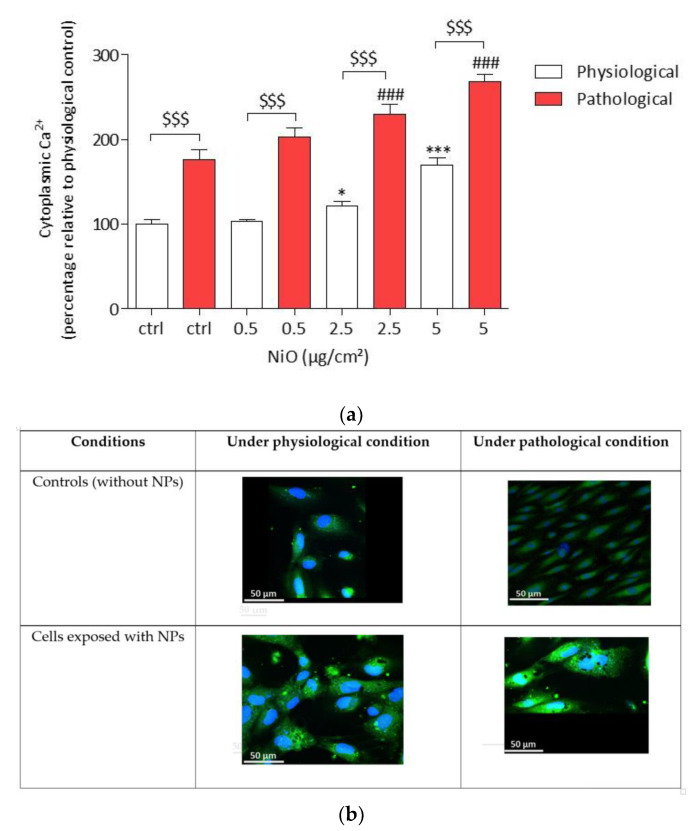
The development and use of nanomaterials, especially of nickel oxide nanoparticles (NiONPs), is expected to provide many benefits but also has raised concerns about the potential human health risks. Inhaled NPs are known to exert deleterious cardiovascular side effects, including pulmonary hypertension. Consequently, patients with pulmonary hypertension (PH) could be at increased risk for morbidity. The objective of this study was to compare the toxic effects of NiONPs on human pulmonary artery endothelial cells (HPAEC) under physiological and pathological conditions. The study was conducted with an in vitro model mimicking the endothelial dysfunction observed in PH. HPAEC were cultured under physiological (static and normoxic) or pathological (20% cycle stretch and hypoxia) conditions and exposed to NiONPs (0.5-5 μg/cm) for 4 or 24 h. The following endpoints were studied: (i) ROS production using CM-HDCF-DA and MitoSOX probes, (ii) nitrite production by the Griess reaction, (iii) IL-6 secretion by ELISA, (iv) calcium signaling with a Fluo-4 AM probe, and (v) mitochondrial dysfunction with TMRM and MitoTracker probes. Our results evidenced that under pathological conditions, ROS and nitrite production, IL-6 secretions, calcium signaling, and mitochondria alterations increased compared to physiological conditions. Human exposure to NiONPs may be associated with adverse effects in vulnerable populations with cardiovascular risks.
纳米材料的开发和使用,尤其是氧化镍纳米颗粒(NiONPs),有望带来诸多益处,但也引发了对其潜在人类健康风险的担忧。已知吸入纳米颗粒会产生有害的心血管副作用,包括肺动脉高压。因此,肺动脉高压(PH)患者的发病风险可能会增加。本研究的目的是比较NiONPs在生理和病理条件下对人肺动脉内皮细胞(HPAEC)的毒性作用。该研究采用了一种体外模型,模拟在PH中观察到的内皮功能障碍。HPAEC在生理(静态和常氧)或病理(20%周期性拉伸和缺氧)条件下培养,并暴露于NiONPs(0.5 - 5μg/cm)4或24小时。研究了以下终点指标:(i)使用CM - HDCF - DA和MitoSOX探针检测活性氧(ROS)生成;(ii)通过格里斯反应检测亚硝酸盐生成;(iii)采用酶联免疫吸附测定(ELISA)检测白细胞介素-6(IL - 6)分泌;(iv)使用Fluo - 4 AM探针检测钙信号;(v)使用TMRM和MitoTracker探针检测线粒体功能障碍。我们的结果表明,与生理条件相比,在病理条件下,ROS和亚硝酸盐生成、IL - 6分泌、钙信号以及线粒体改变均增加。人类接触NiONPs可能与心血管风险较高的易感人群的不良反应有关。