Gentsch Antje, Kuehn Esther
Department of Psychology, General and Experimental Psychology, LMU Munich, 80802 Munich, Germany.
Institute for Psychoanalysis, Psychotherapy and Psychosomatics (IPB), 10557 Berlin, Germany.
Brain Sci. 2022 May 3;12(5):594. doi: 10.3390/brainsci12050594.
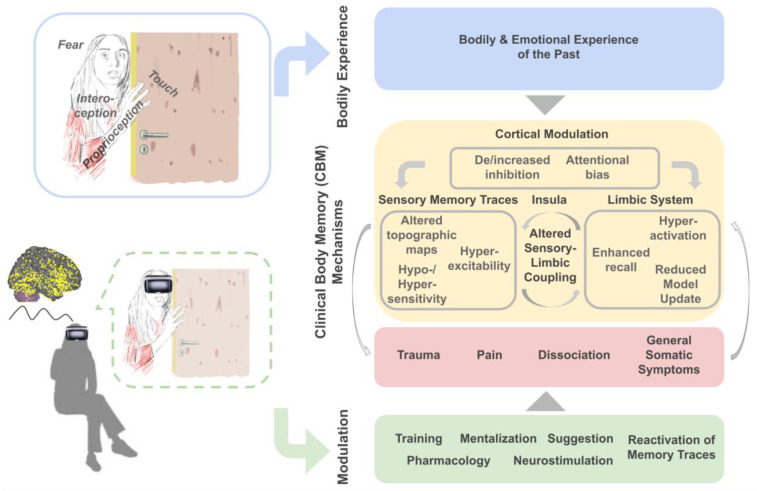
Bodily experiences such as the feeling of touch, pain or inner signals of the body are deeply emotional and activate brain networks that mediate their perception and higher-order processing. While the ad hoc perception of bodily signals and their influence on behavior is empirically well studied, there is a knowledge gap on how we store and retrieve bodily experiences that we perceived in the past, and how this influences our everyday life. Here, we explore the hypothesis that negative body memories, that is, negative bodily experiences of the past that are stored in memory and influence behavior, contribute to the development of somatic manifestations of mental health problems including somatic symptoms, traumatic re-experiences or dissociative symptoms. By combining knowledge from the areas of cognitive neuroscience and clinical neuroscience with insights from psychotherapy, we identify Clinical Body Memory (CBM) mechanisms that specify how mental health problems could be driven by corporeal experiences stored in memory. The major argument is that the investigation of the neuronal mechanisms that underlie the storage and retrieval of body memories provides us with empirical access to reduce the negative impact of body memories on mental health.
诸如触觉、疼痛或身体内部信号等身体体验具有深刻的情感意义,并激活介导其感知和高级加工的脑网络。虽然对身体信号的临时感知及其对行为的影响已得到充分的实证研究,但对于我们如何存储和检索过去感知到的身体体验,以及这如何影响我们的日常生活,仍存在知识空白。在此,我们探讨这样一种假设:负面身体记忆,即存储在记忆中并影响行为的过去负面身体体验,会导致包括躯体症状、创伤再体验或解离症状在内的心理健康问题的躯体表现的发展。通过将认知神经科学和临床神经科学领域的知识与心理治疗的见解相结合,我们确定了临床身体记忆(CBM)机制,该机制明确了心理健康问题如何由存储在记忆中的身体体验驱动。主要观点是,对身体记忆存储和检索背后的神经元机制的研究为我们提供了减少身体记忆对心理健康负面影响的实证途径。