Fu Yu-Show, Chen Po-Ru, Yeh Chang-Ching, Pan Jian-Yu, Kuo Wen-Chuan, Tseng Kuang-Wen
Department of Anatomy and Cell Biology, School of Medicine, National Yang Ming Chiao Tung University, Taipei 112, Taiwan.
Institute of Anatomy and Cell Biology, School of Medicine, National Yang Ming Chiao Tung University, Taipei 112, Taiwan.
Biomedicines. 2022 May 12;10(5):1125. doi: 10.3390/biomedicines10051125.
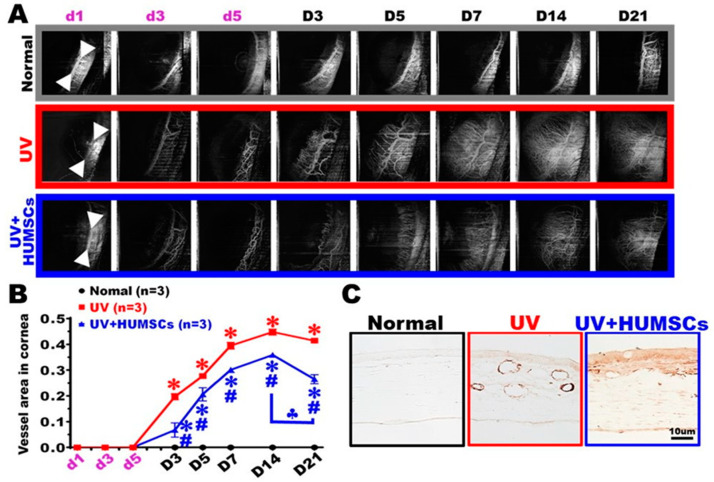
Most patients with a corneal injury are administered anti-inflammatory medications and antibiotics, but no other treatments are currently available. Thus, the corneal injury healing is unsatisfactory, affects the vision, and has a risk of blindness in severe cases. Human umbilical mesenchymal stem cells exhibit pluripotent and anti-inflammatory properties and do not cause immunological rejection in the host. Rats were irradiated with type B ultraviolet (UVB) light to generate a stable animal model of photokeratitis. After irradiation-induced photokeratitis, human umbilical mesenchymal stem cells were implanted into the subconjunctival space of the lateral sclera, and the changes in the corneal pathology were evaluated. Three weeks after implantation, many mesenchymal stem cells were visible in the subconjunctival space. These mesenchymal stem cells effectively reduced the extent of injury to the adjacent corneal tissue. They accelerated the epithelial layer repair, reduced the inflammatory response and neovascularization, and improved the disorganization of collagen and fibronectin in the corneal stroma caused by the injury. In conclusion, xenografted human umbilical mesenchymal stem cells can survive in rat eye tissues for a long time, effectively support the structural integrity of injured corneal tissues, restore corneal permeability, and reduce abnormal neovascularization. This study provides a new approach to the treatment of photokeratitis.
大多数角膜损伤患者会接受抗炎药物和抗生素治疗,但目前尚无其他治疗方法。因此,角膜损伤愈合情况不理想,会影响视力,严重时还存在失明风险。人脐带间充质干细胞具有多能性和抗炎特性,且不会在宿主体内引发免疫排斥反应。用B型紫外线(UVB)照射大鼠以建立稳定的光性角膜炎动物模型。在照射诱发光性角膜炎后,将人脐带间充质干细胞植入外侧巩膜的结膜下间隙,并评估角膜病理学变化。植入三周后,在结膜下间隙可见许多间充质干细胞。这些间充质干细胞有效减轻了对相邻角膜组织的损伤程度。它们加速了上皮层修复,减轻了炎症反应和新生血管形成,并改善了损伤所致角膜基质中胶原蛋白和纤连蛋白的紊乱。总之,异种移植的人脐带间充质干细胞可在大鼠眼组织中长期存活,有效维持受损角膜组织的结构完整性,恢复角膜通透性,并减少异常新生血管形成。本研究为光性角膜炎的治疗提供了一种新方法。