Puylaert Pauline, Van Praet Melissa, Vaes Frederik, Neutel Cédric H G, Roth Lynn, Guns Pieter-Jan, De Meyer Guido R Y, Martinet Wim
Laboratory of Physiopharmacology, University of Antwerp, 2610 Antwerp, Belgium.
Biomedicines. 2022 May 19;10(5):1171. doi: 10.3390/biomedicines10051171.
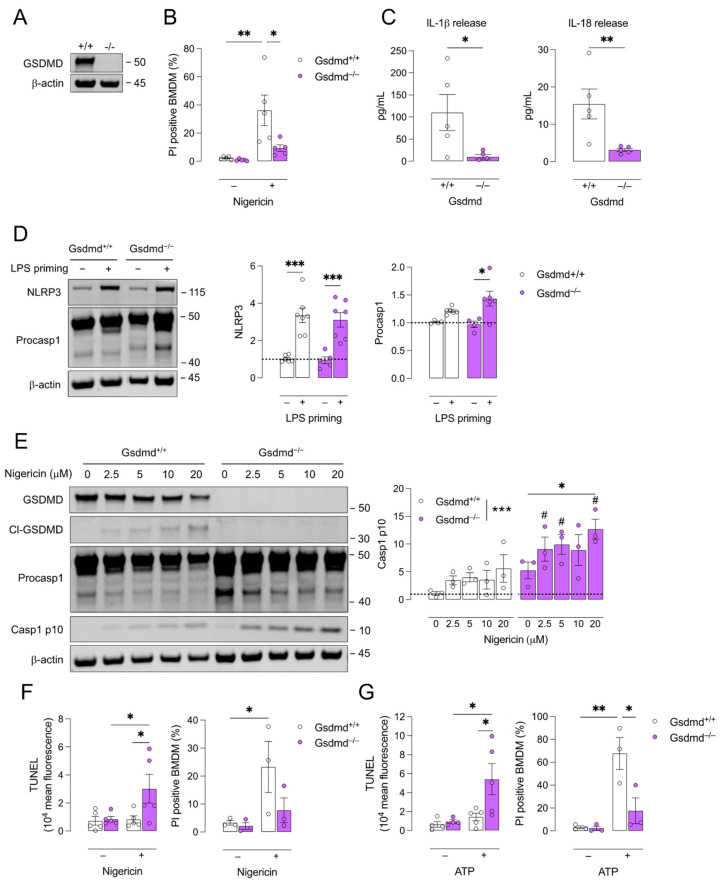
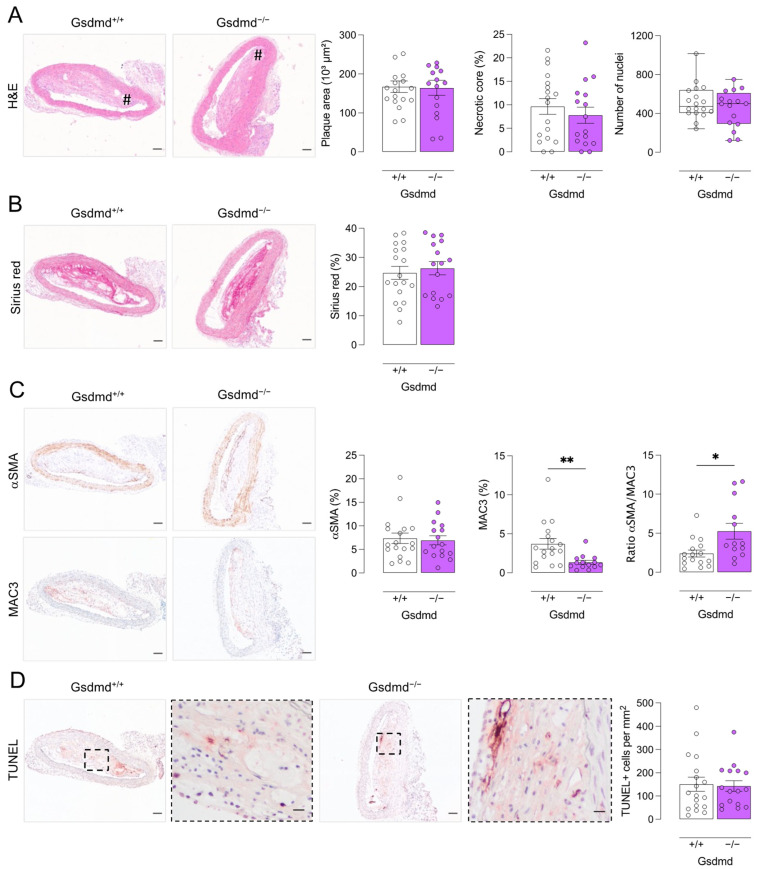
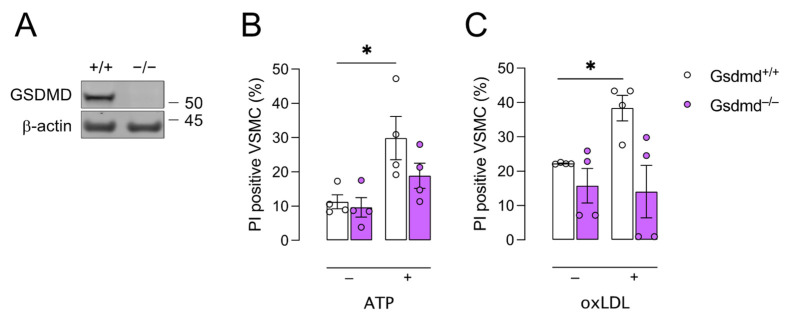
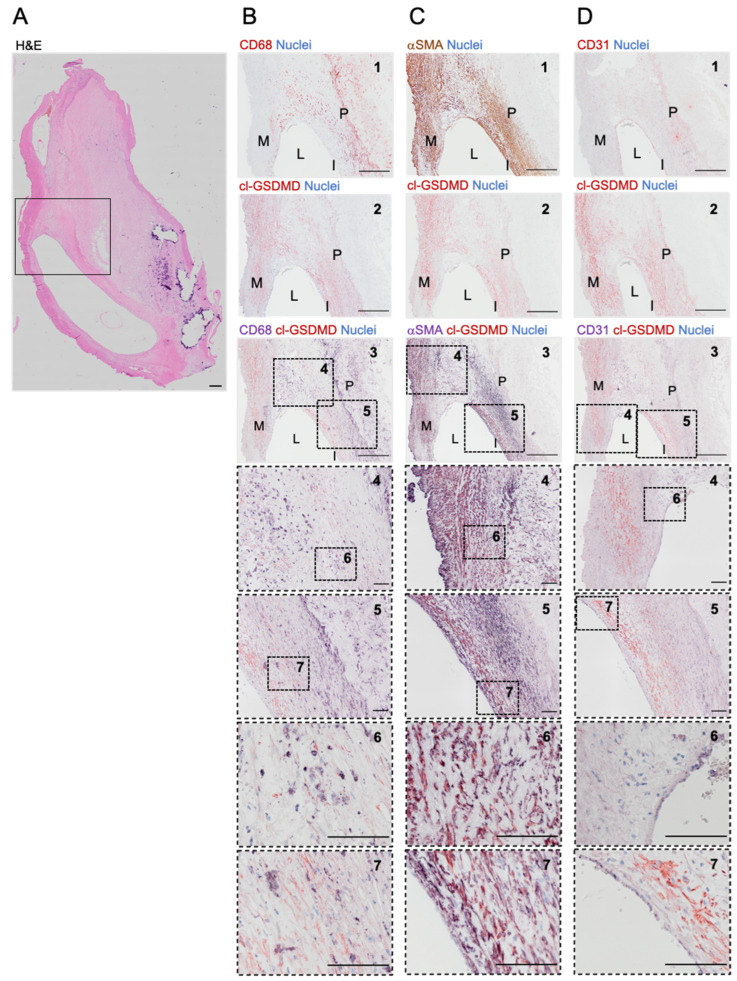
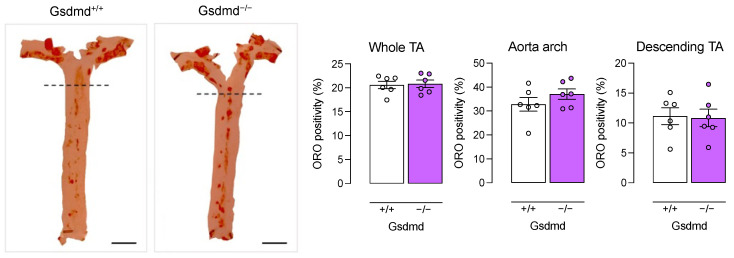
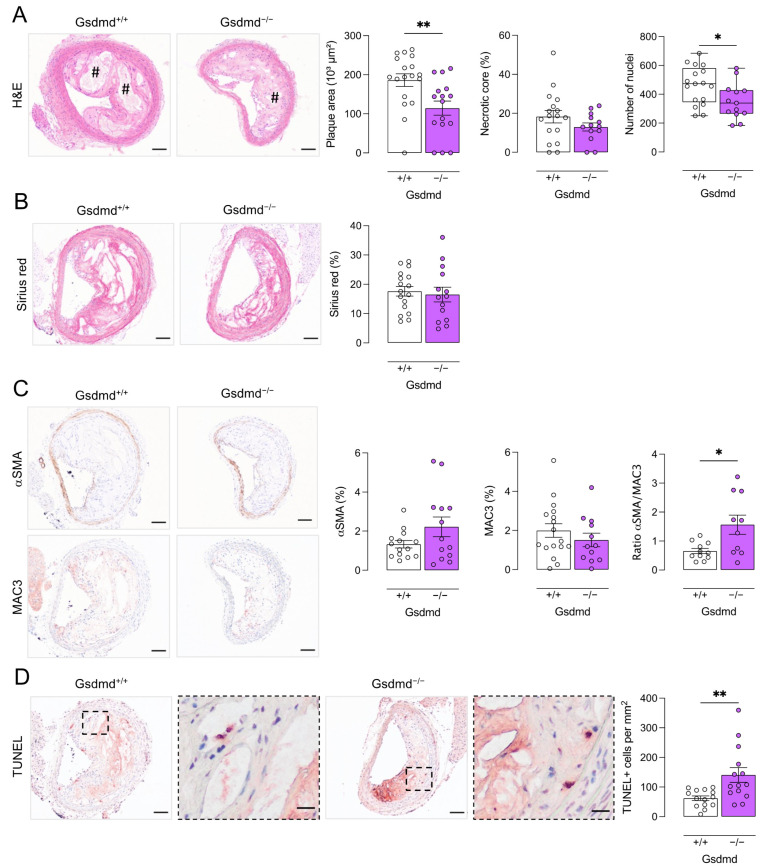
Gasdermin D (GSDMD) is the key executor of pyroptotic cell death. Recent studies suggest that GSDMD-mediated pyroptosis is involved in atherosclerotic plaque destabilization. We report that cleaved GSDMD is expressed in macrophage- and smooth muscle cell-rich areas of human plaques. To determine the effects of GSDMD deficiency on atherogenesis, ( = 16) and ( = 18) mice were fed a western-type diet for 16 weeks. Plaque initiation and formation of stable proximal aortic plaques were not altered. However, plaques in the brachiocephalic artery (representing more advanced lesions compared to aortic plaques) of mice were significantly smaller (115 ± 18 vs. 186 ± 16 × 10 µm, = 0.006) and showed features of increased stability, such as decreased necrotic core area (19 ± 4 vs. 37 ± 7 × 10 µm, = 0.03) and increased αSMA/MAC3 ratio (1.6 ± 0.3 vs. 0.7 ± 0.1, = 0.01), which was also observed in proximal aortic plaques. Interestingly, a significant increase in TUNEL positive cells was observed in brachiocephalic artery plaques from mice (141 ± 25 vs. 62 ± 8 cells/mm, = 0.005), indicating a switch to apoptosis. This switch from pyroptosis to apoptosis was also observed in vitro in macrophages. In conclusion, targeting GSDMD appears to be a promising approach for limiting the transition to an inflammatory, vulnerable plaque phenotype.
Gasdermin D(GSDMD)是细胞焦亡的关键执行者。最近的研究表明,GSDMD介导的细胞焦亡参与动脉粥样硬化斑块的不稳定过程。我们报道,裂解的GSDMD在人类斑块中富含巨噬细胞和平滑肌细胞的区域表达。为了确定GSDMD缺乏对动脉粥样硬化发生的影响,将野生型(WT,n = 16)和GSDMD基因敲除(KO,n = 18)小鼠喂食西式饮食16周。斑块起始和稳定的近端主动脉斑块形成未改变。然而,KO小鼠头臂动脉中的斑块(与主动脉斑块相比代表更晚期病变)明显更小(115±18 vs. 186±16×10³μm²,P = 0.006),并显示出稳定性增加的特征,如坏死核心面积减小(19±4 vs. 37±7×10³μm²,P = 0.03)和αSMA/MAC3比率增加(1.6±0.3 vs. 0.7±0.1,P = 0.01),这在近端主动脉斑块中也观察到。有趣的是,在KO小鼠头臂动脉斑块中观察到TUNEL阳性细胞显著增加(141±25 vs. 62±8个细胞/mm²,P = 0.005),表明转变为凋亡。在体外KO巨噬细胞中也观察到这种从细胞焦亡到凋亡的转变。总之,靶向GSDMD似乎是限制向炎症性、易损斑块表型转变的一种有前景的方法。