Barbosa-Gouveia Sofia, Vázquez-Mosquera Maria Eugenia, González-Vioque Emiliano, Hermida-Ameijeiras Álvaro, Sánchez-Pintos Paula, de Castro Maria José, León Soraya Ramiro, Gil-Fournier Belén, Domínguez-González Cristina, Camacho Salas Ana, Negrão Luis, Fineza Isabel, Laranjeira Francisco, Couce Maria Luz
Unit of Diagnosis and Treatment of Congenital Metabolic Diseases, Department of Paediatrics, Santiago de Compostela University Clinical Hospital, 15704 Santiago de Compostela, Spain.
Centro de Investigación Biomédica en Red de Enfermedades Raras (CIBERER), IDIS-Health Research Institute of Santiago de Compostela, Santiago de Compostela University Clinical Hospital, European Reference Network for Hereditary Metabolic Disorders (MetabERN), 15704 Santiago de Compostela, Spain.
J Clin Med. 2022 May 12;11(10):2750. doi: 10.3390/jcm11102750.
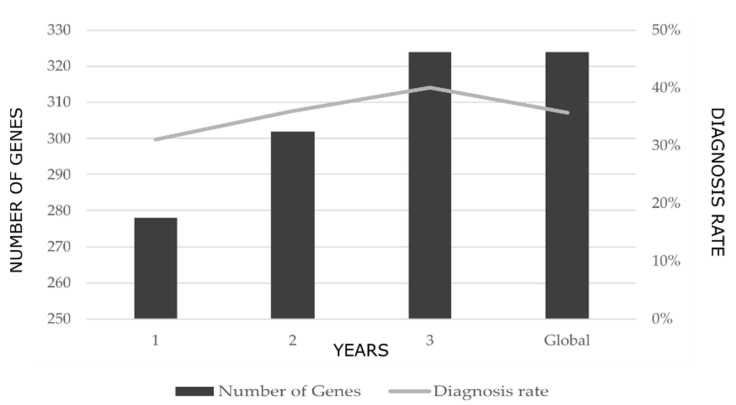
Neuromuscular diseases are genetically highly heterogeneous, and differential diagnosis can be challenging. Over a 3-year period, we prospectively analyzed 268 pediatric and adult patients with a suspected diagnosis of inherited neuromuscular disorder (INMD) using comprehensive gene-panel analysis and next-generation sequencing. The rate of diagnosis increased exponentially with the addition of genes to successive versions of the INMD panel, from 31% for the first iteration (278 genes) to 40% for the last (324 genes). The global mean diagnostic rate was 36% (97/268 patients), with a diagnostic turnaround time of 4-6 weeks. Most diagnoses corresponded to muscular dystrophies/myopathies (68.37%) and peripheral nerve diseases (22.45%). The most common causative genes, , , and , accounted for almost 30% of the diagnosed cases. Finally, we evaluated the utility of the differential diagnosis tool Phenomizer, which established a correlation between the phenotype and molecular findings in 21% of the diagnosed patients. In summary, comprehensive gene-panel analysis of all genes implicated in neuromuscular diseases facilitates a rapid diagnosis and provides a high diagnostic yield.
神经肌肉疾病在遗传上具有高度异质性,鉴别诊断可能具有挑战性。在3年的时间里,我们使用综合基因panel分析和下一代测序对268例疑似遗传性神经肌肉疾病(INMD)的儿科和成人患者进行了前瞻性分析。随着INMD panel后续版本中基因数量的增加,诊断率呈指数增长,从第一次迭代(278个基因)的31%增加到最后一次(324个基因)的40%。总体平均诊断率为36%(97/268例患者),诊断周转时间为4至6周。大多数诊断结果对应于肌肉营养不良症/肌病(68.37%)和周围神经疾病(22.45%)。最常见的致病基因, , 和 ,占确诊病例的近30%。最后,我们评估了鉴别诊断工具Phenomizer的效用,该工具在21%的确诊患者中建立了表型与分子发现之间的相关性。总之,对所有与神经肌肉疾病相关的基因进行综合基因panel分析有助于快速诊断,并提供高诊断率。