Cocchetti Carlotta, Romani Alessia, Mazzoli Francesca, Ristori Jiska, Lagi Filippo, Meriggiola Maria Cristina, Motta Giovanna, Pierdominici Marina, Bartoloni Alessandro, Vignozzi Linda, Maggi Mario, Fisher Alessandra Daphne
Andrology, Women's Endocrinology and Gender Incongruence Unit, Careggi University Hospital, Viale Pieraccini 6, 50100 Florence, Italy.
Infectious and Tropical Diseases Unit, Careggi University Hospital, 50134 Florence, Italy.
J Clin Med. 2022 May 14;11(10):2774. doi: 10.3390/jcm11102774.
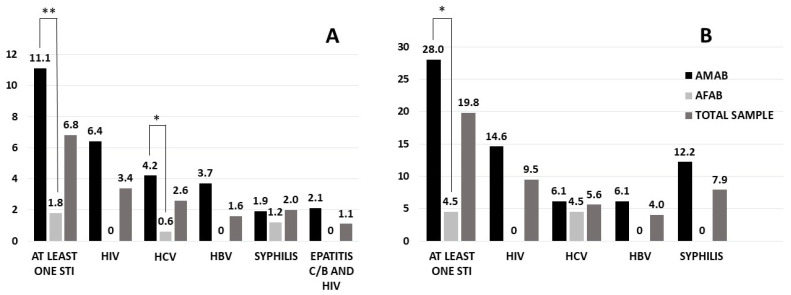
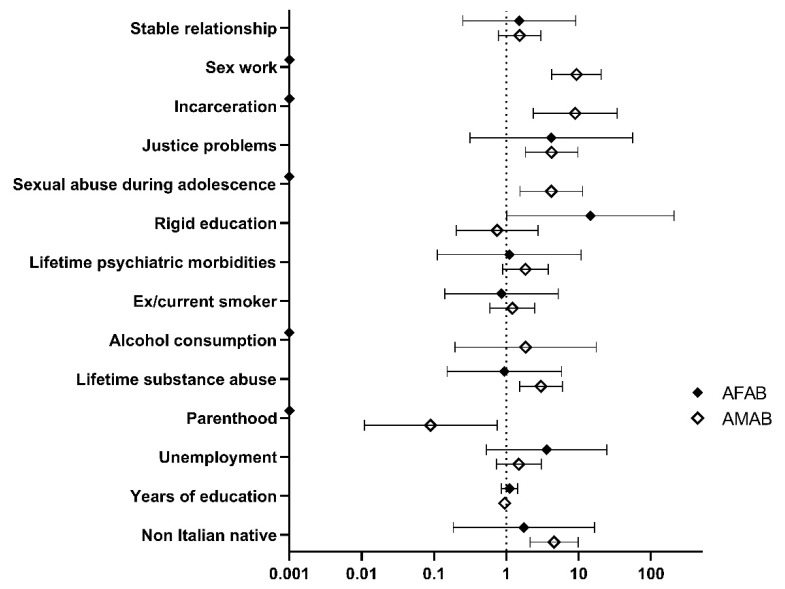
The burden of sexually transmitted infections (STIs) in the transgender population remains an underestimated issue. The aims of the present study were to evaluate the prevalence of either self-reported and serological STIs and to describe socio-demographic and clinical characteristics of transgender individuals with STIs. A consecutive series of 705 transgender individuals (assigned-male at birth, AMAB n = 377; assigned-female at birth, AFAB n = 328) referring to six Italian gender clinics were included. Sociodemographic and clinical information was collected during the first visit. In a subsample of 126 individuals prevalence of STIs (human immunodeficiency virus, HIV; hepatitis C, HCV; hepatitis B, HBV; syphilis) were evaluated through serology tests. The self-reported prevalence of HIV, HBV, HCV and syphilis infection in the total sample were 3.4%, 1.6%, 2.6% and 2.0%, respectively. In the subsample who underwent serological tests, higher rates of serological prevalence were found (9.5%, 4.0%, 5.6% and 7.9% for HIV, HBV, HCV and syphilis, respectively). When comparing transgender people with or without self-reported STIs, unemployment, previous incarceration, justice problems and sex work resulted more frequent in the first group (p< 0.03 for all). Regarding health status, we observed higher rates of lifetime substance abuse and psychiatric morbidities in trans people with at least one reported STI (p < 0.05). The prevalence of STIs exceeded that reported in general population and STIs correlates underline the importance of stigma and discrimination as determinants of transgender health.
性传播感染(STIs)在跨性别群体中的负担仍然是一个被低估的问题。本研究的目的是评估自我报告的性传播感染和血清学性传播感染的患病率,并描述患有性传播感染的跨性别个体的社会人口统计学和临床特征。纳入了连续的705名跨性别个体(出生时被指定为男性,AMAB,n = 377;出生时被指定为女性,AFAB,n = 328),他们来自意大利的六个性别诊所。在首次就诊时收集了社会人口统计学和临床信息。在126名个体的子样本中,通过血清学检测评估了性传播感染(人类免疫缺陷病毒,HIV;丙型肝炎,HCV;乙型肝炎,HBV;梅毒)的患病率。总样本中HIV、HBV、HCV和梅毒感染的自我报告患病率分别为3.4%、1.6%、2.6%和2.0%。在接受血清学检测的子样本中,发现血清学患病率更高(HIV、HBV、HCV和梅毒分别为9.5%、4.0%、5.6%和7.9%)。在比较有或没有自我报告性传播感染的跨性别者时,第一组中失业、以前被监禁、司法问题和性工作更为常见(所有p<0.03)。关于健康状况,我们观察到至少报告有一种性传播感染的跨性别者一生中药物滥用和精神疾病的发生率更高(p < 0.05)。性传播感染的患病率超过了一般人群报告的患病率,性传播感染之间的相关性强调了耻辱和歧视作为跨性别健康决定因素的重要性。