Nishihara Takahiro, Miyoshi Toru, Ichikawa Keishi, Osawa Kazuhiro, Nakashima Mitsutaka, Miki Takashi, Ito Hiroshi
Department of Cardiovascular Medicine, Faculty of Medicine, Dentistry and Pharmaceutical Sciences, Okayama University, Okayama 700-8558, Japan.
Department of General Internal Medicine 3, Kawasaki Medical School General Medicine Centre, Okayama 700-0821, Japan.
J Clin Med. 2022 May 17;11(10):2838. doi: 10.3390/jcm11102838.
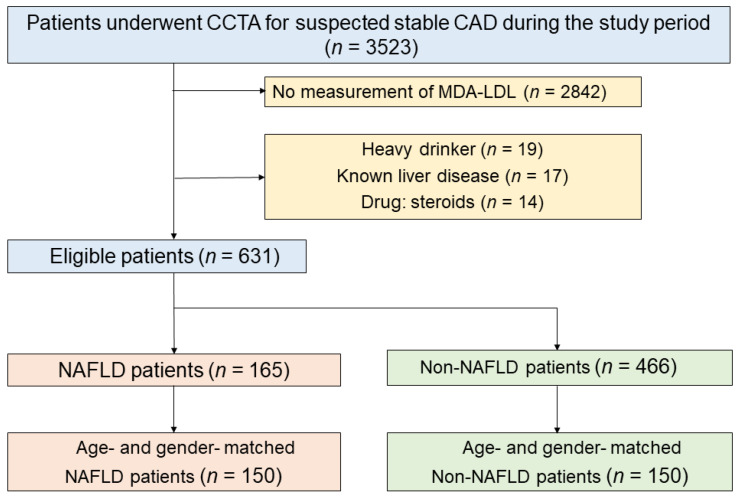
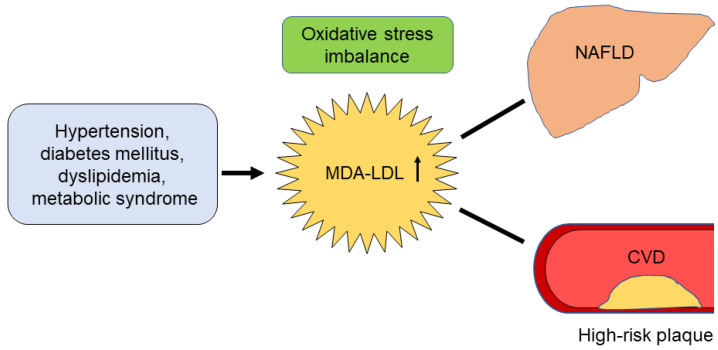
Nonalcoholic fatty liver disease (NAFLD) is a risk factor for the development of atherosclerotic cardiovascular diseases (CVDs), and oxidative stress has been proposed as a shared pathophysiological condition. This study examined whether oxidized low-density lipoprotein (LDL) is involved in the underlying mechanism that links coronary atherosclerosis and NAFLD. This study included 631 patients who underwent coronary computed tomography angiography (CTA) for suspected coronary artery disease. NAFLD was defined on CT images as a liver-to-spleen attenuation ratio of <1.0. Serum-malondialdehyde-modified LDL (MDA-LDL) and coronary CTA findings were analyzed in a propensity-score-matched cohort of patients with NAFLD (n = 150) and those without NAFLD (n = 150). This study analyzed 300 patients (median age, 65 years; 64% men). Patients with NAFLD had higher MDA-LDL levels and a greater presence of CTA-verified high-risk plaques than those without NAFLD. In the multivariate linear regression analysis, MDA-LDL was independently associated with NAFLD (β = 11.337, p = 0.005) and high-risk plaques (β = 12.487, p = 0.007). Increased MDA-LDL may be a mediator between NAFLD and high-risk coronary plaque on coronary CTA. Increased oxidative stress in NAFLD, as assessed using MDA-LDL, may be involved in the development of CVDs.
非酒精性脂肪性肝病(NAFLD)是动脉粥样硬化性心血管疾病(CVD)发生的一个危险因素,氧化应激被认为是一种共同的病理生理状态。本研究探讨氧化型低密度脂蛋白(LDL)是否参与了冠状动脉粥样硬化与NAFLD之间潜在的机制联系。本研究纳入了631例因疑似冠心病接受冠状动脉计算机断层扫描血管造影(CTA)的患者。NAFLD在CT图像上被定义为肝脾衰减比<1.0。在倾向评分匹配的NAFLD患者队列(n = 150)和无NAFLD患者队列(n = 150)中分析血清丙二醛修饰的LDL(MDA-LDL)和冠状动脉CTA结果。本研究分析了300例患者(中位年龄65岁;64%为男性)。与无NAFLD的患者相比,NAFLD患者的MDA-LDL水平更高,CTA证实的高危斑块更多。在多变量线性回归分析中,MDA-LDL与NAFLD(β = 11.337,p = 0.005)和高危斑块(β = 12.487,p = 0.007)独立相关。MDA-LDL升高可能是NAFLD与冠状动脉CTA上高危冠状动脉斑块之间的一个介导因素。使用MDA-LDL评估的NAFLD中氧化应激增加可能参与了CVD的发生发展。