Caminiti Giuseppe, Perrone Marco Alfonso, Iellamo Ferdinando, D'Antoni Valentino, Catena Matteo, Franchini Alessio, Volterrani Maurizio
Cardiology Rehabilitation Unit, IRCCS San Raffaele Pisana, 00163 Rome, Italy.
Department of Clinical Sciences and Translational Medicine, University of Rome Tor Vergata, 00133 Rome, Italy.
J Pers Med. 2022 Apr 26;12(5):689. doi: 10.3390/jpm12050689.
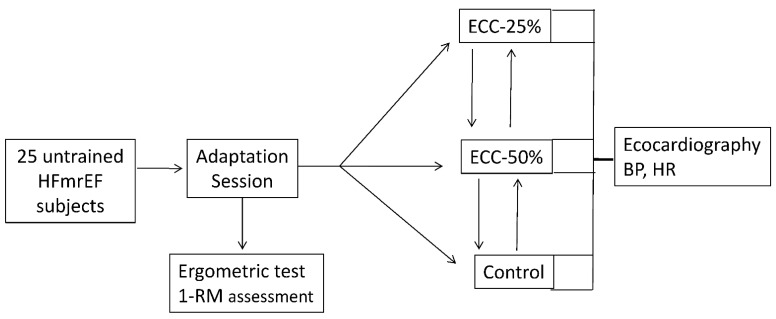
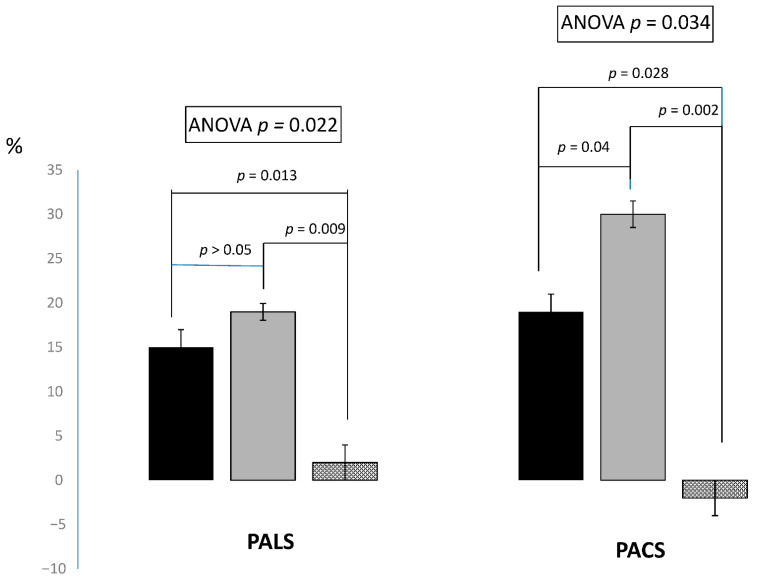
In this study, we aimed to assess acute changes occurring on atrial function following single bouts of eccentric resistance exercise (ECC-RE) performed at two different loads. Twenty-five patients with chronic heart failure with middle range ejection fraction (HFmrEF) participated in three experimental sessions in a randomized order and on separate days: two sessions of ECC RE at 20% (ECC-20) of one-repetition maximum (1-RM) and 50% (ECC-50) 1-RM, and one session of control, without exercise. Each session lasted three minutes. Before and immediately after the sessions, patients underwent echocardiography and blood pressure and heart rate measurement. Peak atrial longitudinal strain (PALS) and peak atrial contractile strain (PACS) significantly increased after both ECC-20 (+16.3%) and ECC-50 (+18.1%) compared to control (between sessions = 0.022). Peak atrial contractile strain (PACS) significantly increased after ECC-50 (+28.4%) compared to ECC-20 (+17.0%) and control (between sessions = 0.034). The ratio of transmitral and annular velocities (E/E') increased significantly after ECC-20 (+10.4%) and ECC-50 (+19.0%) compared to control (between groups = 0.003). EF, left ventricular longitudinal strain, and stroke volume did not change after ECC-RE sessions compared to control. Cardiac output increased significantly after ECC-20 and ECC-50 compared to control, (between groups = 0.025). In conclusion, both ECC-RE sessions were well tolerated, and LA functional reserve was properly mobilized in response to ECC-RE in patients with HFmrEF. Cardiac output increased at the cost of an increased LV filling pressure, but no detrimental changes of LV function occurred.
在本研究中,我们旨在评估在两种不同负荷下进行单次离心抗阻运动(ECC-RE)后心房功能发生的急性变化。25例中度射血分数慢性心力衰竭(HFmrEF)患者按随机顺序在不同日期参加了三个实验环节:两个分别为1次重复最大值(1-RM)的20%(ECC-20)和50%(ECC-50)的ECC RE环节,以及一个无运动的对照环节。每个环节持续三分钟。在各环节之前和之后,患者接受了超声心动图检查以及血压和心率测量。与对照组相比,ECC-20(增加16.3%)和ECC-50(增加18.1%)后,心房纵向峰值应变(PALS)和心房收缩峰值应变(PACS)均显著增加(组间差异=0.022)。与ECC-20(增加17.0%)和对照组相比,ECC-50后心房收缩峰值应变(PACS)显著增加(增加28.4%)(组间差异=0.034)。与对照组相比,ECC-20(增加10.4%)和ECC-50(增加19.0%)后二尖瓣与瓣环速度比值(E/E')显著增加(组间差异=0.003)。与对照组相比ECC-RE环节后射血分数、左心室纵向应变和每搏输出量未发生变化。与对照组相比,ECC-20和ECC-50后心输出量显著增加(组间差异=0.025)。总之,两个ECC-RE环节耐受性良好,HFmrEF患者的左心房功能储备在ECC-RE后得到了适当调动。心输出量增加是以左心室充盈压升高为代价的,但左心室功能未发生有害变化。