Cameli Matteo, Lisi Matteo, Mondillo Sergio, Padeletti Margherita, Ballo Piercarlo, Tsioulpas Charilaos, Bernazzali Sonia, Maccherini Massimo
Department of Cardiovascular Diseases, University of Siena, Siena, Italy.
Cardiovasc Ultrasound. 2010 Apr 21;8:14. doi: 10.1186/1476-7120-8-14.
The combination of early transmitral inflow velocity and mitral annular tissue Doppler imaging (E/Em ratio) is widely applied to noninvasively estimate left ventricular (LV) filling pressures. However E/Em ratio has a significant gray zone and its accuracy in patients with heart failure is debated. Left atrial (LA) deformation analysis by speckle tracking echocardiography (STE) was recently proposed as an alternative approach to estimate LV filling pressures. This study aimed at exploring the correlation of LA longitudinal function by STE and Doppler measurements with direct measurements of LV filling pressures in patients with heart failure.
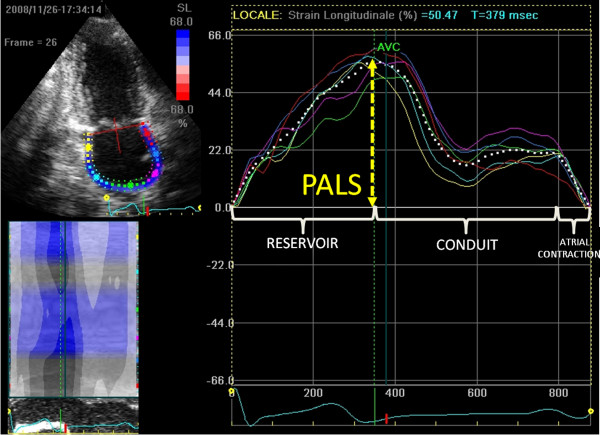
A total of 36 patients with advanced systolic heart failure (ejection fraction < or = 35%), undergoing right heart catheterization, were studied. Simultaneously to pulmonary capillary wedge pressure (PCWP) determination, peak atrial longitudinal strain (PALS) and mean E/Em ratio were measured in all subjects by two independent operators. PALS values were obtained by averaging all segments (global PALS), and by separately averaging segments measured in the 4-chamber and 2-chamber views.
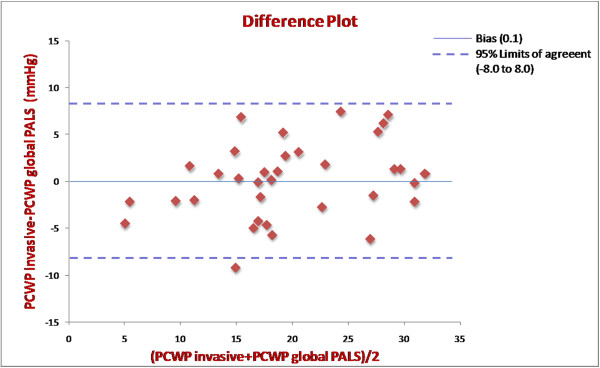
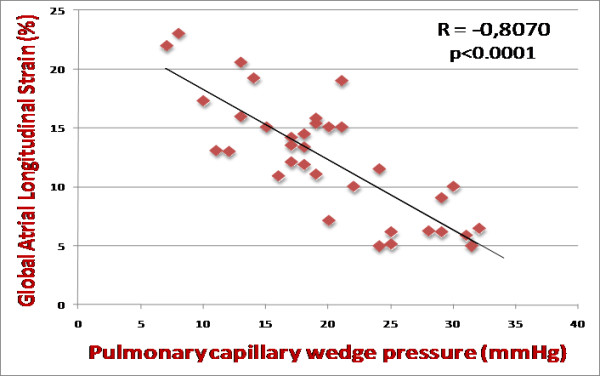
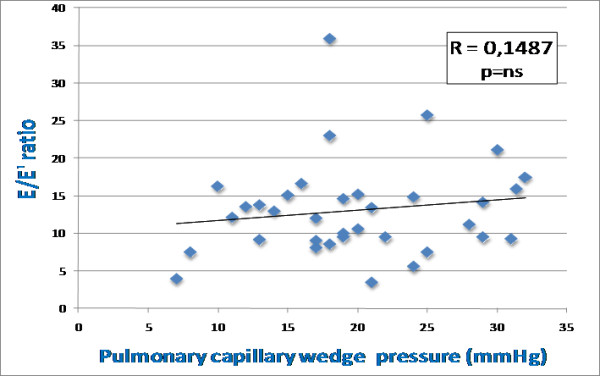
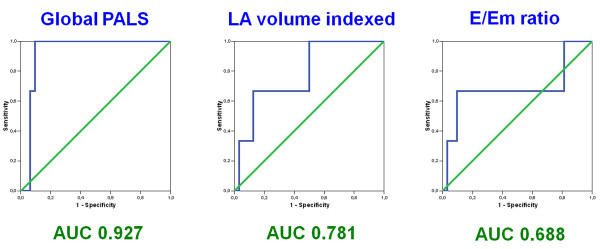
Not significant correlation was found between mean E/Em ratio and PCWP (R = 0.15). A close negative correlation between global PALS and the PCWP was found (R = -0.81, p < 0.0001). Furthermore, global PALS demonstrated the highest diagnostic accuracy (AUC of 0.93) and excellent sensitivity and specificity of 100% and 93%, respectively, to predict elevated filling pressure using a cutoff value less than 15.1%. Bland-Altman analysis confirmed this close agreement between PCWP estimated by global PALS and invasive PCWP (mean bias 0.1 +/- 8.0 mmHg).
In a group of patients with advanced systolic heart failure, E/Em ratio correlated poorly with invasively obtained LV filling pressures. However, LA longitudinal deformation analysis by STE correlated well with PCWP, providing a better estimation of LV filling pressures in this particular clinical setting.
早期二尖瓣流入速度与二尖瓣环组织多普勒成像(E/Em 比值)的联合应用被广泛用于无创估计左心室(LV)充盈压。然而,E/Em 比值存在显著的灰色区域,其在心力衰竭患者中的准确性存在争议。最近,斑点追踪超声心动图(STE)对左心房(LA)变形分析被提出作为估计 LV 充盈压的替代方法。本研究旨在探讨 STE 评估的 LA 纵向功能及多普勒测量值与心力衰竭患者 LV 充盈压直接测量值之间的相关性。
共研究了 36 例晚期收缩性心力衰竭(射血分数≤35%)且接受右心导管检查的患者。在测定肺毛细血管楔压(PCWP)的同时,由两名独立操作人员测量所有受试者的心房纵向应变峰值(PALS)和平均 E/Em 比值。PALS 值通过对所有节段求平均值(整体 PALS)获得,并分别对四腔心和两腔心视图中测量的节段求平均值。
平均 E/Em 比值与 PCWP 之间未发现显著相关性(R = 0.15)。发现整体 PALS 与 PCWP 之间存在密切的负相关(R = -0.81,p < 0.0001)。此外,整体 PALS 显示出最高的诊断准确性(曲线下面积为 0.93),预测充盈压升高时的敏感性和特异性分别为 100%和 93%,使用的截断值小于 15.1%。Bland-Altman 分析证实了整体 PALS 估计的 PCWP 与有创 PCWP 之间的密切一致性(平均偏差 0.1±8.0 mmHg)。
在一组晚期收缩性心力衰竭患者中,E/Em 比值与有创获得的 LV 充盈压相关性较差。然而,STE 对 LA 纵向变形的分析与 PCWP 相关性良好,在这一特定临床环境中能更好地估计 LV 充盈压。