Fouka Evangelia, Papaioannou Andriana I, Hillas Georgios, Steiropoulos Paschalis
Pulmonary Medicine Department, Aristotle University of Thessaloniki, G Papanikolaou Hospital, 57010 Thessaloniki, Greece.
2nd Department of Respiratory Medicine, "Attikon" Hospital, Medical School, National and Kapodistrian University of Athens, 12462 Athens, Greece.
J Pers Med. 2022 Apr 28;12(5):708. doi: 10.3390/jpm12050708.
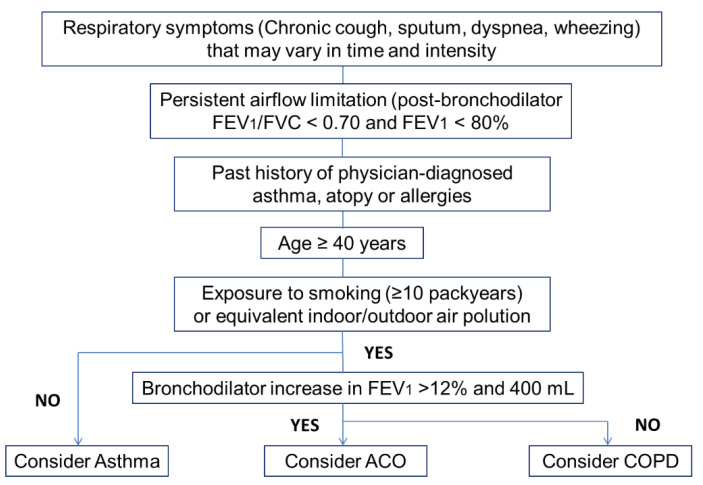
The term asthma-COPD overlap (ACO) has been used to identify a heterogeneous condition in which patients present with airflow limitation that is not completely reversible and clinical and inflammatory features of both asthma and chronic obstructive pulmonary disease (COPD). ACO diagnosis may be difficult in clinical practice, while controversy still exists regarding its definition, pathophysiology, and impact. Patients with ACO experience a greater disease burden compared to patients with asthma or COPD alone, but in contrast they show better response to inhaled corticosteroid treatment than other COPD phenotypes. Current management recommendations focus on defining specific and measurable treatable clinical traits, according to disease phenotypes and underlying biological mechanisms for every single patient. In this publication, we review the current knowledge on definition, pathophysiology, clinical characteristics, and management options of ACO.
术语“哮喘-慢性阻塞性肺疾病重叠综合征(ACO)”用于识别一种异质性疾病,此类患者存在不完全可逆的气流受限,同时具有哮喘和慢性阻塞性肺疾病(COPD)的临床及炎症特征。在临床实践中,ACO的诊断可能存在困难,而且关于其定义、病理生理学及影响仍存在争议。与单纯哮喘或COPD患者相比,ACO患者承受着更大的疾病负担,但相比其他COPD表型,他们对吸入性糖皮质激素治疗表现出更好的反应。当前的管理建议侧重于根据每位患者的疾病表型和潜在生物学机制,确定具体且可测量的可治疗临床特征。在本出版物中,我们综述了关于ACO的定义、病理生理学、临床特征及管理方案的现有知识。