Bokor Szilvia, Vass Réka A, Funke Simone, Ertl Tibor, Molnár Dénes
Department of Paediatrics, University of Pécs Medical School, H-7624 Pécs, Hungary.
National Laboratory for Human Reproduction, University of Pécs, H-7624 Pécs, Hungary.
Life (Basel). 2022 Apr 19;12(5):609. doi: 10.3390/life12050609.
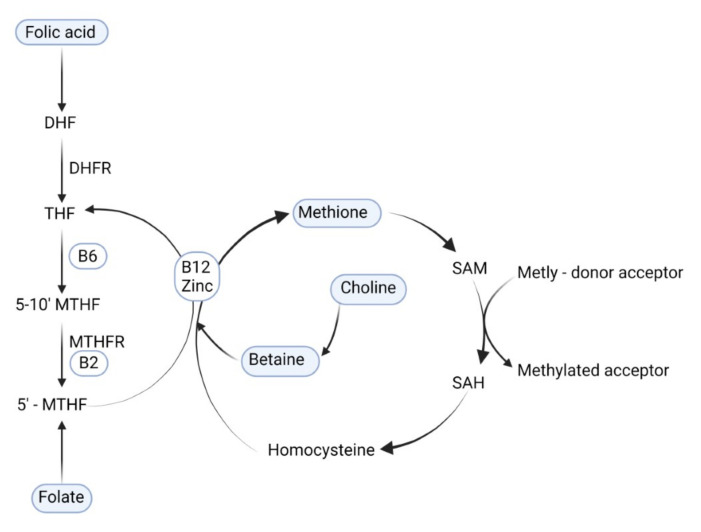
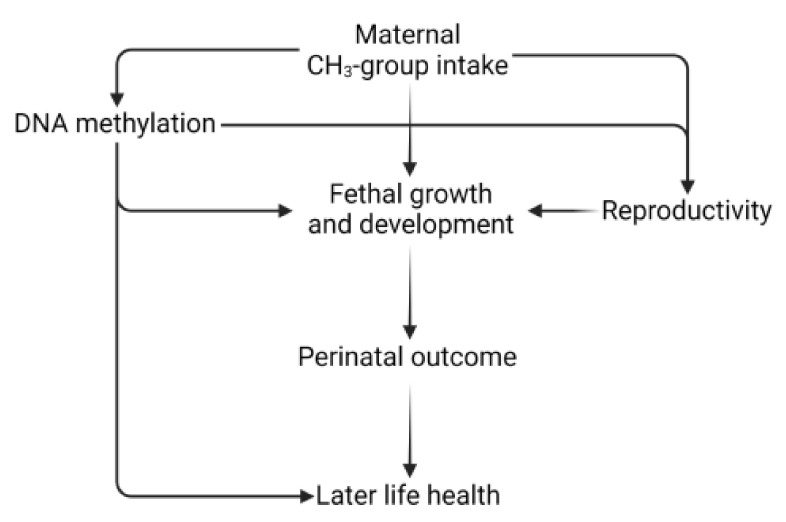
Maternal exposure to some dietary and environmental factors during embryonic development can affect offspring's phenotype and, furthermore, the risk of developing diseases later in life. One potential mechanism responsible for this early programming may be the modification of the epigenome, such as DNA methylation. Methyl-group donors are essential for DNA methylation and are shown to have an important role in fetal development and later health. The main goal of the present review is to summarize the available literature data on the epigenetic effect (DNA methylation) of maternal methyl-group donor availability on reproductivity, perinatal outcome, and later health of the offspring. In our literature search, we found evidence for the association between alterations in DNA methylation patterns caused by different maternal methyl-group donor (folate, choline, methionine, betaine) intake and reproductivity, birth weight, neural tube defect, congenital heart defect, cleft lip and palate, brain development, and the development of obesity and associated non-communicable diseases in later life. We can conclude that maternal methyl-group donor availability could affect offspring's health via alterations in DNA methylation and may be a major link between early environmental exposure and the development of diseases in the offspring. However, still, further studies are necessary to confirm the associations and causal relationships.
母亲在胚胎发育期间接触某些饮食和环境因素会影响后代的表型,进而影响其日后患疾病的风险。造成这种早期编程的一个潜在机制可能是表观基因组的修饰,比如DNA甲基化。甲基供体对DNA甲基化至关重要,并且已证明其在胎儿发育及后期健康中发挥重要作用。本综述的主要目的是总结现有文献数据,阐述母体甲基供体可利用性对后代生殖能力、围产期结局及后期健康的表观遗传效应(DNA甲基化)。在文献检索中,我们发现了证据,表明不同母体甲基供体(叶酸、胆碱、蛋氨酸、甜菜碱)摄入量导致的DNA甲基化模式改变与生殖能力、出生体重、神经管缺陷、先天性心脏病、唇腭裂、大脑发育以及后期肥胖及相关非传染性疾病的发生之间存在关联。我们可以得出结论,母体甲基供体的可利用性可能通过DNA甲基化的改变影响后代健康,并且可能是早期环境暴露与后代疾病发生之间的主要联系。然而,仍需要进一步研究来证实这些关联和因果关系。