Huang Kuang-Hua, Chang Ya-Lan, Gau Shuo-Yan, Tsai Tung-Han, Lee Chien-Ying
Department of Health Services Administration, China Medical University, Taichung 40402, Taiwan.
Department of Pharmacology, Chung Shan Medical University, No. 110, Sec. 1, Jianguo N. Rd., Taichung 40201, Taiwan.
Pharmaceutics. 2022 Apr 27;14(5):946. doi: 10.3390/pharmaceutics14050946.
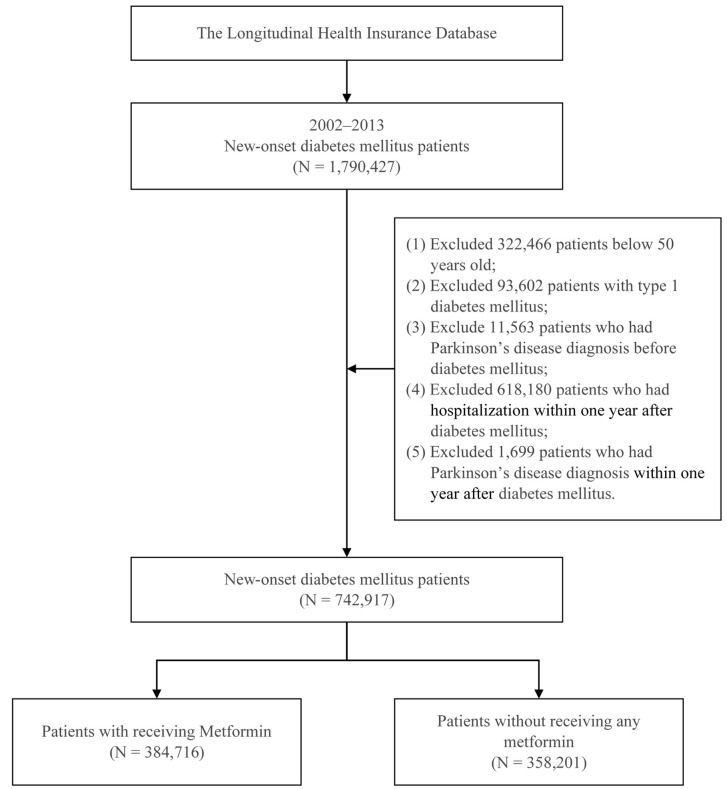
Background. Studies have demonstrated that patients with diabetes mellitus who receive metformin have a lower risk of developing Parkinson’s disease (PD). However, studies have also suggested that metformin may increase the risk of PD. In this study, we investigated whether metformin use was associated with the risk of PD in type 2 diabetes mellitus (T2DM). Methods. In this population-based cross-sectional study, patients with T2DM diagnosed between 2001 and 2018 were enrolled. We categorized these patients as metformin users or nonusers. Participants below 50 years old were excluded. Two models were employed to evaluate the associations of metformin exposure and use intensity with PD after 3 and 5 years of follow-up. Results. Patients with T2DM who received <300 cumulative defined daily doses (cDDD) of metformin and those with metformin use intensity of <10 DDD/month had respective odds ratios (ORs) for PD of 0.88 (95% confidence interval [CI] = 0.83−0.94) and 0.87 (95% CI = 0.81−0.93) in a 3-year follow-up. In a 5-year follow-up, such patients had respective ORs for PD of 0.94 (95% CI = 0.90−0.98) and 0.93 (95% CI = 0.89−0.98). Patients with T2DM who received ≥300 cDDD of metformin or used metformin with intensity of ≥10 DDD/month experienced no neuroprotective effects after 3 or 5 years. Conclusions. Metformin was associated with PD odds in T2DM in a dose−response association manner. Patients who received low dosage and intensity of metformin use were associated with lower odds of PD, while higher dosage and intensity of metformin use had no neuroprotective effect.
背景。研究表明,接受二甲双胍治疗的糖尿病患者患帕金森病(PD)的风险较低。然而,研究也表明二甲双胍可能会增加患PD的风险。在本研究中,我们调查了在2型糖尿病(T2DM)中使用二甲双胍是否与患PD的风险相关。方法。在这项基于人群的横断面研究中,纳入了2001年至2018年期间诊断为T2DM的患者。我们将这些患者分为二甲双胍使用者和非使用者。排除50岁以下的参与者。采用两种模型评估随访3年和5年后二甲双胍暴露和使用强度与PD的关联。结果。在3年随访中,接受二甲双胍累积限定日剂量(cDDD)<300的T2DM患者和二甲双胍使用强度<10 DDD/月的患者患PD的比值比(OR)分别为0.88(95%置信区间[CI]=0.83−0.94)和0.87(95%CI=0.81−0.93)。在5年随访中,此类患者患PD的OR分别为0.94(95%CI=0.90−0.98)和0.93(95%CI=0.89−0.98)。接受二甲双胍cDDD≥300或使用二甲双胍强度≥10 DDD/月的T2DM患者在3年或5年后未出现神经保护作用。结论。二甲双胍与T2DM中PD的比值呈剂量反应关联。接受低剂量和低强度二甲双胍治疗的患者患PD的几率较低,而高剂量和高强度二甲双胍治疗则没有神经保护作用。