Sukhova Ekaterina, Yudina Lyubov, Kior Anastasiia, Kior Dmitry, Popova Alyona, Zolin Yuriy, Gromova Ekaterina, Sukhov Vladimir
Department of Biophysics, N.I. Lobachevsky State University of Nizhny Novgorod, 603950 Nizhny Novgorod, Russia.
Plants (Basel). 2022 May 14;11(10):1308. doi: 10.3390/plants11101308.
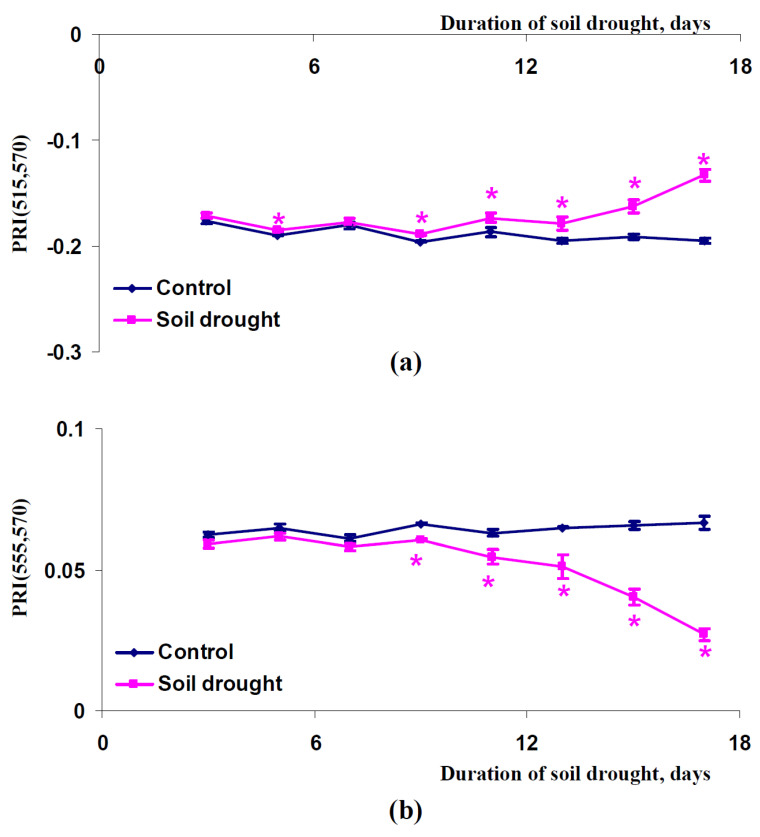
In environmental conditions, plants can be affected by the action of numerous abiotic stressors. These stressors can induce both damage of physiological processes and adaptive changes including signaling-based changes. Development of optical methods of revealing influence of stressors on plants is an important task for plant investigations. The photochemical reflectance index (PRI) based on plant reflectance at 531 nm (measuring wavelength) and 570 nm (reference wavelength) can be effective tool of revealing plant stress changes (mainly, photosynthetic changes); however, its efficiency is strongly varied at different conditions. Earlier, we proposed series of modified PRIs with moderate shifts of the measuring wavelength and showed that these indices can be effective for revealing photosynthetic changes under fluctuations in light intensity. The current work was devoted to the analysis of sensitivity of these modified PRIs to action of drought and short-term heat stress. Investigation of spatially-fixed leaves of pea plants showed that the modified PRI with the shorter measuring wavelength (515 nm) was increased under response of drought and heat; by contrast, the modified PRI with the longer wavelength (555 nm) was decreased under response to these stressors. Changes of investigated indices could be related to parameters of photosynthetic light reactions; however, these relations were stronger for the modified PRI with the 555 nm measuring wavelength. Investigation of canopy of pea (vegetation room) and wheat (vegetation room and open-ground) supported these results. Thus, moderate changes in the measuring wavelengths of PRI can strongly modify the efficiency of their use for the estimation of plant physiological changes (mainly photosynthetic changes) under action of stressors. It is probable that the modified PRI with the 555 nm measuring wavelength (or similar indices) can be an effective tool for revealing photosynthetic changes induced by stressors.
在环境条件下,植物会受到多种非生物胁迫因素的影响。这些胁迫因素既能诱导生理过程的损伤,也能引发适应性变化,包括基于信号传导的变化。开发揭示胁迫因素对植物影响的光学方法是植物研究的一项重要任务。基于植物在531纳米(测量波长)和570纳米(参考波长)处反射率的光化学反射指数(PRI),可以成为揭示植物胁迫变化(主要是光合变化)的有效工具;然而,其在不同条件下的效率差异很大。此前,我们提出了一系列测量波长有适度偏移的改进型PRI,并表明这些指数对于揭示光强波动下的光合变化是有效的。当前的工作致力于分析这些改进型PRI对干旱和短期热胁迫作用的敏感性。对豌豆植株固定叶片的研究表明,测量波长较短(515纳米)的改进型PRI在干旱和热胁迫响应下会增加;相比之下,测量波长较长(555纳米)的改进型PRI在对这些胁迫因素的响应下会降低。所研究指数的变化可能与光合光反应参数有关;然而,对于测量波长为555纳米的改进型PRI,这些关系更为显著。对豌豆(植被室)和小麦(植被室和露天场地)冠层的研究支持了这些结果。因此,PRI测量波长的适度变化会强烈改变其用于评估胁迫因素作用下植物生理变化(主要是光合变化)的效率。测量波长为555纳米的改进型PRI(或类似指数)很可能是揭示胁迫因素诱导的光合变化的有效工具。