• 文献检索
  • 文档翻译
  • 深度研究
  • 学术资讯
  • Suppr Zotero 插件Zotero 插件
  • 邀请有礼
  • 套餐&价格
  • 历史记录
应用&插件
Suppr Zotero 插件Zotero 插件浏览器插件Mac 客户端Windows 客户端微信小程序
定价
高级版会员购买积分包购买API积分包
服务
文献检索文档翻译深度研究API 文档MCP 服务
关于我们
关于 Suppr公司介绍联系我们用户协议隐私条款
关注我们

Suppr 超能文献

核心技术专利:CN118964589B侵权必究
粤ICP备2023148730 号-1Suppr @ 2026

文献检索

告别复杂PubMed语法,用中文像聊天一样搜索,搜遍4000万医学文献。AI智能推荐,让科研检索更轻松。

立即免费搜索

文件翻译

保留排版,准确专业,支持PDF/Word/PPT等文件格式,支持 12+语言互译。

免费翻译文档

深度研究

AI帮你快速写综述,25分钟生成高质量综述,智能提取关键信息,辅助科研写作。

立即免费体验

基于近景图像的棉花铃分割与计数的有监督和弱监督深度学习方法

Supervised and Weakly Supervised Deep Learning for Segmentation and Counting of Cotton Bolls Using Proximal Imagery.

机构信息

Institute of Artificial Intelligence, University of Georgia, Athens, GA 30602, USA.

Bio-Sensing and Instrumentation Laboratory, College of Engineering, University of Georgia, Athens, GA 30602, USA.

出版信息

Sensors (Basel). 2022 May 12;22(10):3688. doi: 10.3390/s22103688.

DOI:10.3390/s22103688
PMID:35632096
原文链接:https://pmc.ncbi.nlm.nih.gov/articles/PMC9147286/
Abstract

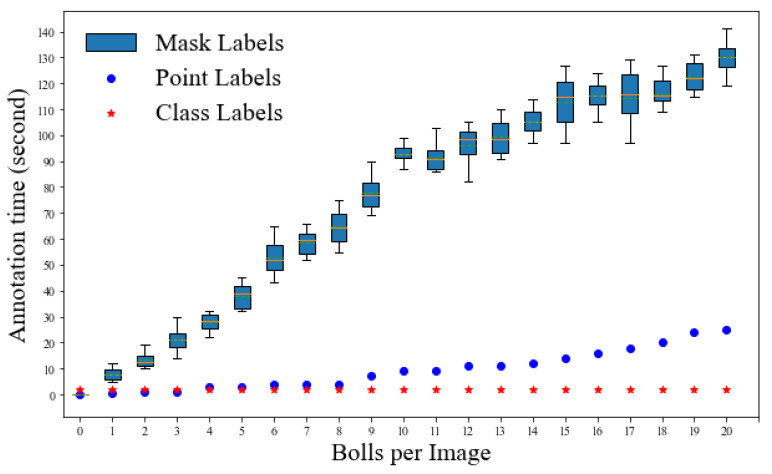
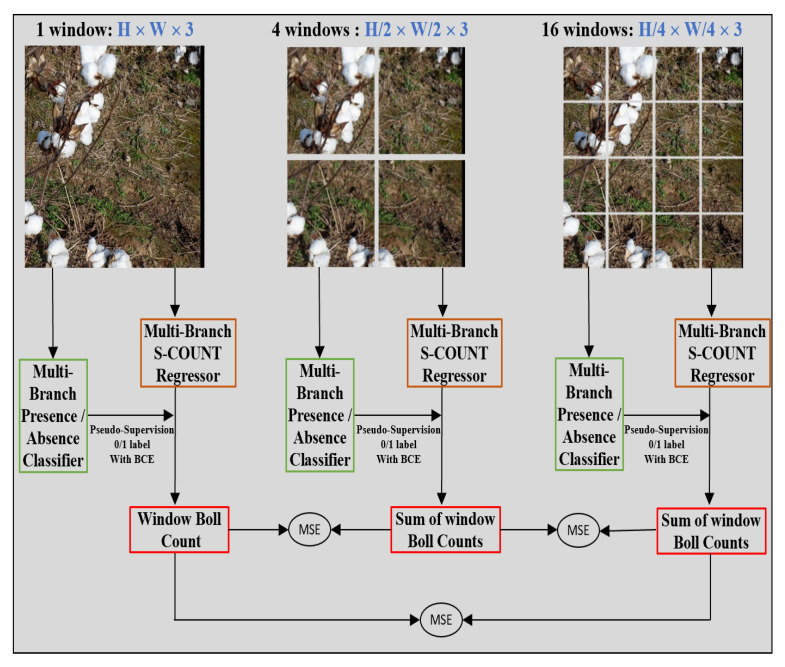
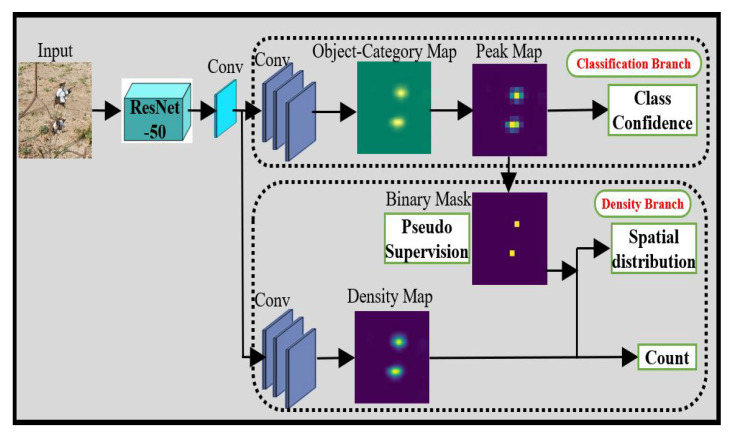
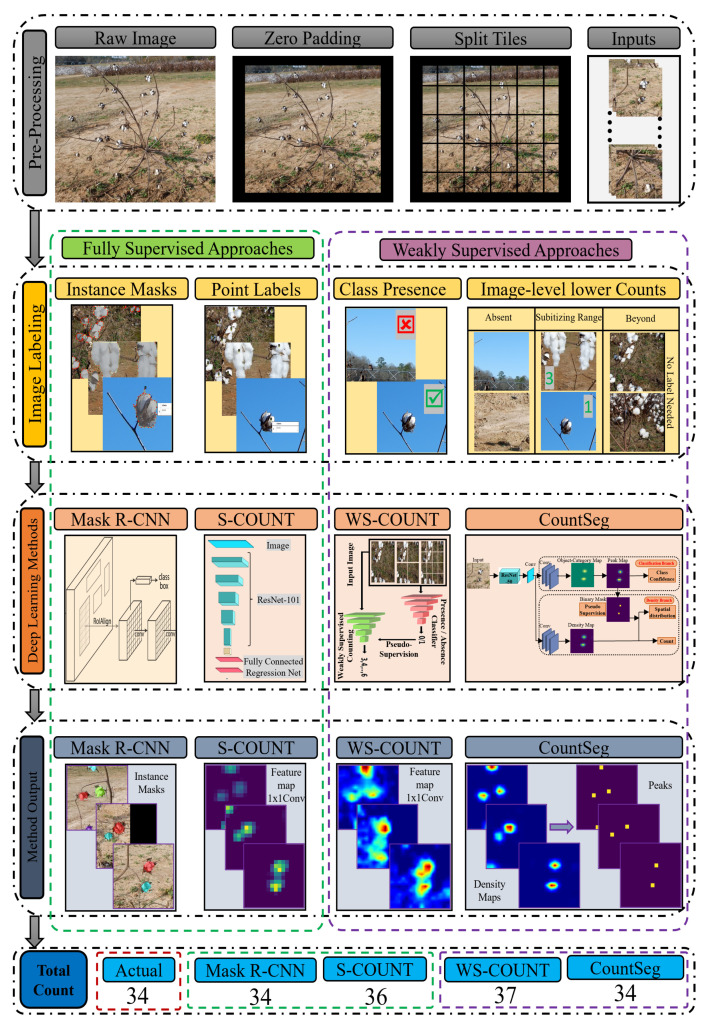
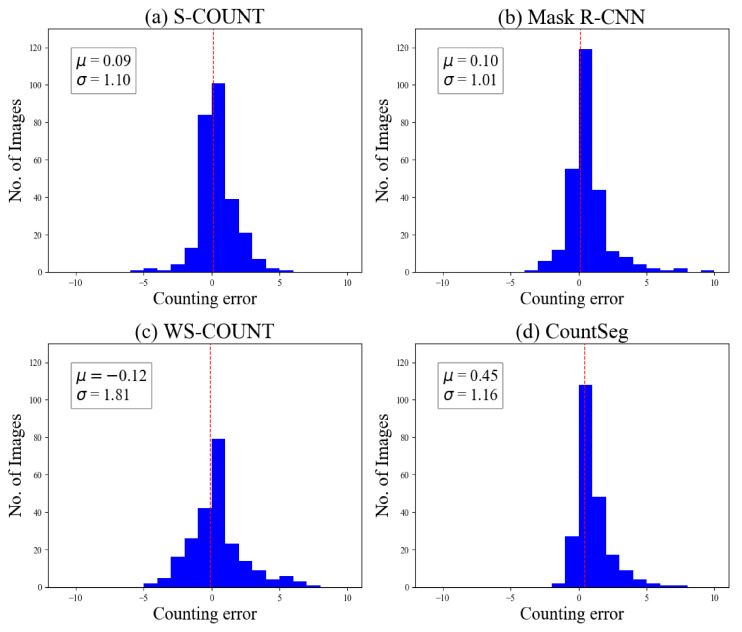
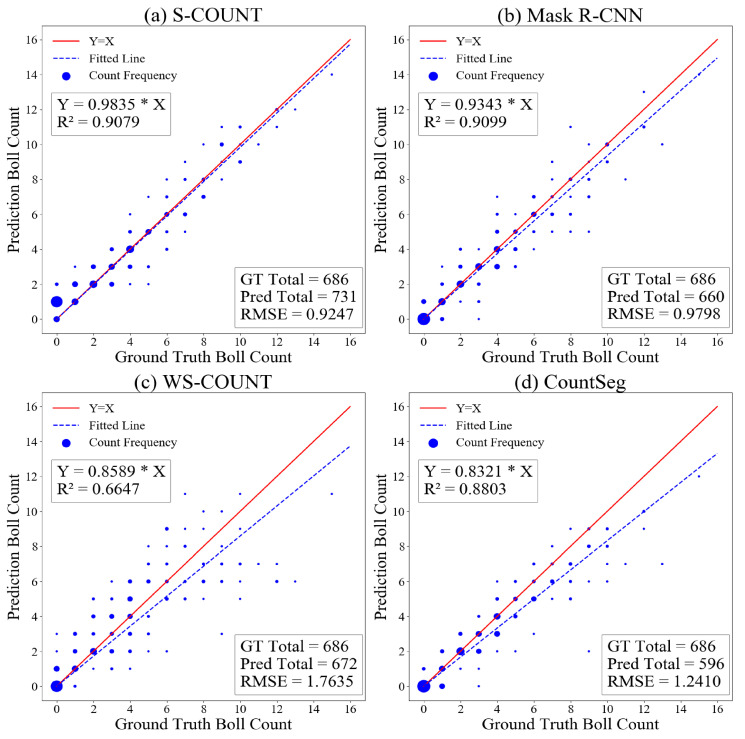
The total boll count from a plant is one of the most important phenotypic traits for cotton breeding and is also an important factor for growers to estimate the final yield. With the recent advances in deep learning, many supervised learning approaches have been implemented to perform phenotypic trait measurement from images for various crops, but few studies have been conducted to count cotton bolls from field images. Supervised learning models require a vast number of annotated images for training, which has become a bottleneck for machine learning model development. The goal of this study is to develop both fully supervised and weakly supervised deep learning models to segment and count cotton bolls from proximal imagery. A total of 290 RGB images of cotton plants from both potted (indoor and outdoor) and in-field settings were taken by consumer-grade cameras and the raw images were divided into 4350 image tiles for further model training and testing. Two supervised models (Mask R-CNN and S-Count) and two weakly supervised approaches (WS-Count and CountSeg) were compared in terms of boll count accuracy and annotation costs. The results revealed that the weakly supervised counting approaches performed well with RMSE values of 1.826 and 1.284 for WS-Count and CountSeg, respectively, whereas the fully supervised models achieve RMSE values of 1.181 and 1.175 for S-Count and Mask R-CNN, respectively, when the number of bolls in an image patch is less than 10. In terms of data annotation costs, the weakly supervised approaches were at least 10 times more cost efficient than the supervised approach for boll counting. In the future, the deep learning models developed in this study can be extended to other plant organs, such as main stalks, nodes, and primary and secondary branches. Both the supervised and weakly supervised deep learning models for boll counting with low-cost RGB images can be used by cotton breeders, physiologists, and growers alike to improve crop breeding and yield estimation.

摘要

总铃数是棉花育种中最重要的表型性状之一,也是种植者估计最终产量的重要因素。随着深度学习的最新进展,许多监督学习方法已经被用于从各种作物的图像中进行表型性状测量,但很少有研究致力于从田间图像中计数棉花铃。监督学习模型需要大量标注的图像进行训练,这已成为机器学习模型开发的瓶颈。本研究的目的是开发完全监督和弱监督的深度学习模型,以从近景图像中分割和计数棉花铃。通过消费级相机共拍摄了 290 张盆栽(室内和室外)和田间环境下棉花植株的 RGB 图像,原始图像被分为 4350 个图像块,用于进一步的模型训练和测试。在棉花铃计数精度和标注成本方面,比较了两种监督模型(Mask R-CNN 和 S-Count)和两种弱监督方法(WS-Count 和 CountSeg)。结果表明,弱监督计数方法表现良好,WS-Count 和 CountSeg 的 RMSE 值分别为 1.826 和 1.284,而完全监督模型的 RMSE 值分别为 1.181 和 1.175,当图像块中的棉花铃数量少于 10 个时。在数据标注成本方面,弱监督方法比监督方法在棉花铃计数方面至少节省 10 倍的成本。在未来,本研究开发的深度学习模型可以扩展到其他植物器官,如主茎、节点以及一级和二级分支。棉花育种者、生理学家和种植者都可以使用低成本的 RGB 图像进行监督和弱监督的棉花铃计数深度学习模型,以改进作物育种和产量估计。
https://cdn.ncbi.nlm.nih.gov/pmc/blobs/9b9b/9147286/8bdbed6ab7fe/sensors-22-03688-g008.jpg
https://cdn.ncbi.nlm.nih.gov/pmc/blobs/9b9b/9147286/630656d1c318/sensors-22-03688-g001.jpg
https://cdn.ncbi.nlm.nih.gov/pmc/blobs/9b9b/9147286/1dc67ce5f13e/sensors-22-03688-g002.jpg
https://cdn.ncbi.nlm.nih.gov/pmc/blobs/9b9b/9147286/0e2dc1200153/sensors-22-03688-g003.jpg
https://cdn.ncbi.nlm.nih.gov/pmc/blobs/9b9b/9147286/223a9dd0cd0d/sensors-22-03688-g004.jpg
https://cdn.ncbi.nlm.nih.gov/pmc/blobs/9b9b/9147286/cd98109c7d99/sensors-22-03688-g005.jpg
https://cdn.ncbi.nlm.nih.gov/pmc/blobs/9b9b/9147286/a6993aa419db/sensors-22-03688-g006.jpg
https://cdn.ncbi.nlm.nih.gov/pmc/blobs/9b9b/9147286/08ce07aa5bcd/sensors-22-03688-g007.jpg
https://cdn.ncbi.nlm.nih.gov/pmc/blobs/9b9b/9147286/8bdbed6ab7fe/sensors-22-03688-g008.jpg
https://cdn.ncbi.nlm.nih.gov/pmc/blobs/9b9b/9147286/630656d1c318/sensors-22-03688-g001.jpg
https://cdn.ncbi.nlm.nih.gov/pmc/blobs/9b9b/9147286/1dc67ce5f13e/sensors-22-03688-g002.jpg
https://cdn.ncbi.nlm.nih.gov/pmc/blobs/9b9b/9147286/0e2dc1200153/sensors-22-03688-g003.jpg
https://cdn.ncbi.nlm.nih.gov/pmc/blobs/9b9b/9147286/223a9dd0cd0d/sensors-22-03688-g004.jpg
https://cdn.ncbi.nlm.nih.gov/pmc/blobs/9b9b/9147286/cd98109c7d99/sensors-22-03688-g005.jpg
https://cdn.ncbi.nlm.nih.gov/pmc/blobs/9b9b/9147286/a6993aa419db/sensors-22-03688-g006.jpg
https://cdn.ncbi.nlm.nih.gov/pmc/blobs/9b9b/9147286/08ce07aa5bcd/sensors-22-03688-g007.jpg
https://cdn.ncbi.nlm.nih.gov/pmc/blobs/9b9b/9147286/8bdbed6ab7fe/sensors-22-03688-g008.jpg

相似文献

1
Supervised and Weakly Supervised Deep Learning for Segmentation and Counting of Cotton Bolls Using Proximal Imagery.基于近景图像的棉花铃分割与计数的有监督和弱监督深度学习方法
Sensors (Basel). 2022 May 12;22(10):3688. doi: 10.3390/s22103688.
2
A Weakly Supervised Deep Learning Framework for Sorghum Head Detection and Counting.一种用于高粱穗检测与计数的弱监督深度学习框架。
Plant Phenomics. 2019 Jun 27;2019:1525874. doi: 10.34133/2019/1525874. eCollection 2019.
3
Combining ability analysis for within-boll yield components in upland cotton (Gossypium hirsutum L.).陆地棉(陆地棉)棉铃内产量构成因素的配合力分析。
Genet Mol Res. 2012 Aug 24;11(3):2790-800. doi: 10.4238/2012.August.24.4.
4
[Effect of seedling stage shading on cotton yield and its quality formation].苗期遮光对棉花产量及其品质形成的影响
Ying Yong Sheng Tai Xue Bao. 2002 Aug;13(8):997-1000.
5
Verde plant bug (Hemiptera: Miridae) feeding injury to cotton bolls characterized by boll age, size, and damage ratings.绿叶盲蝽(半翅目:盲蝽科)对棉铃的取食损伤特征与棉铃的年龄、大小和损伤程度有关。
J Econ Entomol. 2013 Feb;106(1):189-95. doi: 10.1603/ec12018.
6
Oviposition on and mining in bolls of Bt and non-Bt cotton by resistant and susceptible pink bollworm (Lepidoptera: Gelechiidae).抗性和敏感棉红铃虫(鳞翅目:麦蛾科)在转Bt基因棉花和非转Bt基因棉花棉铃上的产卵及蛀食情况
J Econ Entomol. 2002 Feb;95(1):143-8. doi: 10.1603/0022-0493-95.1.143.
7
SpikeSegNet-a deep learning approach utilizing encoder-decoder network with hourglass for spike segmentation and counting in wheat plant from visual imaging.SpikeSegNet——一种利用带有沙漏结构的编码器-解码器网络进行小麦植株视觉成像中穗分割和计数的深度学习方法。
Plant Methods. 2020 Mar 18;16:40. doi: 10.1186/s13007-020-00582-9. eCollection 2020.
8
YOLO SSPD: a small target cotton boll detection model during the boll-spitting period based on space-to-depth convolution.YOLO SSPD:一种基于空间到深度卷积的吐絮期棉花小棉铃检测模型。
Front Plant Sci. 2024 Jun 20;15:1409194. doi: 10.3389/fpls.2024.1409194. eCollection 2024.
9
Use of synthetic images for training a deep learning model for weed detection and biomass estimation in cotton.利用合成图像训练棉花杂草检测和生物量估计的深度学习模型。
Sci Rep. 2022 Nov 15;12(1):19580. doi: 10.1038/s41598-022-23399-z.
10
Detection and analysis of wheat spikes using Convolutional Neural Networks.使用卷积神经网络对小麦穗进行检测与分析。
Plant Methods. 2018 Nov 15;14:100. doi: 10.1186/s13007-018-0366-8. eCollection 2018.

引用本文的文献

1
The pipelines of deep learning-based plant image processing.基于深度学习的植物图像处理流程。
Quant Plant Biol. 2025 Jul 25;6:e23. doi: 10.1017/qpb.2025.10018. eCollection 2025.
2
Image-based classification of wheat spikes by glume pubescence using convolutional neural networks.基于卷积神经网络利用颖片柔毛对小麦穗进行图像分类
Front Plant Sci. 2024 Jan 12;14:1336192. doi: 10.3389/fpls.2023.1336192. eCollection 2023.
3
Cotton plant part 3D segmentation and architectural trait extraction using point voxel convolutional neural networks.

本文引用的文献

1
Weakly Supervised Object Localization and Detection: A Survey.弱监督目标定位与检测:综述
IEEE Trans Pattern Anal Mach Intell. 2022 Sep;44(9):5866-5885. doi: 10.1109/TPAMI.2021.3074313. Epub 2022 Aug 4.
2
DeepFlower: a deep learning-based approach to characterize flowering patterns of cotton plants in the field.DeepFlower:一种基于深度学习的方法,用于表征田间棉花植株的开花模式。
Plant Methods. 2020 Dec 7;16(1):156. doi: 10.1186/s13007-020-00698-y.
3
Convolutional Neural Networks for Image-Based High-Throughput Plant Phenotyping: A Review.
利用点体素卷积神经网络进行棉花植株部分的三维分割和结构特征提取。
Plant Methods. 2023 Mar 30;19(1):33. doi: 10.1186/s13007-023-00996-1.
4
Learning with Weak Annotations for Robust Maritime Obstacle Detection.基于弱标注的稳健航海障碍物检测学习
Sensors (Basel). 2022 Nov 25;22(23):9139. doi: 10.3390/s22239139.
基于图像的高通量植物表型分析的卷积神经网络综述
Plant Phenomics. 2020 Apr 9;2020:4152816. doi: 10.34133/2020/4152816. eCollection 2020.
4
A Weakly Supervised Deep Learning Framework for Sorghum Head Detection and Counting.一种用于高粱穗检测与计数的弱监督深度学习框架。
Plant Phenomics. 2019 Jun 27;2019:1525874. doi: 10.34133/2019/1525874. eCollection 2019.
5
Towards Partial Supervision for Generic Object Counting in Natural Scenes.面向自然场景中通用目标计数的部分监督方法。
IEEE Trans Pattern Anal Mach Intell. 2022 Mar;44(3):1604-1622. doi: 10.1109/TPAMI.2020.3021025. Epub 2022 Feb 3.
6
DeepSeedling: deep convolutional network and Kalman filter for plant seedling detection and counting in the field.深度幼苗检测:用于田间植物幼苗检测与计数的深度卷积网络和卡尔曼滤波器
Plant Methods. 2019 Nov 23;15:141. doi: 10.1186/s13007-019-0528-3. eCollection 2019.
7
Plant Disease Detection and Classification by Deep Learning.基于深度学习的植物病害检测与分类
Plants (Basel). 2019 Oct 31;8(11):468. doi: 10.3390/plants8110468.
8
In-field High Throughput Phenotyping and Cotton Plant Growth Analysis Using LiDAR.利用激光雷达进行田间高通量表型分析及棉花植株生长分析
Front Plant Sci. 2018 Jan 22;9:16. doi: 10.3389/fpls.2018.00016. eCollection 2018.
9
Deep Neural Networks Based Recognition of Plant Diseases by Leaf Image Classification.基于深度神经网络的植物病害叶片图像分类识别
Comput Intell Neurosci. 2016;2016:3289801. doi: 10.1155/2016/3289801. Epub 2016 Jun 22.