Xia Qiang, Liu Qianqian, Denoya Gabriela I, Yang Caijiao, Barba Francisco J, Yu Huaning, Chen Xiaojia
State Key Laboratory of Dairy Biotechnology, Shanghai Engineering Research Center of Dairy Biotechnology, Dairy Research Institute, Bright Dairy & Food Co., Ltd., Shanghai, China.
State Key Laboratory of Quality Research in Chinese Medicine, Institute of Chinese Medical Sciences, University of Macau, Macau, Macau SAR, China.
Front Nutr. 2022 May 11;9:878904. doi: 10.3389/fnut.2022.878904. eCollection 2022.
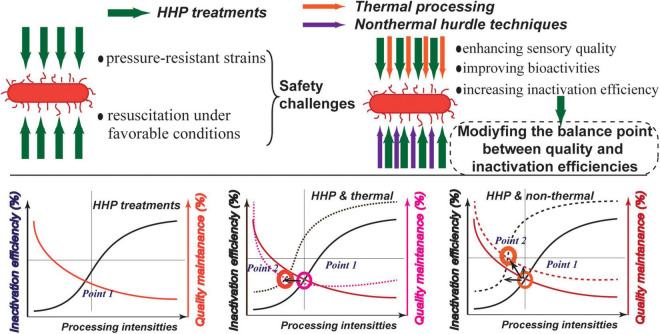
The high demand for fresh-like characteristics of vegetables and fruits (V&F) boosts the industrial implementation of high hydrostatic pressure (HHP), due to its capability to simultaneously maintain original organoleptic characteristics and to achieve preservative effect of the food. However, there remains great challenges for assuring complete microbial inactivation only relying on individual HHP treatments, including pressure-resistant strains and regrowth of injured microbes during the storage process. Traditional HHP-assisted thermal processing may compromise the nutrition and functionalities due to accelerated chemical kinetics under high pressure conditions. This work summarizes the recent advances in HHP-based combination strategies for microbial safety, as exemplified by several emerging non-thermally combined patterns with high inactivation efficiencies. Considerations and requirements about future process design and development of HHP-based combination technologies are also given.
对新鲜蔬菜和水果特性的高需求推动了高静水压(HHP)在工业上的应用,因为它能够同时保持原有的感官特性并实现食品的防腐效果。然而,仅依靠单独的HHP处理来确保微生物完全失活仍然面临巨大挑战,包括耐压菌株以及储存过程中受损微生物的再生长。传统的HHP辅助热处理可能会因高压条件下加速的化学动力学而损害营养和功能。本文总结了基于HHP的微生物安全组合策略的最新进展,以几种具有高灭活效率的新兴非热组合模式为例。还给出了关于未来基于HHP的组合技术工艺设计和开发的考虑因素及要求。