Guangzhou Institute of Traumatic Surgery, Guangzhou Red Cross Hospital, Jinan University, Guangzhou, China.
Department of Neurology, Guangzhou Red Cross Hospital, Jinan University, Guangzhou, China.
Front Endocrinol (Lausanne). 2022 May 12;13:873662. doi: 10.3389/fendo.2022.873662. eCollection 2022.
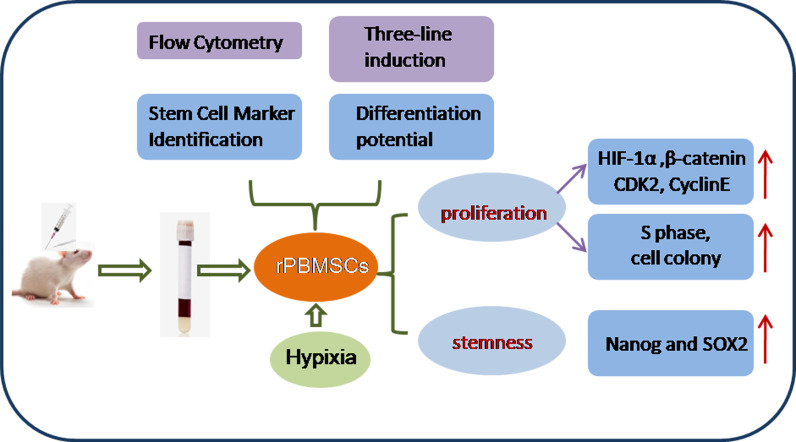
This study aimed to address the dilemma of low peripheral blood-derived mesenchymal stromal cell (PBMSC) activity and reduced phenotype in bone or cartilage tissue engineering. Rat PBMSCs (rPBMSCs) were obtained by density gradient centrifugation, and stromal cell characteristics were confirmed by flow cytometry (FCM) and multi-differentiation potential induction experiments. Cell growth curve, viability experiments, and clone formation experiments were performed by [3-(4,5-dimethylthiazol-2-yl)-5-(3-carboxymethoxyphenyl)-2-(4-sulfophenyl)-2H-tetrazolium] (MTS) and cell counting, and the cell cycle was confirmed by cell FCM. The proliferation signal pathway and stemness-related proteins were detected by molecular methods including Western blot and real-time polymerase chain reaction. , and were highly expressed, and , and were barely expressed in rPBMSCs. rPBMSCs possessed the potential to differentiate into chondrocytes, adipocytes, and osteoblasts under their respective induction conditions. Cell growth curve and viability experiments were performed under hypoxic conditions: 19% O, 5% O, and 1% O. Specifically, 5% O accelerated the proliferation and expression of the stemness of PBMSCs. Cycle experiments proved that hypoxia promoted the cell transition from the G1 phase to the S phase. Molecular experiments confirmed that 5% O hypoxia significantly elevated the expressions of hypoxia-inducible factor 1α and β-catenin and simultaneously the expressions of cycle-related genes including and stemness-related genes including and . The appropriate concentration of hypoxia (i.e., 5% O) enhanced the proliferation and stemness of rPBMSCs and increased the multidirectional differentiation potential of stromal cells. The proposed culture method could improve the viability and maintain the phenotype of rPBMSCs in cartilage or bone tissue engineering.
本研究旨在解决外周血源性间充质基质细胞(PBMSC)活性低和在骨或软骨组织工程中表型减少的难题。通过密度梯度离心法获取大鼠 PBMSCs(rPBMSCs),并通过流式细胞术(FCM)和多向分化潜能诱导实验确认基质细胞特征。通过[3-(4,5-二甲基噻唑-2-基)-5-(3-羧基甲氧基苯基)-2-(4-磺基苯基)-2H-四唑](MTS)和细胞计数进行细胞生长曲线、活力实验和克隆形成实验,通过细胞 FCM 确认细胞周期。通过分子方法包括 Western blot 和实时聚合酶链反应检测增殖信号通路和干细胞相关蛋白。结果显示,rPBMSCs 中高表达、几乎不表达。rPBMSCs 在各自的诱导条件下具有分化为软骨细胞、脂肪细胞和成骨细胞的潜能。在低氧条件下(19% O、5% O 和 1% O)进行细胞生长曲线和活力实验。具体来说,5% O 加速了 PBMSCs 的增殖和干性表达。周期实验证明,低氧促进了细胞从 G1 期向 S 期的过渡。分子实验证实,5% O 低氧显著上调了缺氧诱导因子 1α 和 β-连环蛋白的表达,同时上调了周期相关基因如和干细胞相关基因如和。适当的低氧浓度(即 5% O)增强了 rPBMSCs 的增殖和干性,并增加了基质细胞的多向分化潜能。所提出的培养方法可以提高 rPBMSCs 在软骨或骨组织工程中的活力并维持其表型。