General Practice Clinical Unit, The University of Queensland, Brisbane, QLD 4006, Australia.
School of Medicine and Public Health, University of Newcastle, Callaghan, NSW, Australia.
Fam Pract. 2022 Nov 22;39(6):1063-1069. doi: 10.1093/fampra/cmac052.
Most antibiotic prescribing for upper respiratory tract infections (URTIs) and acute bronchitis is inappropriate. Substantive and sustained reductions in prescribing are needed to reduce antibiotic resistance. Prescribing habits develop early in clinicians' careers. Hence, general practice (GP) trainees are an important group to target.
We aimed to establish temporal trends in antibiotic prescribing for URTIs and acute bronchitis/bronchiolitis by Australian GP trainees (registrars).
A longitudinal analysis, 2010-2019, of the Registrars Clinical Encounters in Training (ReCEnT) dataset. In ReCEnT, registrars record clinical and educational content of 60 consecutive consultations, on 3 occasions, 6 monthly. Analyses were of new diagnoses of URTI and acute bronchitis/bronchiolitis, with the outcome variable a systemic antibiotic being prescribed. The independent variable of interest was year of prescribing (modelled as a continuous variable).
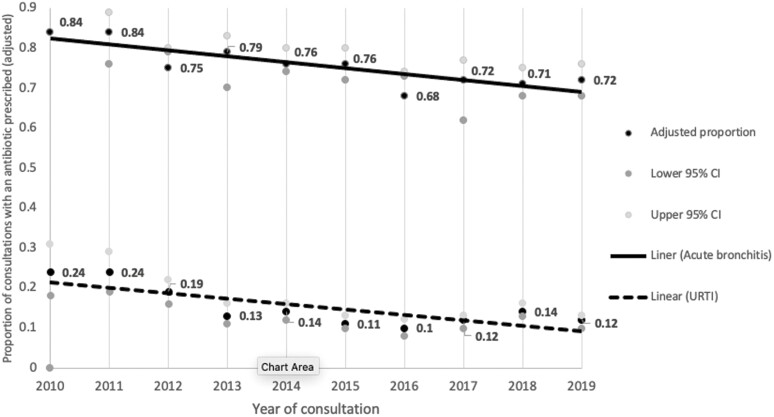
28,372 diagnoses of URTI and 5,289 diagnoses of acute bronchitis/bronchiolitis were recorded by 2,839 registrars. Antibiotic prescribing for URTI decreased from 24% in 2010 to 12% in 2019. Prescribing for acute bronchitis/bronchiolitis decreased from 84% to 72%. "Year" was significantly, negatively associated with antibiotic prescribing for both URTI (odds ratio [OR] 0.90; 95% confidence interval [CI]: 0.88-0.93) and acute bronchitis/bronchiolitis (OR 0.92; 95% CI: 0.88-0.96) on multivariable analysis, with estimates representing the mean annual change.
GP registrars' prescribing for URTI and acute bronchitis/bronchiolitis declined over the 10-year period. Prescribing for acute bronchitis/bronchiolitis, however, remains higher than recommended benchmarks. Continued education and programme-level antibiotic stewardship interventions are required to further reduce registrars' antibiotic prescribing for acute bronchitis/bronchiolitis to appropriate levels.
大多数对上呼吸道感染(URTI)和急性支气管炎的抗生素处方都是不恰当的。需要实质性和持续的减少处方来减少抗生素耐药性。处方习惯在临床医生职业生涯的早期就形成了。因此,全科医生(GP)培训生是一个重要的目标群体。
我们旨在确定澳大利亚 GP 培训生(住院医师)URTI 和急性支气管炎/细支气管炎的抗生素处方的时间趋势。
对 Registrars Clinical Encounters in Training(ReCEnT)数据集进行了 2010 年至 2019 年的纵向分析。在 ReCEnT 中,住院医师记录了 60 次连续就诊的临床和教育内容,每 6 个月记录 3 次。分析了新诊断的 URTI 和急性支气管炎/细支气管炎,结果变量为开了全身抗生素。感兴趣的自变量是开处方的年份(建模为连续变量)。
2839 名住院医师记录了 28372 例 URTI 和 5289 例急性支气管炎/细支气管炎的诊断。URTI 的抗生素处方从 2010 年的 24%下降到 2019 年的 12%。急性支气管炎/细支气管炎的处方从 84%下降到 72%。在多变量分析中,“年份”与 URTI(比值比 [OR] 0.90;95%置信区间 [CI]:0.88-0.93)和急性支气管炎/细支气管炎(OR 0.92;95% CI:0.88-0.96)的抗生素处方均呈显著负相关,估计值代表每年的平均变化。
全科医生住院医师治疗 URTI 和急性支气管炎/细支气管炎的处方在 10 年内有所下降。然而,急性支气管炎/细支气管炎的处方仍然高于推荐的基准。需要持续的教育和以方案为基础的抗生素管理干预措施,以进一步将住院医师治疗急性支气管炎/细支气管炎的抗生素处方减少到适当水平。