Gastroenterology and Endoscopy, IRCCS Ospedale San Raffaele and Vita-Salute San Raffaele University, Milan, Italy.
Department of Biomedical Sciences, Humanitas University, Pieve Emanuele, Milan, Italy.
Inflamm Bowel Dis. 2023 Apr 3;29(4):539-547. doi: 10.1093/ibd/izac110.
Two-thirds of Crohn's disease (CD) patients require surgery during their disease course. However, surgery is not curative, and endoscopic recurrence is observed in up to 90% of cases. Our aim was to investigate the impact of postoperative biological therapy on the incidence of endoscopic recurrence and long-term outcomes in CD patients.
This retrospective cohort study was conducted at the Humanitas Research Hospital-IRCCS (Milan, Italy) between 2014 and 2021. All consecutive CD patients who underwent surgery and colonoscopy at 6-12 months postoperatively were eligible for inclusion.
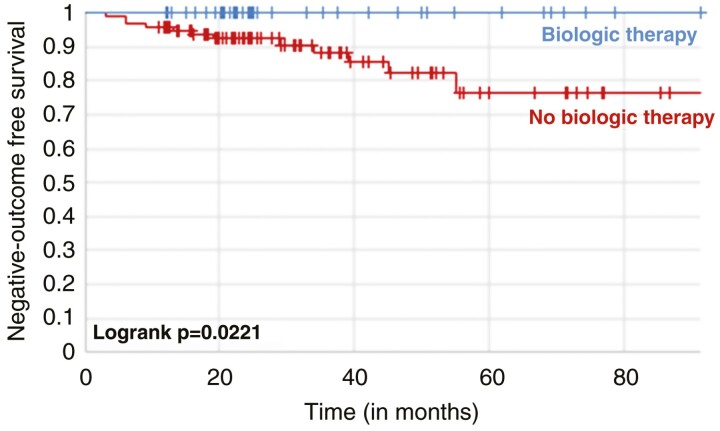
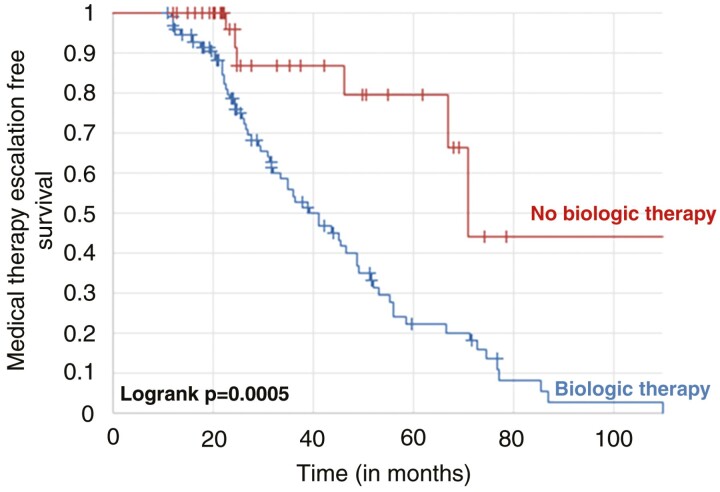
A total of 141 patients were included (42.6% female, mean age 44 years). Median follow-up was 28 months. About one-third of patients were treated with biologics at baseline colonoscopy. A higher rate of endoscopic recurrence was detected in patients without biologic therapy at the time of colonoscopy compared with those treated (80.8% vs 45.2%, P < .0001). Hospitalization and surgery occurred more in untreated patients than in subjects undergoing biological therapy (12.1% vs 0.0%, P = .01). The Kaplan-Meier curves showed that the no treatment group at baseline had a >23.3% 5-year rate of hospitalization and surgery (log-rank P = .0221) and a >49.7% 5-year rate of medical therapy escalation (log-rank P = .0013) compared with the treatment arm. In the logistic regression model, absence of biologic therapy was independently associated with the risk of endoscopic disease recurrence (odds ratio, 0.22; 95% CI, 0.1-0.51; P = .0004).
Operated CD patients treated early with biologics experience decreased rates of endoscopic recurrence and improved long-term outcomes.
三分之二的克罗恩病(CD)患者在疾病过程中需要手术。然而,手术并非根治性的,多达 90%的病例会出现内镜复发。我们的目的是研究术后生物治疗对 CD 患者内镜复发率和长期结局的影响。
本回顾性队列研究于 2014 年至 2021 年在意大利米兰的 Humanitas Research Hospital-IRCCS 进行。所有接受手术并在术后 6-12 个月行结肠镜检查的连续 CD 患者均符合纳入标准。
共纳入 141 例患者(42.6%为女性,平均年龄 44 岁)。中位随访时间为 28 个月。约三分之一的患者在基线结肠镜检查时接受生物治疗。与接受治疗的患者相比,在结肠镜检查时未接受生物治疗的患者内镜复发率更高(80.8%比 45.2%,P<0.0001)。未接受治疗的患者住院和手术的发生率高于接受生物治疗的患者(12.1%比 0.0%,P=0.01)。Kaplan-Meier 曲线显示,基线时未治疗组的 5 年住院和手术发生率>23.3%(对数秩 P=0.0221),5 年药物升级治疗率>49.7%(对数秩 P=0.0013),均高于治疗组。在逻辑回归模型中,未接受生物治疗与内镜疾病复发的风险独立相关(比值比,0.22;95%CI,0.1-0.51;P=0.0004)。
早期接受生物治疗的手术 CD 患者内镜复发率较低,长期结局改善。