Department of Radiation Oncology, University of Pennsylvania, Philadelphia.
Department of Biochemistry and Biophysics, Perelman School of Medicine, and Department of Chemistry, School of Arts and Sciences, University of Pennsylvania, Philadelphia, Pennsylvania.
Radiat Res. 2022 Aug 1;198(2):181-189. doi: 10.1667/RADE-21-00232.1.
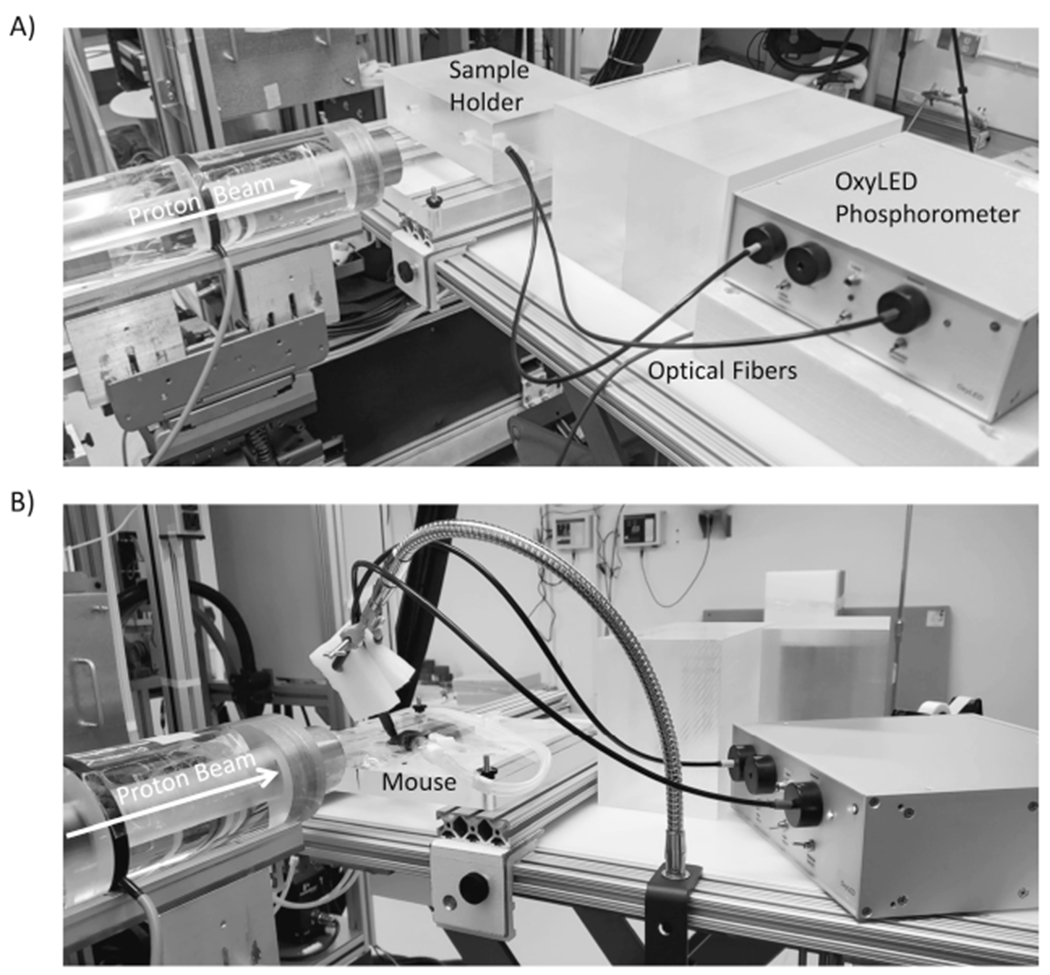
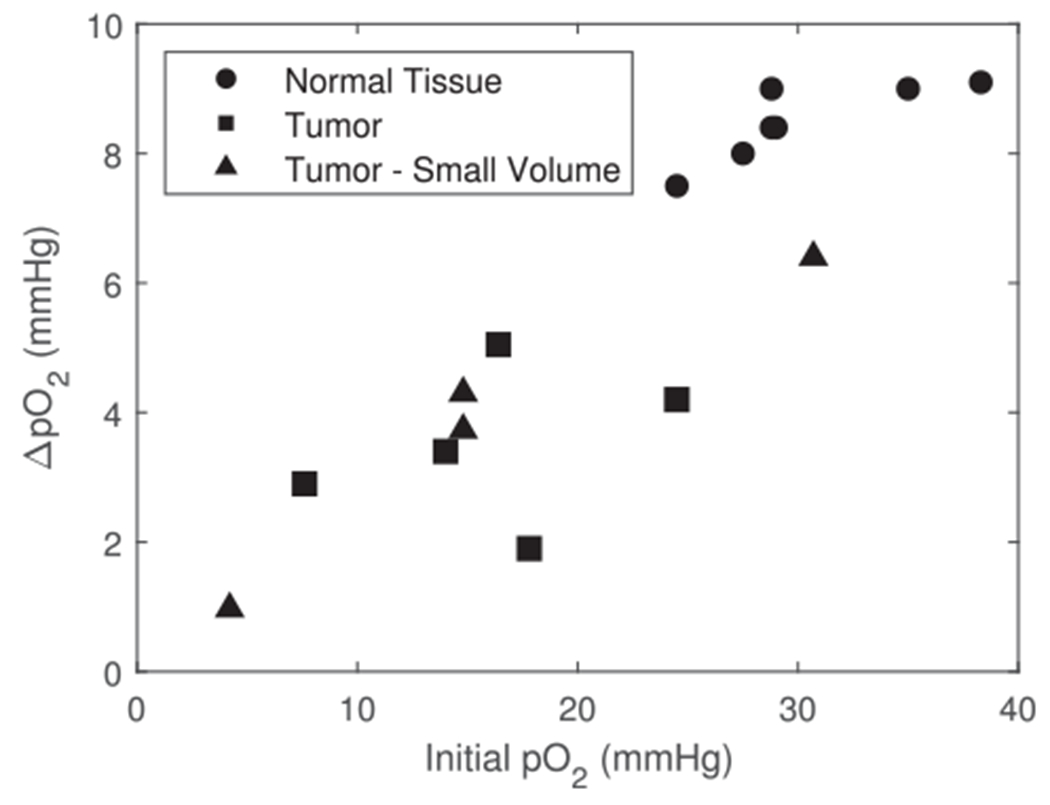
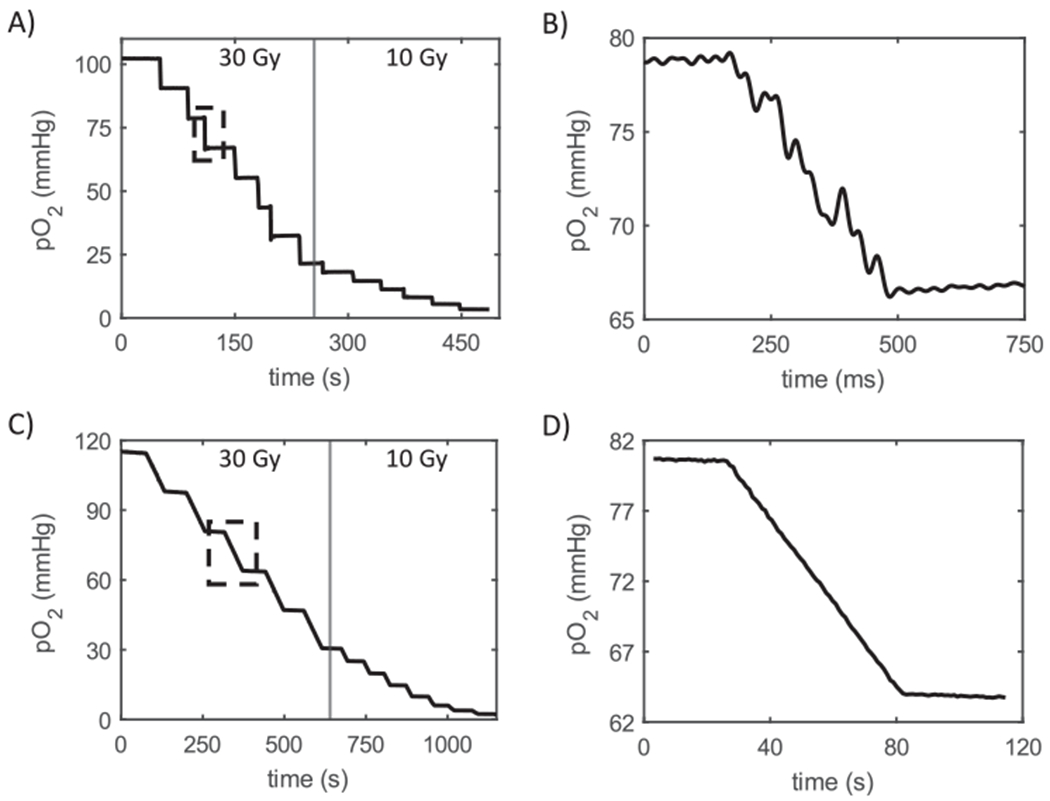
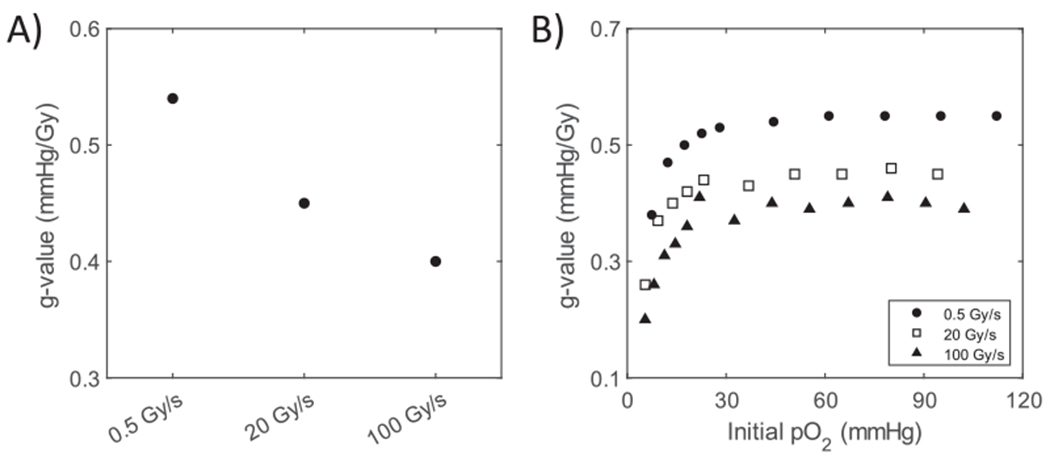
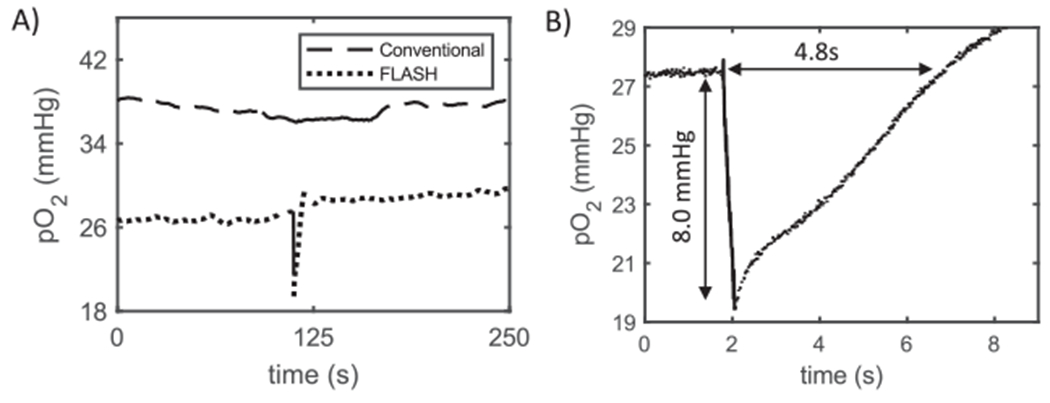
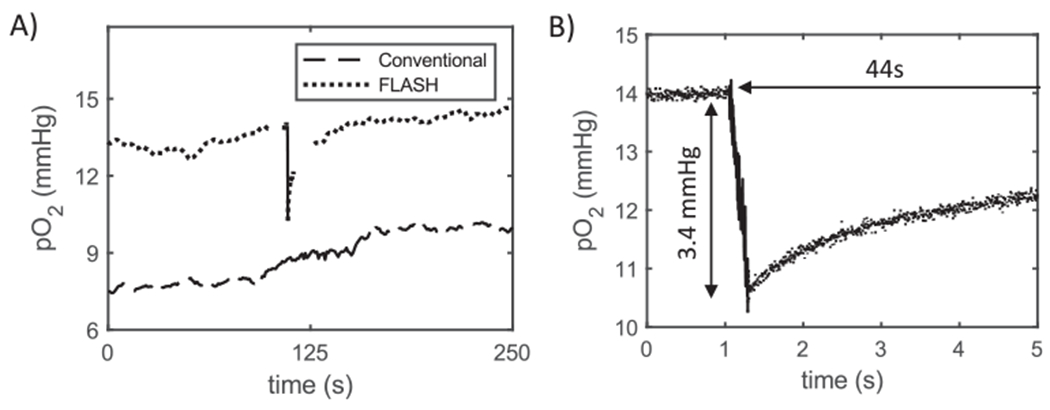
FLASH is a high-dose-rate form of radiation therapy that has the reported ability, compared with conventional dose rates, to spare normal tissues while being equipotent in tumor control, thereby increasing the therapeutic ratio. The mechanism underlying this normal tissue sparing effect is currently unknown, however one possibility is radiochemical oxygen depletion (ROD) during dose delivery in tissue at FLASH dose rates. In order to investigate this possibility, we used the phosphorescence quenching method to measure oxygen partial pressure before, during and after proton radiation delivery in model solutions and in normal muscle and sarcoma tumors in mice, at both conventional (Conv) (∼0.5 Gy/s) and FLASH (∼100 Gy/s) dose rates. Radiation dosimetry was determined by Advanced Markus Chamber and EBT-XL film. For solutions contained in sealed glass vials, phosphorescent probe Oxyphor PtG4 (1 µM) was dissolved in a buffer (10 mM HEPES) containing glycerol (1 M), glucose (5 mM) and glutathione (5 mM), designed to mimic the reducing and free radical-scavenging nature of the intracellular environment. In vivo oxygen measurements were performed 24 h after injection of PtG4 into the interstitial space of either normal thigh muscle or subcutaneous sarcoma tumors in mice. The "g-value" for ROD is reported in mmHg/Gy, which represents a slight modification of the more standard chemical definition (µM/Gy). In solutions, proton irradiation at conventional dose rates resulted in a g-value for ROD of up to 0.55 mmHg/Gy, consistent with earlier studies using X or gamma rays. At FLASH dose rates, the g-value for ROD was ∼25% lower, 0.37 mmHg/Gy. pO2 levels were stable after each dose delivery. For normal muscle in vivo, oxygen depletion during irradiation was counterbalanced by resupply from the vasculature. This process was fast enough to maintain tissue pO2 virtually unchanged at Conv dose rates. However, during FLASH irradiation there was a stepwise decrease in pO2 (g-value ∼0.28 mmHg/Gy), followed by a rebound to the initial level after ∼8 s. The g-values were smaller and recovery times longer in tumor tissue when compared to muscle and may be related to the lower initial endogenous pO2 levels in the former. Considering that the FLASH effect is seen in vivo even at doses as low as 10 Gy, it is difficult to reconcile the amount of protection seen by oxygen depletion alone. However, the phosphorescence probe in our experiments was confined to the extracellular space, and it remains possible that intracellular oxygen depletion was greater than observed herein. In cell-mimicking solutions the oxygen depletion g-vales were indeed significantly higher than observed in vivo.
FLASH 是一种高剂量率的放射治疗形式,据报道,与常规剂量率相比,它在肿瘤控制方面具有等效性的同时,能够保护正常组织,从而提高治疗比率。这种正常组织保护效应的机制目前尚不清楚,但有一种可能性是在 FLASH 剂量率下组织内的放射化学氧耗竭 (ROD)。为了研究这种可能性,我们使用磷光猝灭法在模型溶液中和正常肌肉和肉瘤肿瘤小鼠中,在常规 (Conv)(约 0.5 Gy/s)和 FLASH(约 100 Gy/s)剂量率下,在质子辐射输送前后测量氧分压。辐射剂量学通过高级马库斯室和 EBT-XL 薄膜确定。对于密封在玻璃小瓶中的溶液,将磷光探针 Oxyphor PtG4(1µM)溶解在缓冲液(10 mM HEPES)中,缓冲液中含有甘油(1 M)、葡萄糖(5 mM)和谷胱甘肽(5 mM),旨在模拟细胞内环境的还原和自由基清除特性。在将 PtG4 注射到小鼠的正常大腿肌肉或皮下肉瘤肿瘤的间质空间 24 小时后,进行体内氧测量。ROD 的“g 值”以 mmHg/Gy 报告,这是对更标准的化学定义(µM/Gy)的轻微修改。在溶液中,常规剂量率的质子辐照导致 ROD 的 g 值高达 0.55 mmHg/Gy,与使用 X 射线或伽马射线的早期研究一致。在 FLASH 剂量率下,ROD 的 g 值降低了约 25%,为 0.37 mmHg/Gy。每次剂量输送后,pO2 水平均保持稳定。对于体内正常肌肉,辐照过程中的氧耗竭被血管供应的补充所平衡。这个过程足够快,以至于在 Conv 剂量率下,组织的 pO2 几乎保持不变。然而,在 FLASH 辐照期间,pO2 呈阶跃式下降(g 值约为 0.28 mmHg/Gy),然后在大约 8 秒后反弹至初始水平。与肌肉相比,肿瘤组织中的 g 值较小且恢复时间较长,这可能与前者中较低的初始内源性 pO2 水平有关。考虑到即使在低至 10 Gy 的剂量下也能观察到 FLASH 效应,仅通过氧耗竭来解释观察到的保护量是很困难的。然而,我们实验中的磷光探针仅限于细胞外空间,并且仍然有可能细胞内氧耗竭比这里观察到的更严重。在模拟细胞的溶液中,氧耗竭 g 值确实明显高于体内观察到的值。