Marchione Demian, Mancini Luca, Liang Pengxiao, Vanuzzo Gianmarco, Pirani Fernando, Skouteris Dimitrios, Rosi Marzio, Casavecchia Piergiorgio, Balucani Nadia
Dipartimento di Chimica, Biologia e Biotecnologie, Università degli Studi di Perugia, 06123 Perugia, Italy.
MASTER TEC, 06123 Perugia, Italy.
J Phys Chem A. 2022 Jun 9;126(22):3569-3582. doi: 10.1021/acs.jpca.2c01802. Epub 2022 May 31.
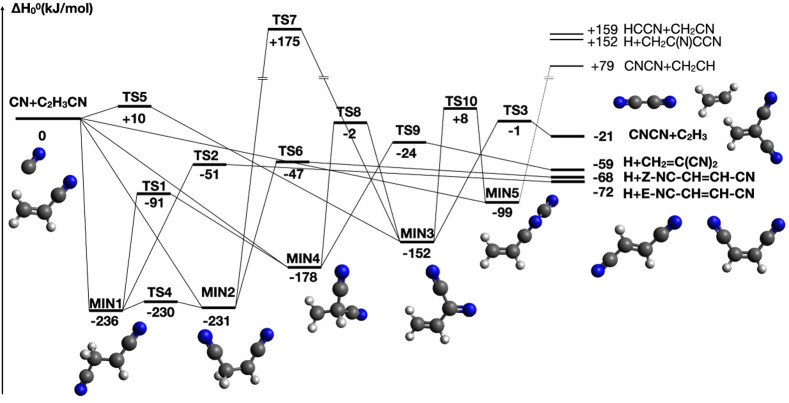
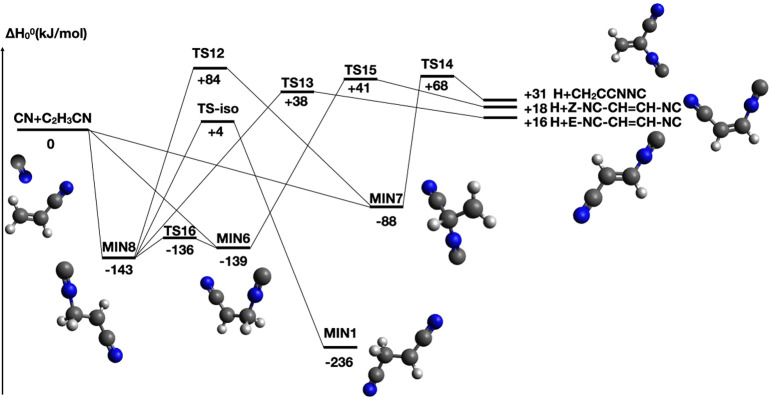
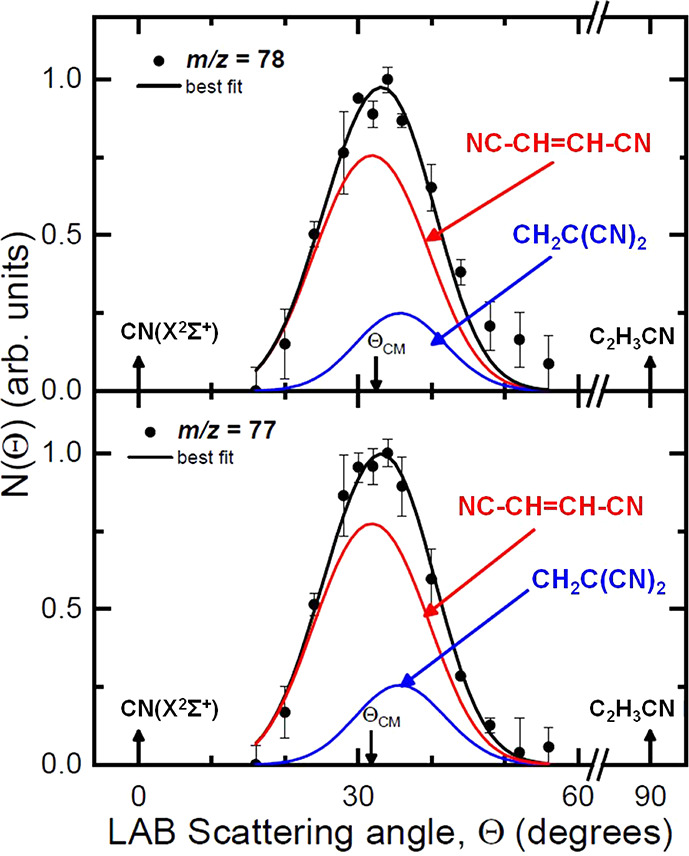
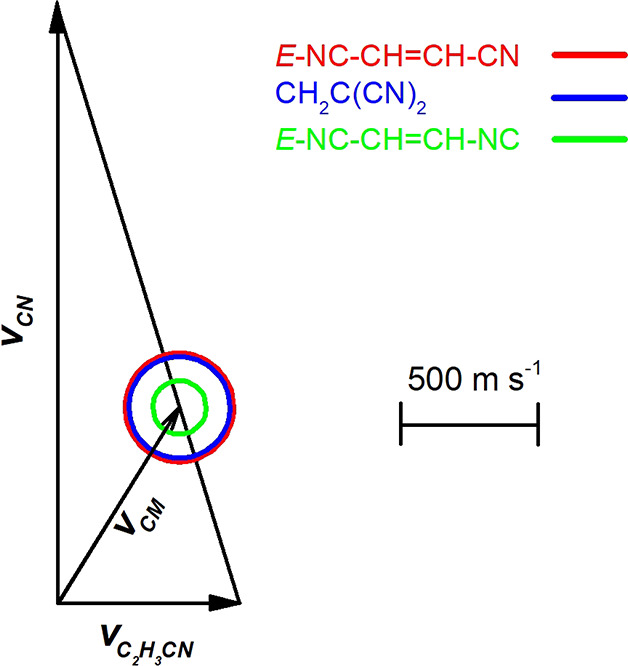
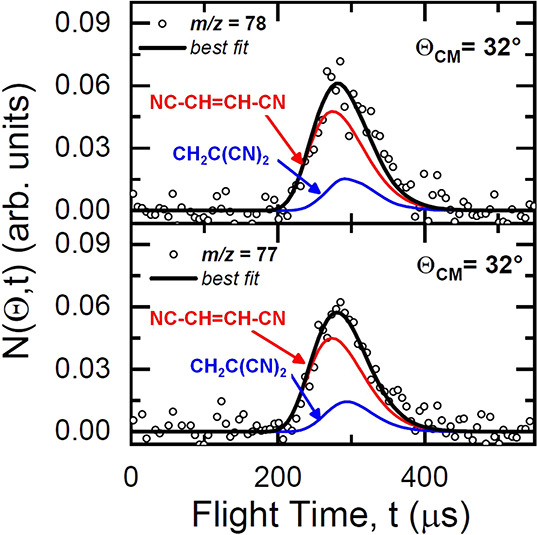
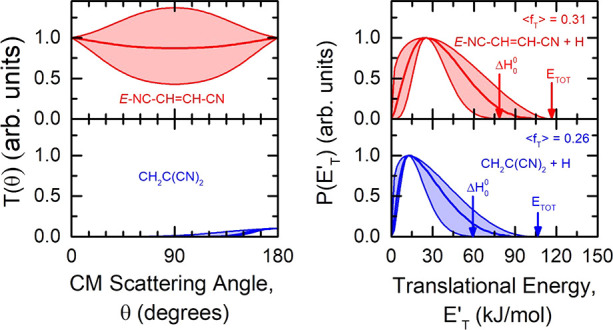
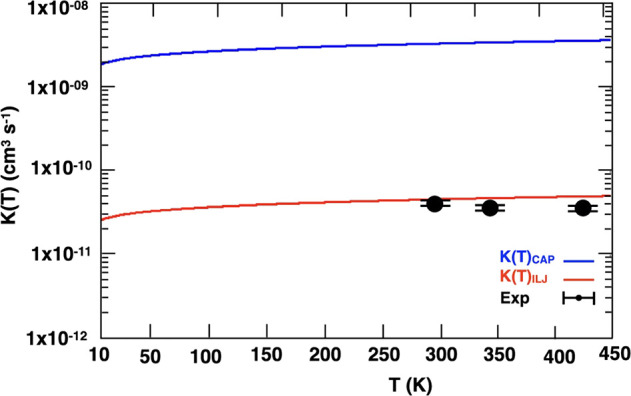
The reaction between cyano radicals (CN, XΣ) and cyanoethene (CHCN) has been investigated by a combined approach coupling crossed molecular beam (CMB) experiments with mass spectrometric detection and time-of-flight analysis at a collision energy of 44.6 kJ mol and electronic structure calculations to determine the relevant potential energy surface. The experimental results can be interpreted by assuming the occurrence of a dominant reaction pathway leading to the two but-2-enedinitrile (1,2-dicyanothene) isomers (- and -NC-CH═CH-CN) in a H-displacement channel and, to a much minor extent, to 1,1-dicyanoethene, CHC(CN). In order to derive the product branching ratios under the conditions of the CMB experiments and at colder temperatures, including those relevant to Titan and to cold interstellar clouds, we have carried out RRKM statistical calculations using the relevant potential energy surface of the investigated reaction. We have also estimated the rate coefficient at very low temperatures by employing a semiempirical method for the treatment of long-range interactions. The reaction has been found to be barrierless and fast also under the low temperature conditions of cold interstellar clouds and the atmosphere of Titan. Astrophysical implications and comparison with literature data are also presented. On the basis of the present work, 1,2-dicyanothene and 1,1-dicyanothene are excellent candidates for the search of dinitriles in the interstellar medium.
通过交叉分子束(CMB)实验与质谱检测及飞行时间分析相结合的方法,在44.6 kJ/mol的碰撞能量下,对氰基自由基(CN,XΣ)与氰乙烯(CHCN)之间的反应进行了研究,并通过电子结构计算来确定相关的势能面。实验结果可以通过假设在一个氢取代通道中存在一条主要反应路径来解释,该路径导致生成两种2-丁烯二腈(1,2-二氰基乙烯)异构体(-和-NC-CH═CH-CN),在较小程度上生成1,1-二氰基乙烯CHC(CN)。为了得出CMB实验条件下以及更低温度(包括与土卫六和冷星际云相关的温度)下的产物分支比,我们利用所研究反应的相关势能面进行了RRKM统计计算。我们还采用一种半经验方法来处理长程相互作用,估算了极低温度下的速率系数。结果发现,在冷星际云和土卫六大气的低温条件下,该反应也是无势垒且快速的。文中还介绍了天体物理学意义以及与文献数据的比较。基于目前的工作,1,2-二氰基乙烯和1,1-二氰基乙烯是在星际介质中搜寻二腈的极佳候选物。