Human Genome Sequencing Center and Department of Molecular and Human Genetics, Baylor College of Medicine, Houston, TX 77030, USA.
Wisconsin National Primate Research Center, University of Wisconsin, 1220 Capitol Court, Madison, WI 53711, USA.
Gigascience. 2022 May 28;11. doi: 10.1093/gigascience/giac039.
The Syrian hamster (Mesocricetus auratus) has been suggested as a useful mammalian model for a variety of diseases and infections, including infection with respiratory viruses such as SARS-CoV-2. The MesAur1.0 genome assembly was generated in 2013 using whole-genome shotgun sequencing with short-read sequence data. Current more advanced sequencing technologies and assembly methods now permit the generation of near-complete genome assemblies with higher quality and greater continuity.
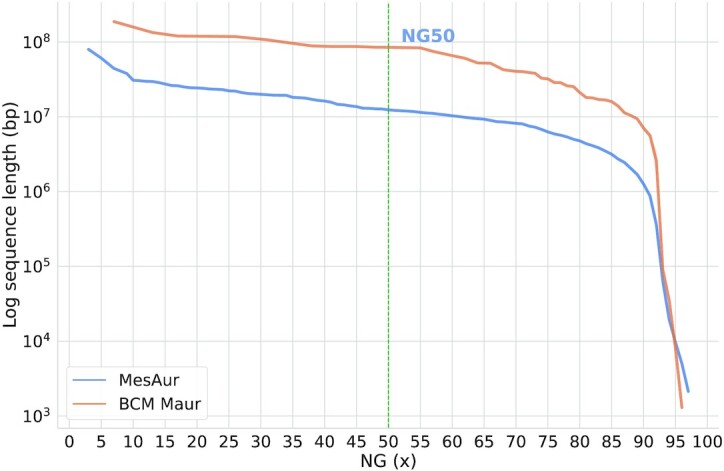
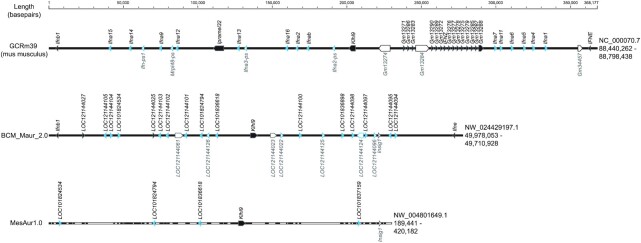
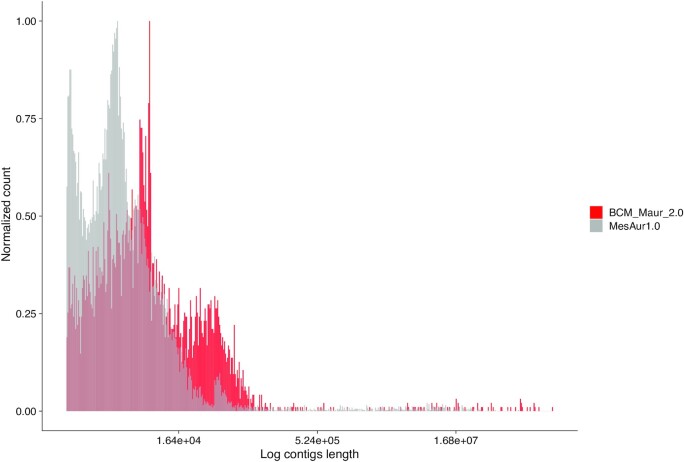
Here, we report an improved assembly of the M. auratus genome (BCM_Maur_2.0) using Oxford Nanopore Technologies long-read sequencing to produce a chromosome-scale assembly. The total length of the new assembly is 2.46 Gb, similar to the 2.50-Gb length of a previous assembly of this genome, MesAur1.0. BCM_Maur_2.0 exhibits significantly improved continuity, with a scaffold N50 that is 6.7 times greater than MesAur1.0. Furthermore, 21,616 protein-coding genes and 10,459 noncoding genes are annotated in BCM_Maur_2.0 compared to 20,495 protein-coding genes and 4,168 noncoding genes in MesAur1.0. This new assembly also improves the unresolved regions as measured by nucleotide ambiguities, where ∼17.11% of bases in MesAur1.0 were unresolved compared to BCM_Maur_2.0, in which the number of unresolved bases is reduced to 3.00%.
Access to a more complete reference genome with improved accuracy and continuity will facilitate more detailed, comprehensive, and meaningful research results for a wide variety of future studies using Syrian hamsters as models.
叙利亚仓鼠(Mesocricetus auratus)已被提议作为多种疾病和感染的有用哺乳动物模型,包括感染 SARS-CoV-2 等呼吸道病毒。MesAur1.0 基因组组装于 2013 年使用全基因组鸟枪法测序和短读序列数据生成。当前更先进的测序技术和组装方法现在允许使用更高质量和更大连续性的近完整基因组组装。
在这里,我们使用 Oxford Nanopore Technologies 长读测序报告了 M. auratus 基因组(BCM_Maur_2.0)的改进组装,以产生染色体规模的组装。新组装的总长度为 2.46Gb,与该基因组的先前组装 MesAur1.0 的 2.50Gb 长度相似。BCM_Maur_2.0 表现出显著改善的连续性,支架 N50 比 MesAur1.0 大 6.7 倍。此外,BCM_Maur_2.0 注释了 21616 个蛋白质编码基因和 10459 个非编码基因,而 MesAur1.0 注释了 20495 个蛋白质编码基因和 4168 个非编码基因。与 MesAur1.0 相比,新组装还改进了核苷酸模糊性测量的未解决区域,其中 MesAur1.0 中有约 17.11%的碱基未解决,而 BCM_Maur_2.0 中未解决的碱基数量减少到 3.00%。
获得具有更高准确性和连续性的更完整参考基因组将促进未来使用叙利亚仓鼠作为模型进行的各种研究的更详细、全面和有意义的研究结果。