Department of Surgery, Charité - Universitätsmedizin Berlin, Corporate Member of Freie Universität Berlin and Humboldt-Universität zu Berlin, Campus Charité Mitte and Campus Virchow-Klinikum, Augustenburger Platz 1, 13353, Berlin, Germany.
Berlin Institute of Health at Charité - Universitätsmedizin Berlin, Charitéplatz 1, 10117, Berlin, Germany.
Surg Endosc. 2022 Aug;36(8):5854-5862. doi: 10.1007/s00464-021-08770-x. Epub 2022 May 31.
While laparoscopic liver surgery has become a standard procedure, experience with robotic liver surgery is still limited. The aim of this prospective study was to evaluate safety and feasibility of robotic liver surgery and compare outcomes with conventional laparoscopy.
We here report the results of a single-center, prospective, post-marketing observational study (DRKS00017229) investigating the safety and feasibility of robotic liver surgery. Baseline characteristics, surgical complexity (using the IWATE score), and postoperative outcomes were then compared to laparoscopic liver resections performed at our center between January 2015 and December 2020. A propensity score-based matching (PSM) was applied to control for selection bias.
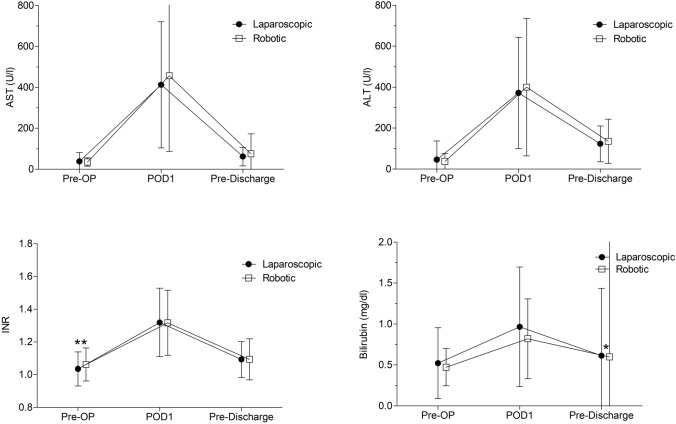
One hundred twenty nine robotic liver resections were performed using the da Vinci Xi surgical system (Intuitive) in this prospective study and were compared to 471 consecutive laparoscopic liver resections. After PSM, both groups comprised 129 cases with similar baseline characteristics and surgical complexity. There were no significant differences in intraoperative variables, such as need for red blood cell transfusion, duration of surgery, or conversion to open surgery. Postoperative complications were comparable after robotic and laparoscopic surgery (Clavien-Dindo ≥ 3a: 23% vs. 19%, p = 0.625); however, there were more bile leakages grade B-C in the robotic group (17% vs. 7%, p = 0.006). Length of stay and oncological short-term outcomes were comparable.
We propose robotic liver resection as a safe and feasible alternative to established laparoscopic techniques. The object of future studies must be to define interventions where robotic techniques are superior to conventional laparoscopy.
虽然腹腔镜肝切除术已成为标准手术,但机器人肝手术的经验仍然有限。本前瞻性研究的目的是评估机器人肝手术的安全性和可行性,并将其结果与传统腹腔镜手术进行比较。
我们在此报告了一项单中心、前瞻性、上市后观察性研究(DRKS00017229)的结果,该研究调查了机器人肝手术的安全性和可行性。然后将基线特征、手术复杂性(使用岩手评分)和术后结果与我们中心 2015 年 1 月至 2020 年 12 月期间进行的腹腔镜肝切除术进行比较。应用倾向评分匹配(PSM)来控制选择偏倚。
在这项前瞻性研究中,我们使用达芬奇 Xi 手术系统(直觉)进行了 129 例机器人肝切除术,并与 471 例连续腹腔镜肝切除术进行了比较。经过 PSM,两组的基线特征和手术复杂性相似,均包括 129 例。术中变量如需要输血、手术时间或转为开放手术等无显著差异。机器人和腹腔镜手术后的并发症相似(Clavien-Dindo≥3a:23%比 19%,p=0.625);然而,机器人组的胆汁漏发生率较高(B-C 级:17%比 7%,p=0.006)。住院时间和肿瘤短期结果相似。
我们提出机器人肝切除术是一种安全可行的替代传统腹腔镜技术的方法。未来的研究必须确定机器人技术优于传统腹腔镜的干预措施。