Department of Computational Biology, St. Jude Children's Research Hospital, MS 1135, Room IA6038, 262 Danny Thomas Place, Memphis, TN, 38105, USA.
Department of Computer Science, Princeton University, Princeton, NJ, 08540, USA.
Acta Neuropathol Commun. 2022 May 31;10(1):80. doi: 10.1186/s40478-022-01381-0.
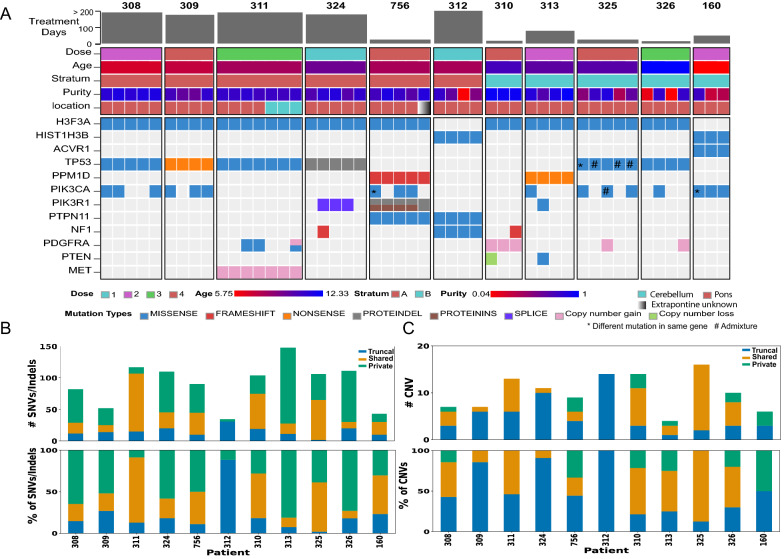
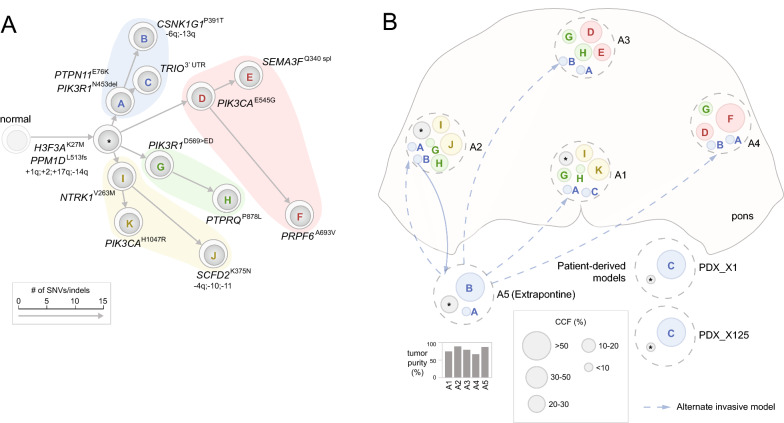
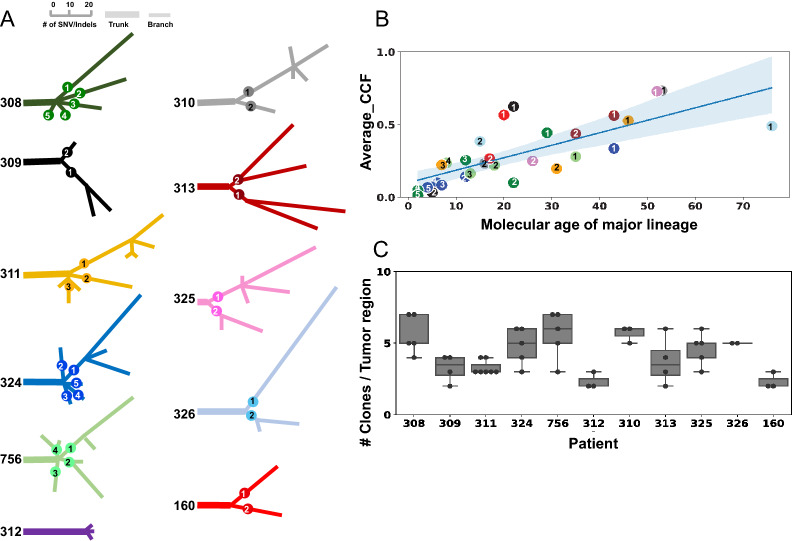
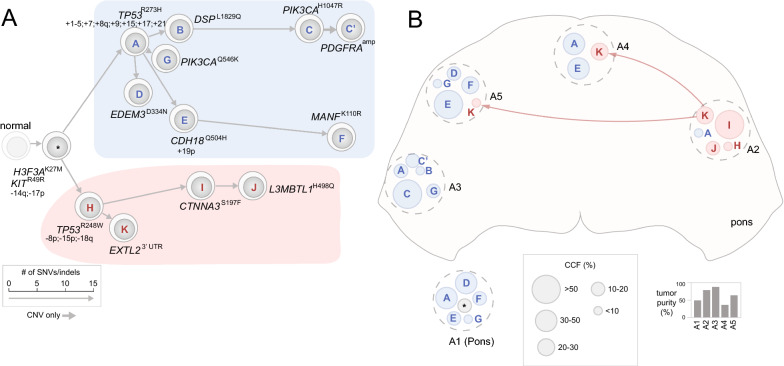
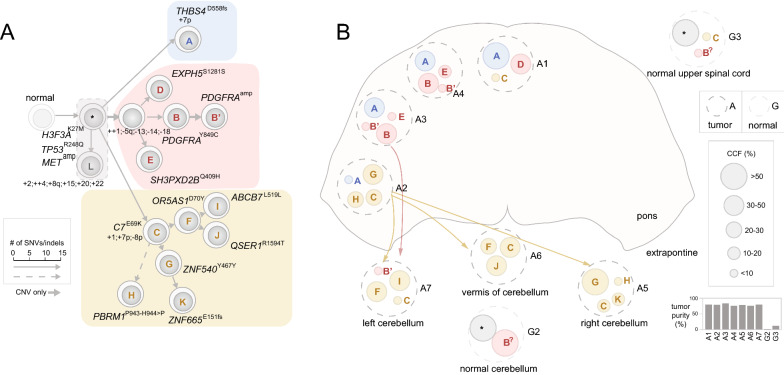
The majority of diffuse midline gliomas, H3 K27-altered (DMG-H3 K27-a), are infiltrating pediatric brain tumors that arise in the pons with no effective treatment. To understand how clonal evolution contributes to the tumor's invasive spread, we performed exome sequencing and SNP array profiling on 49 multi-region autopsy samples from 11 patients with pontine DMG-H3 K27-a enrolled in a phase I clinical trial of PDGFR inhibitor crenolanib. For each patient, a phylogenetic tree was constructed by testing multiple possible clonal evolution models to select the one consistent with somatic mutations and copy number variations across all tumor regions. The tree was then used to deconvolute subclonal composition and prevalence at each tumor region to study convergent evolution and invasion patterns. Somatic variants in the PI3K pathway, a late event, are enriched in our cohort, affecting 70% of patients. Convergent evolution of PI3K at distinct phylogenetic branches was detected in 40% of the patients. 24 (~ 50%) of tumor regions were occupied by subclones of mixed lineages with varying molecular ages, indicating multiple waves of invasion across the pons and extrapontine. Subclones harboring a PDGFRA amplicon, including one that amplified a PDGRFA mutant allele, were detected in four patients; their presence in extrapontine tumor and normal brain samples imply their involvement in extrapontine invasion. Our study expands the current knowledge on tumor invasion patterns in DMG-H3 K27-a, which may inform the design of future clinical trials.
大多数弥漫性中线脑胶质瘤,H3 K27 改变(DMG-H3 K27-a),是浸润性小儿脑肿瘤,发生于桥脑,目前尚无有效治疗方法。为了了解克隆进化如何促进肿瘤的侵袭性扩散,我们对 11 名接受 PDGFR 抑制剂 crenolanib 一期临床试验的桥脑 DMG-H3 K27-a 患者的 49 个多区域尸检样本进行了外显子测序和 SNP 芯片分析。对于每个患者,通过测试多个可能的克隆进化模型来构建系统发育树,以选择与所有肿瘤区域的体细胞突变和拷贝数变异一致的模型。然后,使用该树来解析每个肿瘤区域的亚克隆组成和流行率,以研究趋同进化和侵袭模式。PI3K 通路的体细胞变异是一个晚期事件,在我们的队列中丰富,影响 70%的患者。在 40%的患者中检测到 PI3K 在不同系统发育分支上的趋同进化。24(~50%)个肿瘤区域被具有不同分子年龄的混合谱系的亚克隆占据,表明有多个波次的侵袭跨越桥脑和桥外区域。在四个患者中检测到携带 PDGFRA 扩增子的亚克隆,包括一个扩增了 PDGRFA 突变等位基因的亚克隆;它们在桥外肿瘤和正常脑组织样本中的存在意味着它们参与了桥外侵袭。我们的研究扩展了 DMG-H3 K27-a 中肿瘤侵袭模式的现有知识,这可能为未来临床试验的设计提供信息。