Department of Endocrinology and Nutrition, Germans Trias I Pujol Research Institute (IGTP), Camí de les Escoles, s/n, 08916, Badalona, Catalonia, Spain.
Department of Endocrinology/Medicine, CIBERER U747, ISCIII, Research Center for Pituitary Diseases, Hospital Sant Pau, IIB-SPau, Universitat Autònoma de Barcelona, Barcelona, Spain.
Sci Rep. 2022 May 28;12(1):8979. doi: 10.1038/s41598-022-12955-2.
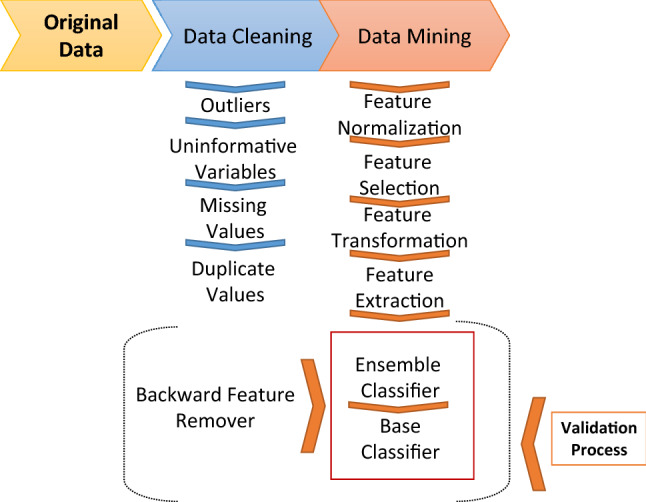
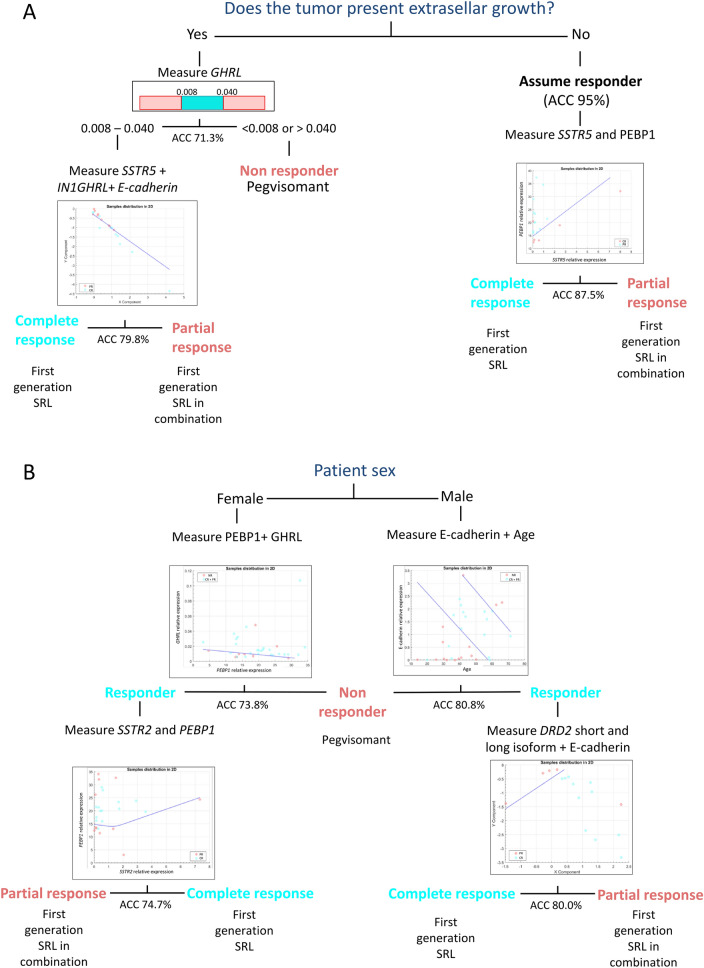
Predicting which acromegaly patients could benefit from somatostatin receptor ligands (SRL) is a must for personalized medicine. Although many biomarkers linked to SRL response have been identified, there is no consensus criterion on how to assign this pharmacologic treatment according to biomarker levels. Our aim is to provide better predictive tools for an accurate acromegaly patient stratification regarding the ability to respond to SRL. We took advantage of a multicenter study of 71 acromegaly patients and we used advanced mathematical modelling to predict SRL response combining molecular and clinical information. Different models of patient stratification were obtained, with a much higher accuracy when the studied cohort is fragmented according to relevant clinical characteristics. Considering all the models, a patient stratification based on the extrasellar growth of the tumor, sex, age and the expression of E-cadherin, GHRL, IN1-GHRL, DRD2, SSTR5 and PEBP1 is proposed, with accuracies that stand between 71 to 95%. In conclusion, the use of data mining could be very useful for implementation of personalized medicine in acromegaly through an interdisciplinary work between computer science, mathematics, biology and medicine. This new methodology opens a door to more precise and personalized medicine for acromegaly patients.
预测哪些肢端肥大症患者可能受益于生长抑素受体配体(SRL)是个性化医疗的必备条件。尽管已经确定了许多与 SRL 反应相关的生物标志物,但对于如何根据生物标志物水平分配这种药物治疗,尚无共识标准。我们的目标是提供更好的预测工具,以便根据 SRL 反应能力对肢端肥大症患者进行准确的分层。我们利用了一项涉及 71 例肢端肥大症患者的多中心研究,并利用先进的数学模型结合分子和临床信息来预测 SRL 反应。获得了不同的患者分层模型,当根据相关临床特征对研究队列进行细分时,准确性更高。考虑到所有模型,提出了一种基于肿瘤的鞍外生长、性别、年龄以及 E-钙黏蛋白、GHRL、IN1-GHRL、DRD2、SSTR5 和 PEBP1 表达的患者分层方法,其准确性在 71%至 95%之间。总之,通过计算机科学、数学、生物学和医学之间的跨学科工作,数据挖掘的使用对于在肢端肥大症中实施个性化医疗可能非常有用。这种新方法为肢端肥大症患者开辟了更精确和个性化医疗的大门。