Center for Care Delivery & Outcomes Research, Minneapolis VA Healthcare System, One Veterans Drive, Minneapolis, MN, 55417, USA; Women's Health Sciences Division at VA Boston, National Center for PTSD, 150 S Huntington Ave, Boston, MA, 02130, USA; University of Minnesota, Department of Medicine, 420 Delaware St SE, Minneapolis, MN, 55455, USA.
Center for Care Delivery & Outcomes Research, Minneapolis VA Healthcare System, One Veterans Drive, Minneapolis, MN, 55417, USA; University of Minnesota, Department of Medicine, 420 Delaware St SE, Minneapolis, MN, 55455, USA.
Behav Res Ther. 2022 Jul;154:104123. doi: 10.1016/j.brat.2022.104123. Epub 2022 May 21.
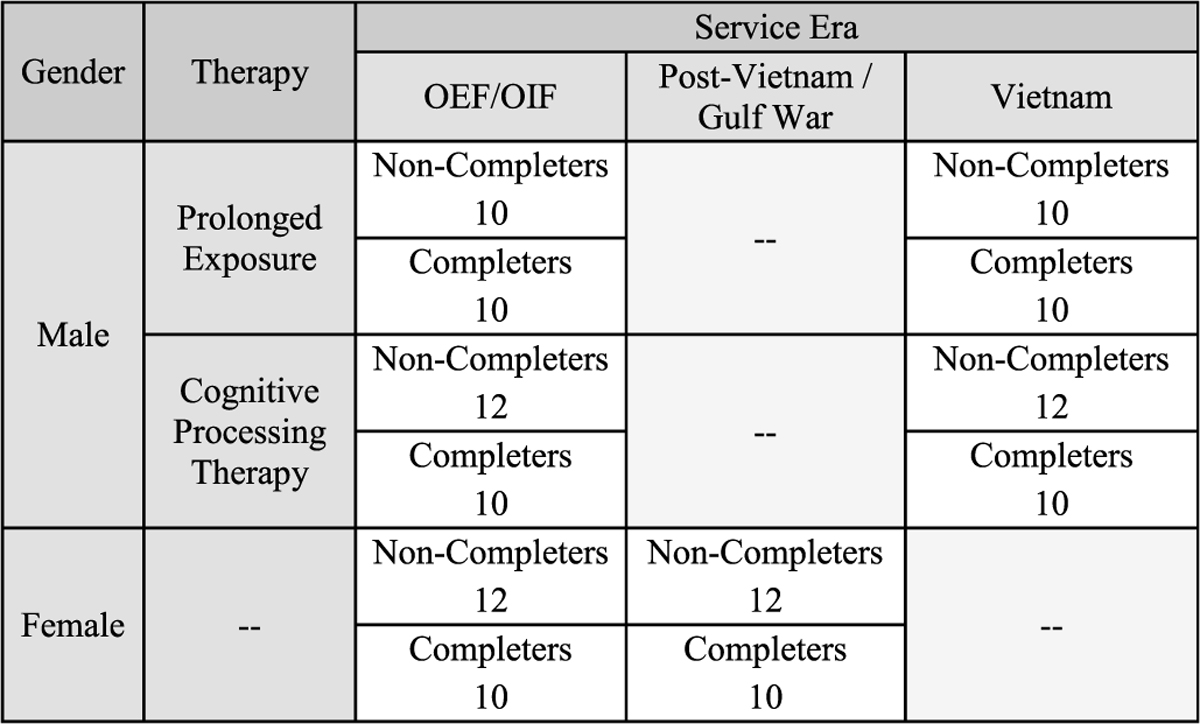
Prolonged Exposure (PE) and Cognitive Processing Therapy (CPT) are first-line treatments for posttraumatic stress disorder (PTSD) and have been disseminated throughout the U.S. Veterans Health Administration. Treatment non-completion is common and lessens clinical effectiveness; however, prior work has failed to identify factors consistently associated with non-completion. Semi-structured interviews were conducted with a national sample of veterans who recently completed (n = 60) or did not complete (n = 66) PE or CPT. Non-completer interviews focused on factors that contributed to veterans' decisions to drop out and efforts undertaken to complete PE/CPT. Completer interviews focused on challenges faced in completing treatment and facilitators of completion. Transcripts were coded using a mixed deductive/inductive approach; constant comparison was used to identify differences between completers and non-completers. Completers and non-completers differed in the extent of treatment-specific therapist support received, therapists' flexibility in treatment delivery, the type of encouragement offered by the care team and social supports, their interpretation of symptom worsening, the perceived impact of treatment on functioning, and the impact of stressors on their treatment engagement. Treatment-specific therapist support, more patient-centered and flexible treatment delivery, leveraging the full care team, and addressing functional concerns are potential targets for PE and CPT engagement interventions.
延长暴露疗法(PE)和认知加工疗法(CPT)是创伤后应激障碍(PTSD)的一线治疗方法,已在美国退伍军人健康管理局得到广泛应用。治疗完成率低是常见的,会降低临床疗效;然而,之前的研究未能确定与治疗完成率相关的一致因素。对最近完成(n=60)或未完成(n=66)PE 或 CPT 的退伍军人进行了全国性抽样的半结构式访谈。未完成者访谈重点关注导致退伍军人决定退出治疗的因素,以及为完成 PE/CPT 而采取的努力。完成者访谈重点关注在完成治疗过程中面临的挑战和完成治疗的促进因素。使用混合演绎/归纳方法对转录本进行编码;使用恒定性比较来确定完成者和未完成者之间的差异。治疗完成者和未完成者在治疗中获得的特定治疗师支持的程度、治疗师在治疗交付方面的灵活性、护理团队提供的鼓励类型和社会支持、对症状恶化的解释、对治疗对功能影响的看法以及治疗压力对他们的治疗参与的影响方面存在差异。治疗特异性治疗师支持、更以患者为中心和灵活的治疗交付、充分利用整个护理团队以及解决功能问题,是针对 PE 和 CPT 参与干预的潜在目标。