Ceccarelli Manuela, Marino Andrea, Pulvirenti Sarah, Coco Viviana, Busà Barbara, Nunnari Giuseppe, Cacopardo Bruno Santi
Department of Clinical and Experimental Medicine, Unit of Infectious Diseases, University of Catania, I-95122 Catania, Italy.
Department of Biomedical, Dental, Morphological and Functional Imaging Sciences, Unit of Infectious Diseases, University of Messina, I-98124 Messina, Italy.
Infect Dis Rep. 2022 May 12;14(3):372-382. doi: 10.3390/idr14030041.
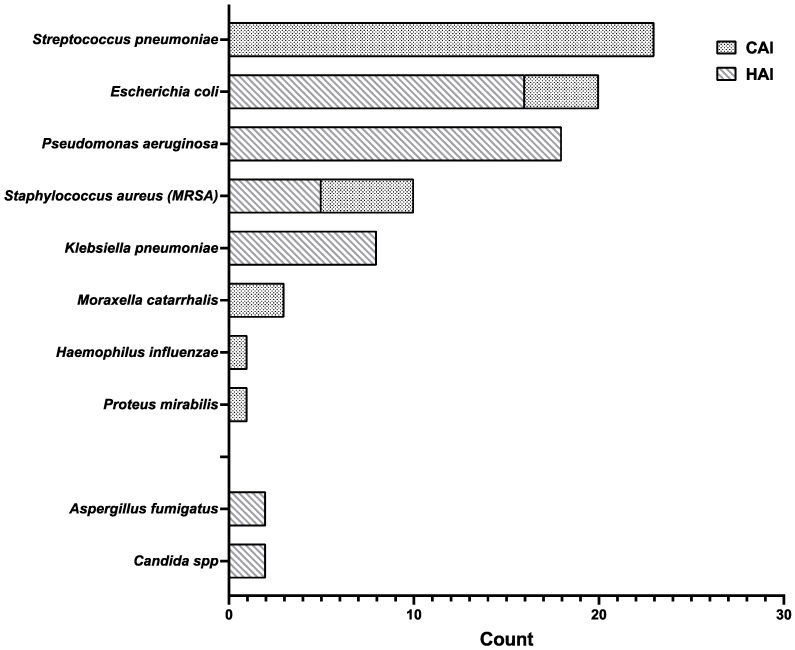
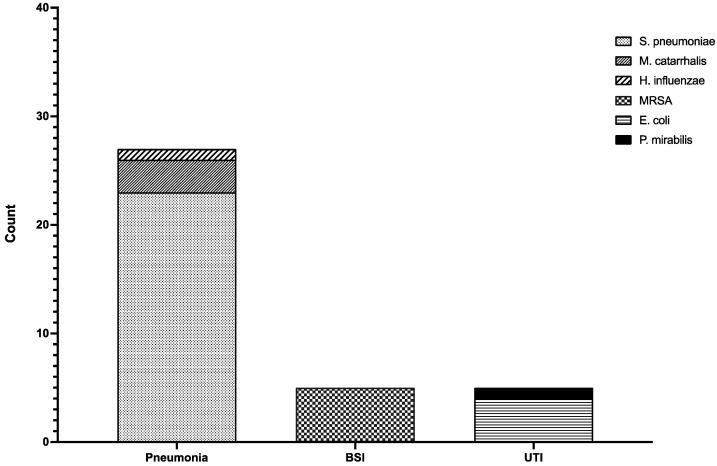
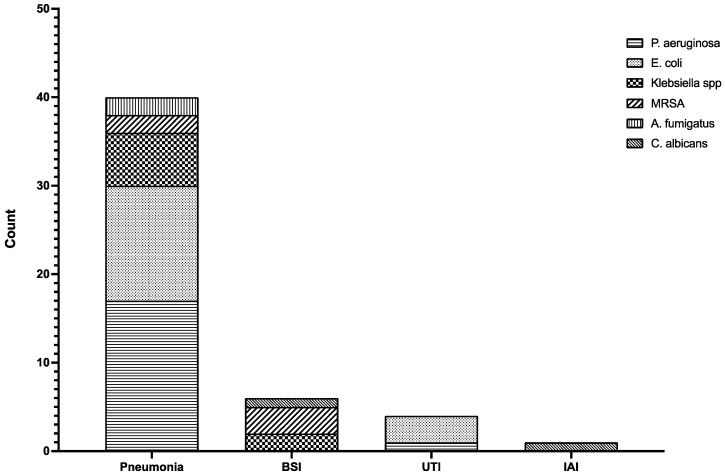
The use of immune suppressive drugs combined with the natural immune suppression caused by SARS-CoV-2 can lead to a surge of secondary bacterial and fungal infections. The aim of this study was to estimate the incidence of superinfections in hospitalized subjects with COVID-19. We carried out an observational retrospective single center cohort study. We enrolled patients admitted at the "Garibaldi" hospital for ≥72 h, with a confirmed diagnosis of COVID-19. All patients were routinely investigated for bacterial, viral, and fungal pathogens. A total of 589 adults with COVID-19 were included. A total of 88 infections were documented in different sites among 74 patients (12.6%). As for the etiology, 84 isolates were bacterial (95.5%), while only 4 were fungal (4.5%). A total of 51 episodes of hospital-acquired infections (HAI) were found in 43 patients, with a bacterial etiology in 47 cases (92.2%). Community-acquired infections (CAIs) are more frequently caused by , while HAIs are mostly associated with . A high rate of CAIs and HAIs due to the use of high-dose corticosteroids and long hospital stays can be suspected. COVID-19 patients should be routinely evaluated for infection and colonization. More data about antimicrobial resistance and its correlation with antibiotic misuse in COVID-19 patients are required.
免疫抑制药物的使用,再加上由严重急性呼吸综合征冠状病毒2(SARS-CoV-2)引起的自然免疫抑制,可能导致继发性细菌和真菌感染激增。本研究的目的是评估住院的2019冠状病毒病(COVID-19)患者中二重感染的发生率。我们开展了一项单中心回顾性观察队列研究。我们纳入了在“加里波第”医院住院≥72小时、确诊为COVID-19的患者。所有患者均接受了细菌、病毒和真菌病原体的常规检测。共纳入589例成年COVID-19患者。74例患者(12.6%)在不同部位共记录到88次感染。至于病因,84株分离菌为细菌(95.5%),而真菌仅4株(4.5%)。43例患者共发现51次医院获得性感染(HAI),其中47例(92.2%)为细菌病因。社区获得性感染(CAI)更常由……引起,而HAI大多与……相关。可以怀疑,高剂量糖皮质激素的使用和长时间住院导致了较高的CAI和HAI发生率。应对COVID-19患者进行感染和定植的常规评估。需要更多关于COVID-19患者抗菌药物耐药性及其与抗生素滥用相关性的数据。