Gs Greeshma, George Sageena, Anandaraj S, Sain Shaniya, Jose Deepak, Sreenivas Arjun, Pillai GadhaRajendran, Mol Noufila
Department of Pediatric and Preventive Dentistry, PMS College of Dental Science and Research, Thiruvananthapuram, Kerala, India.
Int J Clin Pediatr Dent. 2021;14(Suppl 2):S173-S178. doi: 10.5005/jp-journals-10005-2106.
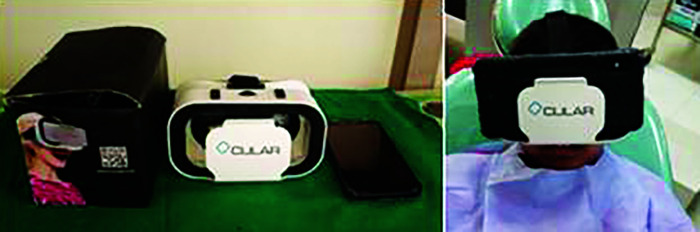
Children, in the age-group of 6 to 8 years, with moderate level of anxiety, (measured with M-DAS), requiring inferior alveolar nerve block (IANB) for mandibular tooth extraction were selected. Informed consent was obtained from parents. Selected children were allocated randomly into 3 groups virtual reality (VR) distraction group, audio distraction group and Tell-show-do (TSD) group. Pre- and post- distraction anxiety level of children was measured subjectively with facial image scale and objectively with pulse rate and oxygen saturation (measured with pulse oxymeter).
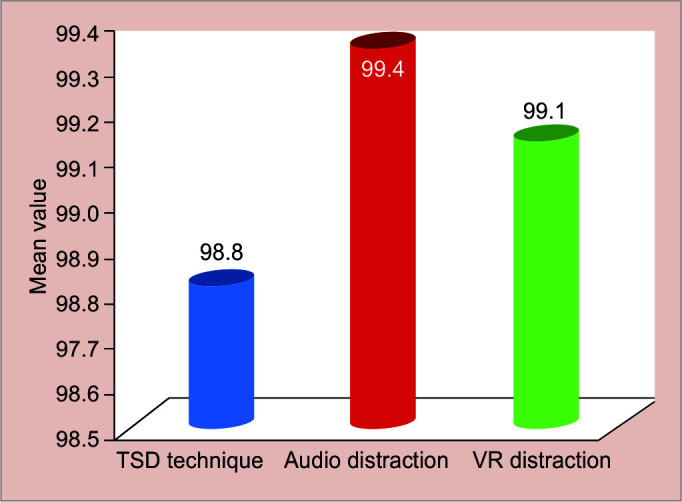
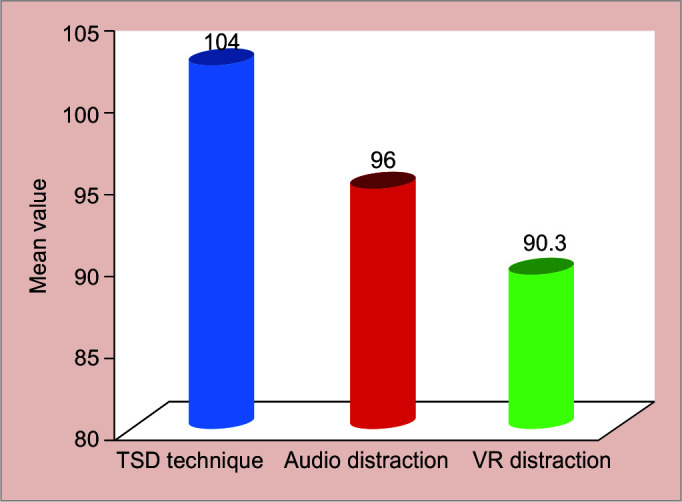
There was a statistically significant decrease in pulse rate after distraction (with a < 0.01) in all the three groups. Postdistraction pulse rate was lowest in the VR distraction group when compared to other groups. While comparing postdistraction pulse rate values in the three groups, the difference in pulse rate between TSD and VR distraction group was significant. But while comparing the pulse rate between audio distraction and TSD group ( = 0.06), and audio distraction and VR distraction group ( = 0.24) was not statistically significant. Oxygen saturation increased in all the three groups which was statistically significant ( < 0.01). There was a statistically significant difference in the postdistraction oxygen (O) saturation levels between TSD and audio distraction groups ( < 0.05) with more O saturation in audio distraction group. But while comparing the audio distraction with VR group and TSD with VR group, the difference was not significant. Facial image scale (FIS) scores decreased in all the three groups ( < 0.01).
The overall results revealed by all the parameters indicate that children were most relaxed in VR group, followed by audio group and were least relaxed in TSD group during dental visits. Hence VR distraction can be considered as a useful technique for behavior management of pediatric patients during a conventional dental treatment.
SG G, George S, S A, Comparative Evaluation of the Efficacy of Virtual Reality Distraction, Audio Distraction and Tell-show-do Techniques in Reducing the Anxiety Level of Pediatric Dental Patients: An Study. Int J Clin Pediatr Dent 2021;14(S-2):S173-S178.
选取6至8岁、焦虑程度中等(采用儿童牙科焦虑量表[M-DAS]测量)、因下颌牙拔除需要进行下牙槽神经阻滞(IANB)的儿童。已获得家长的知情同意。将选定的儿童随机分为3组:虚拟现实(VR)分散注意力组、音频分散注意力组和示范-展示-操作(TSD)组。在分散注意力前后,通过面部图像量表主观测量儿童的焦虑水平,并通过脉搏率和血氧饱和度(用脉搏血氧仪测量)客观测量。
三组在分散注意力后脉搏率均有统计学意义的下降(P<0.01)。与其他组相比,VR分散注意力组分散注意力后的脉搏率最低。比较三组分散注意力后的脉搏率值时,TSD组与VR分散注意力组之间的脉搏率差异显著。但比较音频分散注意力组与TSD组(P=0.06)以及音频分散注意力组与VR分散注意力组(P=0.24)之间的脉搏率时,差异无统计学意义。三组的血氧饱和度均升高,具有统计学意义(P<0.01)。TSD组与音频分散注意力组之间分散注意力后的血氧(O)饱和度水平存在统计学意义的差异(P<0.05),音频分散注意力组的血氧饱和度更高。但比较音频分散注意力组与VR组以及TSD组与VR组时,差异不显著。三组的面部图像量表(FIS)评分均下降(P<0.01)。
所有参数显示的总体结果表明,在牙科就诊期间,儿童在VR组中最放松,其次是音频组,在TSD组中最不放松。因此,VR分散注意力可被视为常规牙科治疗期间小儿患者行为管理的一种有用技术。
SG G, George S, S A, 虚拟现实分散注意力、音频分散注意力和示范-展示-操作技术在降低小儿牙科患者焦虑水平方面疗效的比较评估:一项研究。《国际临床儿科牙科学杂志》2021年;14(S-2):S173-S178。