Bonberg Nadine, Wulms Niklas, Dehghan-Nayyeri Mahboobeh, Berger Klaus, Minnerup Heike
Institute of Epidemiology and Social Medicine, University of Münster, Münster, Germany.
Clinic of Radiology, Medical Faculty, University Hospital Münster, University of Münster, Münster, Germany.
Front Aging Neurosci. 2022 May 11;14:810296. doi: 10.3389/fnagi.2022.810296. eCollection 2022.
To evaluate potential sex-specific effects of multiple cardiovascular risk factors on white matter pathology in normal aging men and women, as well as potential sex-differences in the association of white matter pathology and cognitive functions.
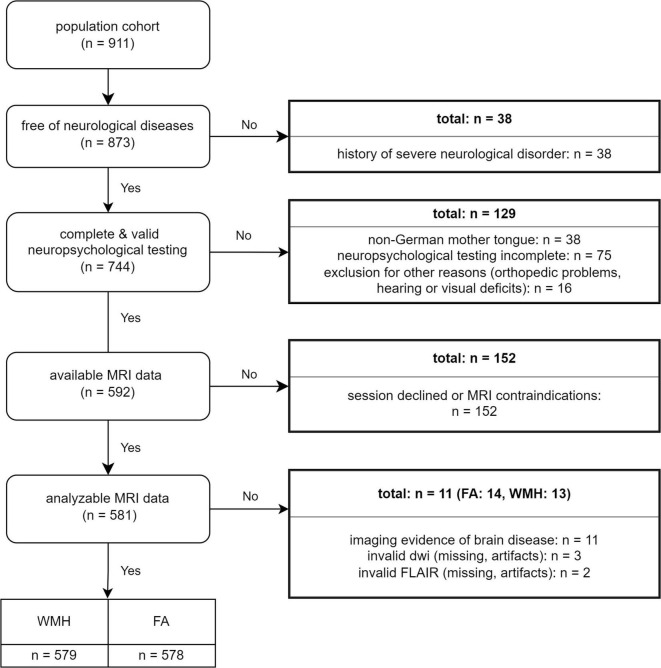
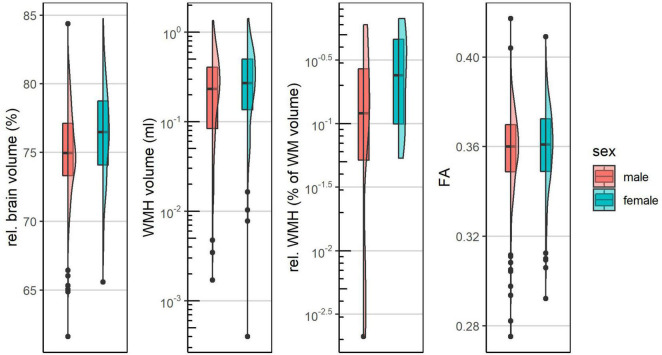
We analyzed cross-sectional data of 581 participants (median age: 53 years, 54% women) of the population-based cohort of the BiDirect Study who completed clinical examinations, five neuropsychological tests, and an 3T MRI examination. White matter pathology was determined by the extent of white matter hyperintensities (WMH) on FLAIR images as well as the magnitude of global fractional anisotropy (FA) based on diffusion tensor imaging. Main effects, interaction as well as sex-stratified generalized linear regression models were used to evaluate the moderating effect of sex on the association of hypertension, diabetes mellitus, smoking, and obesity with WMH and FA, respectively. Associations of imaging markers with cognitive test results were determined with linear regression models.
Hypertension showed stronger associations with more extensive WMH and less FA in women compared to men. Current smoking was associated with more severe WMH in women only. Adjusted for age and education, WMH were not significantly associated with cognitive tests, but higher FA was associated with better performance in motor function in both sexes and with executive functions in men, even after adjustment for cardiovascular risk factors.
We observed a stronger association of hypertension and smoking with white matter damage in women, suggesting a higher susceptibility for vascular pathology in women. However, there was no association of WMH with cognition, and FA was associated with executive function tests only in men, suggesting a higher cognitive reserve in women.
评估多种心血管危险因素对正常衰老男性和女性白质病变的潜在性别特异性影响,以及白质病变与认知功能关联中的潜在性别差异。
我们分析了BiDirect研究基于人群队列中581名参与者(中位年龄:53岁,54%为女性)的横断面数据,这些参与者完成了临床检查、五项神经心理学测试和一次3T磁共振成像检查。白质病变通过液体衰减反转恢复(FLAIR)图像上的白质高信号(WMH)范围以及基于扩散张量成像的全局分数各向异性(FA)大小来确定。分别使用主效应、交互作用以及按性别分层的广义线性回归模型来评估性别对高血压、糖尿病、吸烟和肥胖与WMH和FA关联的调节作用。通过线性回归模型确定成像标志物与认知测试结果的关联。
与男性相比,高血压在女性中与更广泛的WMH和更低的FA关联更强。仅在女性中,当前吸烟与更严重的WMH相关。在调整年龄和教育程度后,WMH与认知测试无显著关联,但更高的FA与两性的运动功能更好表现相关,在男性中与执行功能相关,即使在调整心血管危险因素后也是如此。
我们观察到高血压和吸烟与女性白质损伤的关联更强,表明女性对血管病变的易感性更高。然而,WMH与认知无关联,且FA仅在男性中与执行功能测试相关,表明女性具有更高的认知储备。