Zhong Genlong, Zhang Ruiting, Jiaerken Yerfan, Yu Xinfeng, Zhou Ying, Liu Chang, Lin Longting, Tong Lusha, Lou Min
Department of Neurology, School of Medicine, The Second Affiliated Hospital of Zhejiang UniversityHangzhou, China.
Department of Radiology, School of Medicine, The Second Affiliated Hospital of Zhejiang UniversityHangzhou, China.
Front Aging Neurosci. 2017 Jun 12;9:185. doi: 10.3389/fnagi.2017.00185. eCollection 2017.
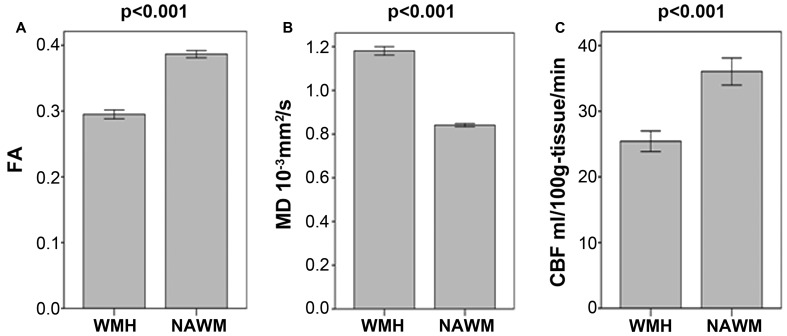
Leukoaraiosis is associated with increased risk of cognitive impairment, but its pathophysiological pathway is unclear. The aim of the present study was to determine whether brain structural damage or cerebral blood supply better correlated with the global cognitive outcome in subjects with leukoaraiosis. Seventy-five subjects with leukoaraiosis were included in present study, with age ranged from 43 to 85 years, with mean white matter hyperintensities (WMH) volume 30.69 ± 24.35 mL. Among them, 19(25.33%) subjects presented with cerebral microbleeds (CMB) and 40 (53.33%) subjects presented with lacunes. These participants received arterial spin labeling perfusion MRI, diffusion-tensor imaging (DTI) and diffusion Kurtosis imaging. We analyzed the cerebral blood flow (CBF) by dividing the brain tissue into three regions: WMH, normal appearing white matter (NAWM) and cortex. After adjusting for age and gender, the CBF of NAWM was significantly correlated with fractional anisotropy (FA) ( = 0.336, = 0.004) and mean diffusion (MD) ( = -0.271, = 0.020) of NAWM, while there lacked of association between CBF of cortex and mean kurtosis (MK) of cortex ( = -0.015, = 0.912). Meanwhile, both NAWM-FA ( = -0.443, < 0.001) and NAWM-MD ( = 0.293, = 0.012), as well as cortex-MK ( = -0.341, = 0.012) was significantly correlated with WMH volume. Univariate regression analysis demonstrated that global cognitive function was significantly associated with mean FA or MD of both WMH and NAWM, and cortex-CBF, but neither with the cortex-MK, nor the presences of CMB or lacunes. Finally, multiple linear regression analysis revealed that global cognitive function was independently associated with NAWM-FA (standardized β = 0.403, < 0.001) and WMH-FA (Standardized β = 0.211, = 0.017), but not with the cortex-CBF. A model that contained NAWM-FA, WMH-FA and years of education explained 49% of the variance of global cognitive function. Cerebral perfusion status might have a significant impact on the maintenance of white matter integrity in subjects with leukoaraiosis. Global cognitive function was more strongly associated with white matter integrity than with blood supply. DTI parameters, especially FA could serve as a potent imaging indicator for detecting the invisible alteration of white matter integrity and implying its potential cognitive relevance.
脑白质疏松症与认知障碍风险增加相关,但其病理生理途径尚不清楚。本研究的目的是确定在脑白质疏松症患者中,脑结构损伤或脑血供与整体认知结果的相关性是否更强。本研究纳入了75例脑白质疏松症患者,年龄范围为43至85岁,平均白质高信号(WMH)体积为30.69±24.35 mL。其中,19例(25.33%)患者出现脑微出血(CMB),40例(53.33%)患者出现腔隙性梗死灶。这些参与者接受了动脉自旋标记灌注磁共振成像、扩散张量成像(DTI)和扩散峰度成像检查。我们将脑组织分为三个区域:WMH、正常白质(NAWM)和皮质,分析脑血流量(CBF)。在调整年龄和性别后,NAWM的CBF与NAWM的各向异性分数(FA)显著相关(=0.336, =0.004)和平均扩散率(MD)显著相关(=-0.271, =0.020),而皮质的CBF与皮质的平均峰度(MK)之间缺乏相关性(=-0.015, =0.912)同时NAWM-FA(=-0.443, <0.001)、NAWM-MD(=0.293, =0.012)以及皮质-MK(=-0.341, =0.012)均与WMH体积显著相关。单因素回归分析表明,整体认知功能与WMH和NAWM的平均FA或MD以及皮质CBF显著相关,但与皮质MK、CMB或腔隙性梗死灶的存在无关。最后,多元线性回归分析显示,整体认知功能与NAWM-FA(标准化β=0.403, <0.001)和WMH-FA(标准化β=0.211, =0.017)独立相关,但与皮质CBF无关。一个包含NAWM-FA、WMH-FA和受教育年限的模型解释了整体认知功能变异的49%。脑灌注状态可能对脑白质疏松症患者白质完整性的维持有显著影响。整体认知功能与白质完整性的相关性强于与血供的相关性。DTI参数,尤其是FA,可作为检测白质完整性不可见改变及其潜在认知相关性的有效影像学指标。