Jiao Yu, Liu Dongjuan, Sun Yi, Chen Zitong, Liu Sai
The First Affiliated Hospital of China Medical University, Shenyang, China.
Liaoning Provincial Key Laboratory of Oral Diseases, School and Hospital of Stomatology, China Medical University, Shenyang, China.
Front Pharmacol. 2022 May 13;13:850750. doi: 10.3389/fphar.2022.850750. eCollection 2022.
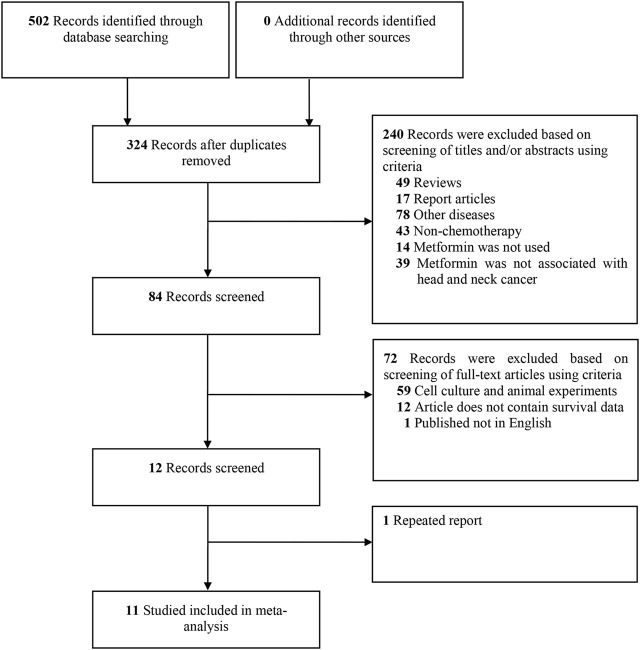
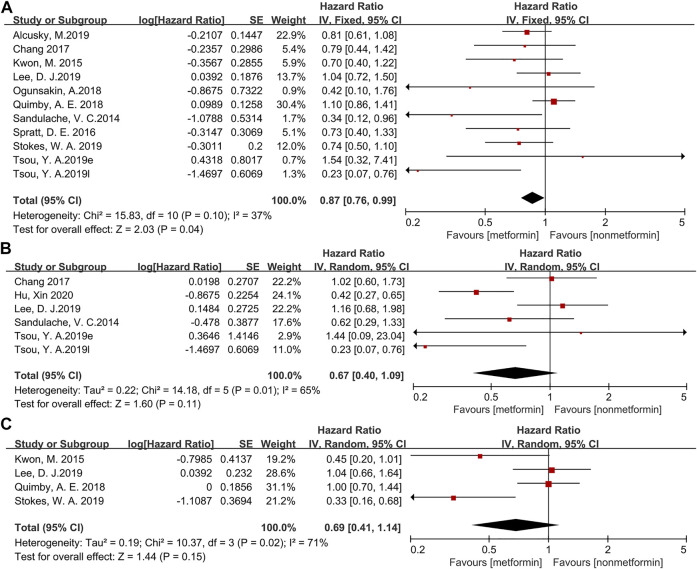
The relationship between the efficacy of metformin and the prognosis of patients with head and neck cancer (HNC) was still unclear. This study aims to clarify the prognostic value of metformin treatment using meta-analysis. Studies related to HNC prognosis and metformin were searched in Cochrane Library, Embase, LILACS, MEDLINE and PubMed databases. A meta-analysis was performed to evaluate the association between metformin therapy and the prognosis of HNC on overall survival (OS), disease-free survival (DFS) and disease-specific survival (DSS) and whether article quality, comorbidities, age, region or smoking had an influence on the prognosis of metformin treatment. Pooled hazard ratio (HR) and 95% confidence interval (CI) were analyzed to assess the effect. Eleven eligible studies involving 14,694 participants were included. Metformin increased the OS (HR = 0.87, 95% CI: 0.76-0.99), but failed on DFS (HR = 0.67, 95% CI: 0.40-1.09) or DSS (HR = 0.69, 95% CI: 0.41-1.14) in HNC patients. Subgroup analysis showed metformin was associated with improved OS (HR = 0.66, 95% CI: 0.49-0.88), DFS (HR = 0.49, 95% CI: 0.26-0.92) and DSS (HR = 0.38, 95% CI: 0.22-0.65) in studies with higher Newcastle-Ottawa Scale (NOS) scores. Subgroup analysis of age indicated that patients younger than 65 years (OS, HR = 0.67, 95% CI: 0.49-0.92) were more likely to benefit from metformin treatment. Subgroup analysis of comorbidities showed metformin significantly improved patient outcomes in studies without adjusted for comorbidities (OS, HR = 0.66, 95% CI: 0.51-0.85; DSS, HR = 0.38, 95% CI: 0.22-0.65), but not in studies that adjusted for comorbidities. Metformin improved the prognosis of HNC patients as an adjuvant therapy, especially in those with higher NOS scores. Age and comorbidities of HNC patients influenced the therapeutic effect of metformin. Further well-conducted investigations are needed.
二甲双胍的疗效与头颈癌(HNC)患者预后之间的关系仍不明确。本研究旨在通过荟萃分析阐明二甲双胍治疗的预后价值。在Cochrane图书馆、Embase、LILACS、MEDLINE和PubMed数据库中检索了与HNC预后和二甲双胍相关的研究。进行荟萃分析以评估二甲双胍治疗与HNC患者总生存期(OS)、无病生存期(DFS)和疾病特异性生存期(DSS)预后之间的关联,以及文章质量、合并症、年龄、地区或吸烟是否对二甲双胍治疗的预后有影响。分析合并风险比(HR)和95%置信区间(CI)以评估效果。纳入了11项符合条件的研究,共14,694名参与者。二甲双胍可提高HNC患者的OS(HR = 0.87,95%CI:0.76 - 0.99),但对DFS(HR = 0.67,95%CI:0.40 - 1.09)或DSS(HR = 0.69,95%CI:0.41 - 1.14)无作用。亚组分析显示,在纽卡斯尔 - 渥太华量表(NOS)评分较高的研究中,二甲双胍与改善的OS(HR = 0.66,95%CI:0.49 - 0.88)、DFS(HR = 0.49,95%CI:0.26 - 0.92)和DSS(HR = 0.38,95%CI:0.22 - 0.6)相关。年龄亚组分析表明,年龄小于65岁的患者(OS,HR = 0.67,95%CI:0.49 - 0.92)更可能从二甲双胍治疗中获益。合并症亚组分析显示,在未对合并症进行校正的研究中,二甲双胍显著改善了患者预后(OS,HR = 0.66,95%CI:0.51 - 0.85;DSS,HR = 0.38,95%CI:0.22 - 0.65),但在对合并症进行校正的研究中则不然。二甲双胍作为辅助治疗可改善HNC患者的预后,尤其是在NOS评分较高的患者中。HNC患者的年龄和合并症会影响二甲双胍的治疗效果。需要进一步开展高质量的研究。