Lee Su-Hee, Jeong Gap-Yeon
Department of Beauty Design, Catholic Kwandong University, Gangneung-si, South Korea.
Department of International Trade, Andong National University, Andong, South Korea.
Front Psychol. 2022 May 12;13:895823. doi: 10.3389/fpsyg.2022.895823. eCollection 2022.
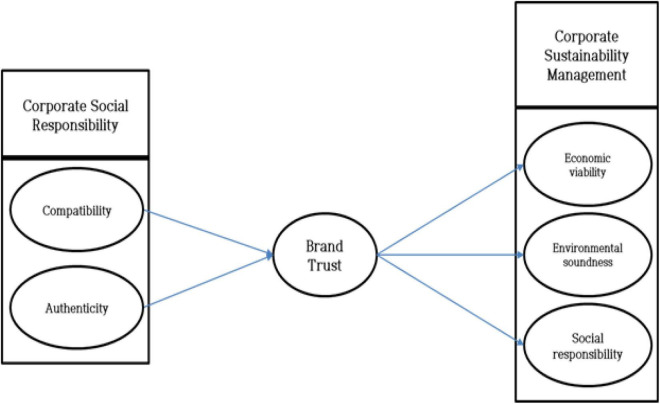
The purpose of this study is to examine whether corporate social responsibility (CSR) activities perceived by consumers affect brand trust and corporate sustainability management (CSM). In other words, this study tried to examine whether the compatibility and authenticity of CSR influences brand trust, thereby affecting CSM including economic viability, environmental soundness, and social responsibility. To measure this, an empirical analysis was conducted on 479 consumers who had experience purchasing products from cosmetic companies that are carrying out CSR. As a result of the analysis, it was found that the compatibility and authenticity of CSR have a positive effect on brand trust. Also, it was found that brand trust had a positive effect on social responsibility among the sub-concepts of CSM, but did not affect economic viability and environmental soundness. The results of this study are expected to provide strategic implications for social responsibility performance and brand trust building necessary for cosmetics companies to grow continuously.
本研究的目的是检验消费者所感知的企业社会责任(CSR)活动是否会影响品牌信任和企业可持续发展管理(CSM)。换句话说,本研究试图检验企业社会责任的兼容性和真实性是否会影响品牌信任,从而影响包括经济可行性、环境健全性和社会责任在内的企业可持续发展管理。为了对此进行衡量,对479名有从开展企业社会责任的化妆品公司购买产品经历的消费者进行了实证分析。分析结果发现,企业社会责任的兼容性和真实性对品牌信任有积极影响。此外,还发现品牌信任对企业可持续发展管理子概念中的社会责任有积极影响,但对经济可行性和环境健全性没有影响。本研究结果有望为化妆品公司持续发展所需的社会责任绩效和品牌信任建设提供战略启示。