Win Sithu, Miranda-Schaeubinger Monica, Gustavo Durán Saucedo Ronald, Carballo Jimenez Paula, Flores Jorge, Mercado-Saavedra Brandon, Camila Telleria Lola, Raafs Anne, Verastegui Manuela, Bern Caryn, Tinajeros Freddy, Heymans Stephane, Marcus Rachel, Gilman Robert H, Mukherjee Monica
University of California San Francisco, San Francisco, CA, USA.
Johns Hopkins University, Bloomberg School of Public Health, Baltimore, MD, USA.
Int J Cardiol Heart Vasc. 2022 May 23;41:101060. doi: 10.1016/j.ijcha.2022.101060. eCollection 2022 Aug.
Chagas disease is an endemic protozoan disease with high prevalence in Latin America. Of those infected, 20-30% will develop chronic Chagas cardiomyopathy (CCC) however, prediction using existing clinical criteria remains poor. In this study, we investigated the utility of left ventricular (LV) echocardiographic speckle-tracking global longitudinal strain (GLS) for early detection of CCC.
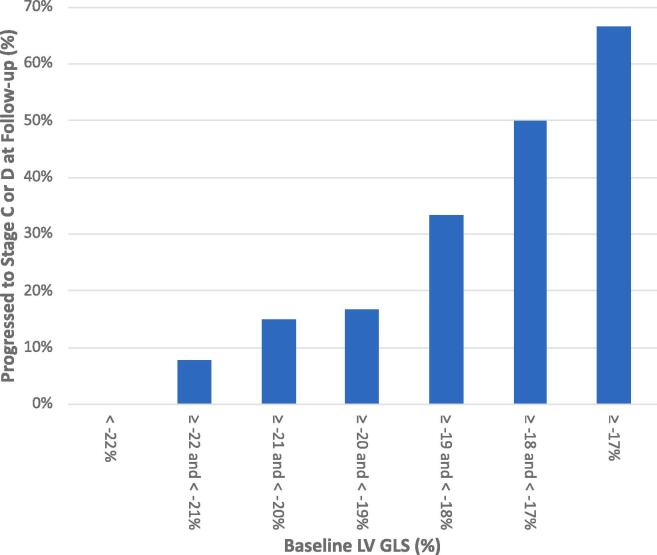
139 asymptomatic seropositive subjects with normal heart size and normal LV ejection fraction (EF) (stage A or B) were enrolled in this prospective observational study and underwent paired echocardiograms at baseline and 1-year follow-up. Progressors were participants classified as stage C or D at follow-up due to development of symptoms of heart failure, cardiomegaly, or decrease in LVEF. LV GLS was calculated as the average peak systolic strain of 16 LV segments. Measurements were compared between participants who progressed and did not progress by two-sample -test, and the odds of progression assessed by multivariable logistic regression. Of the 139 participants, 69.8% were female, mean age 55.8 ± 12.5 years, with 12 (8.6%) progressing to Stage C or D at follow-up. Progressors tended to be older, male, with wider QRS duration. LV GLS was -19.0% in progressors vs. -22.4% in non-progressors at baseline, with 71% higher odds of progression per +1% of GLS (adjusted OR 1.71, 95% CI 1.20-2.44, p = 0.003).
Baseline LV GLS in participants with CCC stage A or B was predictive of progression within 1-year and may guide timing of clinical follow-up and promote early detection or treatment.
恰加斯病是一种在拉丁美洲流行率很高的地方性原生动物疾病。在感染者中,20%-30%会发展为慢性恰加斯心肌病(CCC),然而,使用现有临床标准进行预测的效果仍然很差。在本研究中,我们调查了左心室(LV)超声心动图斑点追踪整体纵向应变(GLS)在早期检测CCC中的作用。
139名心脏大小正常且左心室射血分数(EF)正常的无症状血清阳性受试者(A期或B期)参与了这项前瞻性观察研究,并在基线和1年随访时接受了配对超声心动图检查。进展者是指在随访时因出现心力衰竭症状、心脏扩大或左心室射血分数降低而被分类为C期或D期的参与者。LV GLS计算为16个左心室节段的平均收缩期峰值应变。通过双样本检验比较进展者和未进展者之间的测量值,并通过多变量逻辑回归评估进展的几率。在139名参与者中,69.8%为女性,平均年龄55.8±12.5岁,12名(8.6%)在随访时进展为C期或D期。进展者往往年龄较大,为男性,QRS时限较宽。基线时,进展者的LV GLS为-19.0%,未进展者为-22.4%,GLS每增加1%,进展几率高71%(调整后的OR为1.71,95%CI为1.20-2.44,p=0.003)。
CCC A期或B期参与者的基线LV GLS可预测1年内的病情进展,并可指导临床随访时间,促进早期检测或治疗。