School of Medical Sciences, University of Hyderabad, Telangana, India.
Country Director Orbis, Orbis, India.
Indian J Ophthalmol. 2022 Jun;70(6):2141-2145. doi: 10.4103/ijo.IJO_2804_21.
Currently, there are an estimated 4.95 million blind persons and 70 million vision impaired persons in India, out of which 0.24 million are blind children. Early detection and treatment of the leading causes of blindness such as cataract are important in reducing the prevalence of blindness and vision impairment. There are significant developments in the field of blindness prevention, management, and control since the "Vision 2020: The right to sight" initiative. Very few studies have analyzed the cost of blindness at the population level. This study was undertaken to update the information on the economic burden of blindness and visual impairment in India based on the prevalence of blindness in India. We used secondary and publicly available data and a few assumptions for our estimations.
We used gross national income (GNI), disability weights, and loss of productivity metrics to calculate the economic burden of blindness and vision impairment based on the "cost of illness" methodology.
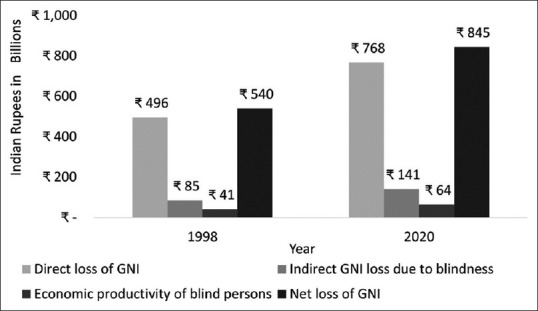
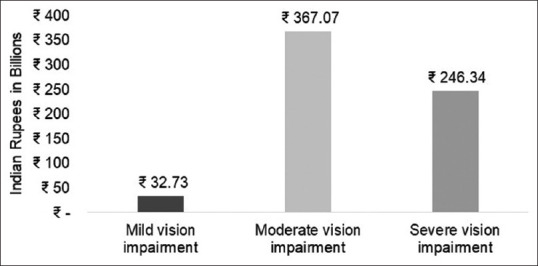
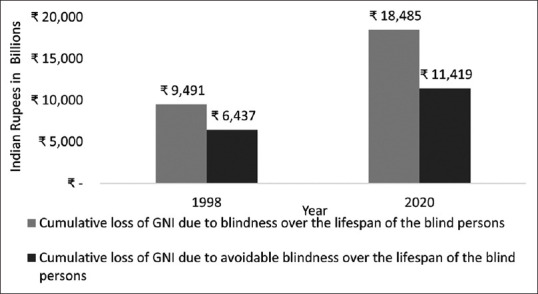
The estimated net loss of GNI due to blindness in India is INR 845 billion (Int$ 38.4 billion), with a per capita loss of GNI per blind person of INR 170,624 (Int$ 7,756). The cumulative loss of GNI due to avoidable blindness in India is INR 11,778.6 billion (Int$ 535 billion). The cumulative loss of GNI due to blindness increased almost three times in the past two decades. The potential loss of productivity due to vision impairment is INR 646 billion (Int$ 29.4 billion).
These estimates provide adequate information for budgetary allocation and will help advocate the need for accelerated adoption of all four strategies of integrated people-centered eye care (IPCEC). Early detection and treatment of blindness, especially among children, is very important in reducing the economic burden; thus, there is a need for integrating primary eye care horizontally with all levels of primary healthcare.
目前,印度估计有 495 万盲人和 7000 万视力受损者,其中 24 万是盲童。及早发现和治疗白内障等主要致盲原因,对于降低盲率和视力损害率至关重要。自“视觉 2020:享有看见的权利”倡议以来,在预防、管理和控制失明方面取得了重大进展。很少有研究分析人口层面的失明成本。本研究旨在根据印度的盲率更新印度失明和视力损害的经济负担信息。我们使用了二级和公开可用的数据,并做了一些假设来进行估算。
我们使用国民总收入(GNI)、残疾权重和生产力损失指标,根据“疾病成本”方法,计算失明和视力损害的经济负担。
印度因失明造成的国民总收入净损失估计为 8450 亿卢比(38.4 亿美元),人均失明者国民总收入损失为 170624 卢比(7756 美元)。印度可避免性失明造成的国民总收入累计损失为 117786 亿卢比(535 亿美元)。在过去二十年中,印度因失明造成的国民总收入损失几乎增加了两倍。视力损害导致的潜在生产力损失为 6460 亿卢比(29.4 亿美元)。
这些估计数为预算分配提供了充分的信息,并将有助于倡导加速采用综合以人为主的眼保健(IPCEC)的所有四项战略。及早发现和治疗失明,特别是儿童的失明,对于减轻经济负担非常重要;因此,需要将初级眼保健横向纳入各级初级医疗保健。