Lancet Glob Health. 2021 Feb;9(2):e130-e143. doi: 10.1016/S2214-109X(20)30425-3. Epub 2020 Dec 1.
To contribute to the WHO initiative, VISION 2020: The Right to Sight, an assessment of global vision impairment in 2020 and temporal change is needed. We aimed to extensively update estimates of global vision loss burden, presenting estimates for 2020, temporal change over three decades between 1990-2020, and forecasts for 2050.
We did a systematic review and meta-analysis of population-based surveys of eye disease from January, 1980, to October, 2018. Only studies with samples representative of the population and with clearly defined visual acuity testing protocols were included. We fitted hierarchical models to estimate 2020 prevalence (with 95% uncertainty intervals [UIs]) of mild vision impairment (presenting visual acuity ≥6/18 and <6/12), moderate and severe vision impairment (<6/18 to 3/60), and blindness (<3/60 or less than 10° visual field around central fixation); and vision impairment from uncorrected presbyopia (presenting near vision <N6 or <N8 at 40 cm where best-corrected distance visual acuity is ≥6/12). We forecast estimates of vision loss up to 2050.
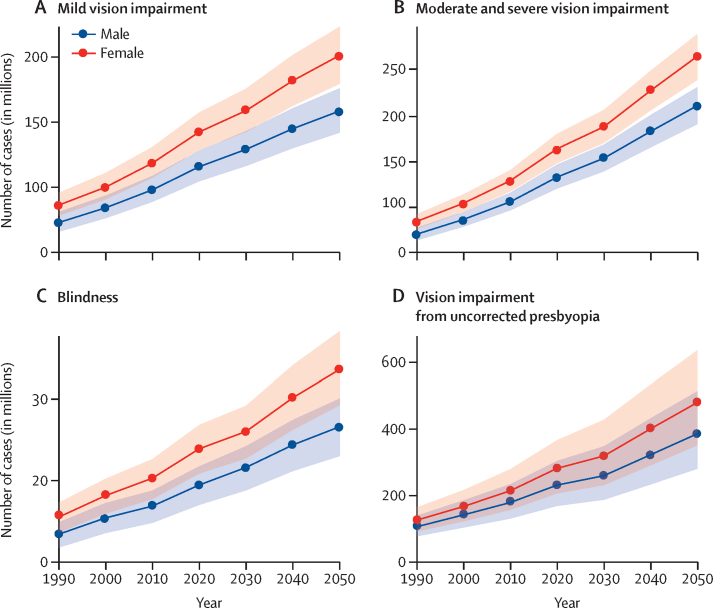
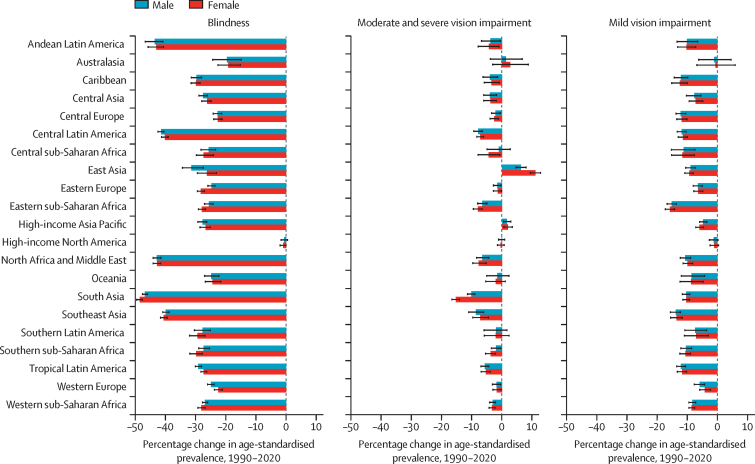
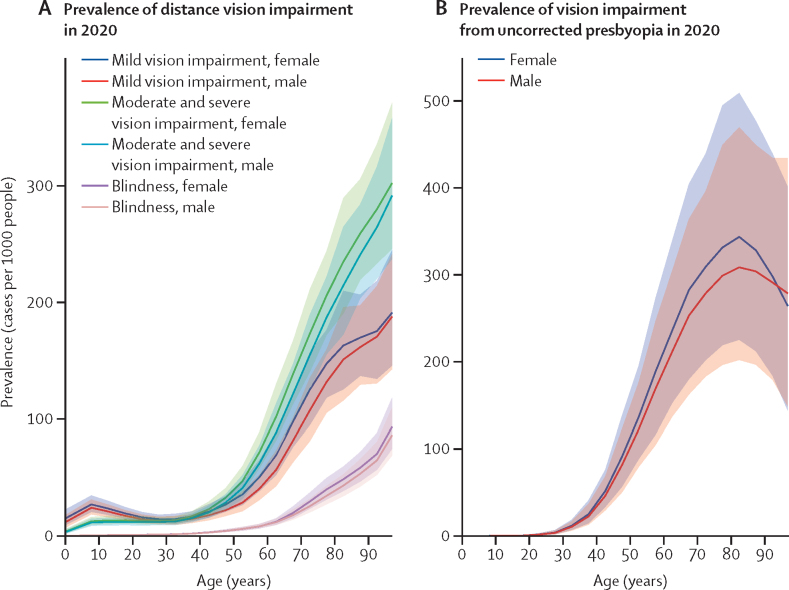
In 2020, an estimated 43·3 million (95% UI 37·6-48·4) people were blind, of whom 23·9 million (55%; 20·8-26·8) were estimated to be female. We estimated 295 million (267-325) people to have moderate and severe vision impairment, of whom 163 million (55%; 147-179) were female; 258 million (233-285) to have mild vision impairment, of whom 142 million (55%; 128-157) were female; and 510 million (371-667) to have visual impairment from uncorrected presbyopia, of whom 280 million (55%; 205-365) were female. Globally, between 1990 and 2020, among adults aged 50 years or older, age-standardised prevalence of blindness decreased by 28·5% (-29·4 to -27·7) and prevalence of mild vision impairment decreased slightly (-0·3%, -0·8 to -0·2), whereas prevalence of moderate and severe vision impairment increased slightly (2·5%, 1·9 to 3·2; insufficient data were available to calculate this statistic for vision impairment from uncorrected presbyopia). In this period, the number of people who were blind increased by 50·6% (47·8 to 53·4) and the number with moderate and severe vision impairment increased by 91·7% (87·6 to 95·8). By 2050, we predict 61·0 million (52·9 to 69·3) people will be blind, 474 million (428 to 518) will have moderate and severe vision impairment, 360 million (322 to 400) will have mild vision impairment, and 866 million (629 to 1150) will have uncorrected presbyopia.
Age-adjusted prevalence of blindness has reduced over the past three decades, yet due to population growth, progress is not keeping pace with needs. We face enormous challenges in avoiding vision impairment as the global population grows and ages.
Brien Holden Vision Institute, Fondation Thea, Fred Hollows Foundation, Bill & Melinda Gates Foundation, Lions Clubs International Foundation, Sightsavers International, and University of Heidelberg.
为了响应世界卫生组织的倡议“视觉 2020:享有看见的权利”,我们需要对 2020 年全球视力障碍情况以及时间变化进行评估。我们的目的是广泛更新全球视力丧失负担的估计值,提供 2020 年的估计值、1990 年至 2020 年 30 年间的时间变化以及 2050 年的预测值。
我们对 1980 年 1 月至 2018 年 10 月的基于人群的眼病调查进行了系统回顾和荟萃分析。只有样本具有代表性且具有明确定义的视力测试协议的研究才被纳入。我们使用分层模型来估计 2020 年轻度视力障碍(目前的视力 ≥6/18 且 <6/12)、中度和重度视力障碍(<6/18 至 3/60)和失明(<3/60 或小于中央注视 10°视野)的患病率(95%不确定性区间[UI]);以及未矫正远视引起的视力障碍(目前近视力 <N6 或 <N8 在 40 cm 处,最佳矫正距离视力 ≥6/12)。我们预测了到 2050 年的视力丧失估计值。
2020 年,估计有 4330 万人(95%UI 376-484)失明,其中 2390 万人(55%;208-268)为女性。我们估计有 2.95 亿人(2.67-3.25)患有中度和重度视力障碍,其中 1.63 亿人(55%;1.47-1.79)为女性;2.58 亿人(2.33-2.85)患有轻度视力障碍,其中 1.42 亿人(55%;1.28-1.57)为女性;5.10 亿人(3.71-6.67)患有未矫正远视引起的视力障碍,其中 2.80 亿人(55%;2.05-3.65)为女性。全球范围内,1990 年至 2020 年间,50 岁及以上成年人中,失明的年龄标准化患病率下降了 28.5%(-29.4 至-27.7),轻度视力障碍的患病率略有下降(-0.3%,-0.8 至-0.2),而中度和重度视力障碍的患病率略有上升(2.5%,1.9 至 3.2;未矫正远视引起的视力障碍的数据不足,无法计算此统计数据)。在此期间,失明人数增加了 50.6%(47.8 至 53.4),中度和重度视力障碍人数增加了 91.7%(87.6 至 95.8)。到 2050 年,我们预测将有 6100 万人(5290 万至 6930 万)失明,4.74 亿人(4.28 亿至 5.18)将患有中度和重度视力障碍,3.60 亿人(3.22 亿至 4.00)将患有轻度视力障碍,8.66 亿人(6.29 亿至 11.50 亿)将患有未矫正远视。
过去三十年来,年龄调整后的失明患病率有所下降,但由于人口增长,进展赶不上需求。随着全球人口的增长和老龄化,我们在避免视力障碍方面面临着巨大的挑战。
Brien Holden 视觉研究所、Thea 基金会、弗雷德·霍洛基金会、比尔和梅琳达·盖茨基金会、狮子俱乐部国际基金会、Sightsavers International 和海德堡大学。