Molecular Diagnostics, Children's Cancer Institute, Lowy Cancer Research Centre, UNSW, Sydney, NSW, Australia.
Department of Paediatric Haematology and Oncology, Second Faculty of Medicine, Charles University, Prague, Czech Republic.
Br J Cancer. 2022 Sep;127(5):908-915. doi: 10.1038/s41416-022-01806-6. Epub 2022 Jun 1.
ABL-class fusions including NUP214-ABL1 and EBF1-PDGFRB occur in high risk acute lymphoblastic leukaemia (ALL) with gene expression patterns similar to BCR-ABL-positive ALL. Our aim was to evaluate new DNA-based measurable residual disease (MRD) tests detecting these fusions and IKZF1-deletions in comparison with conventional immunoglobulin/T-cell receptor (Ig/TCR) markers.
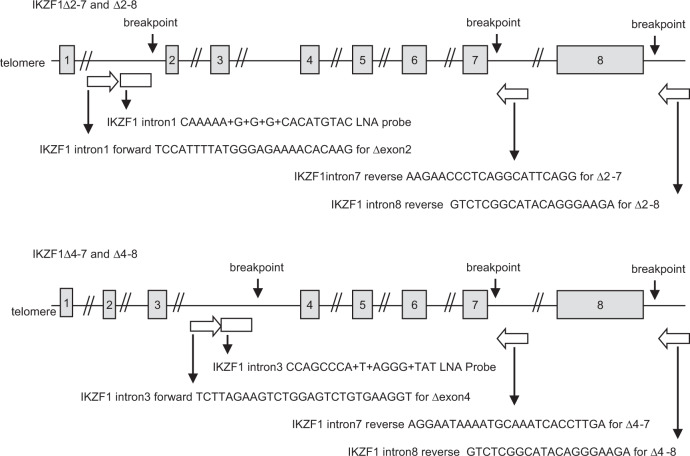
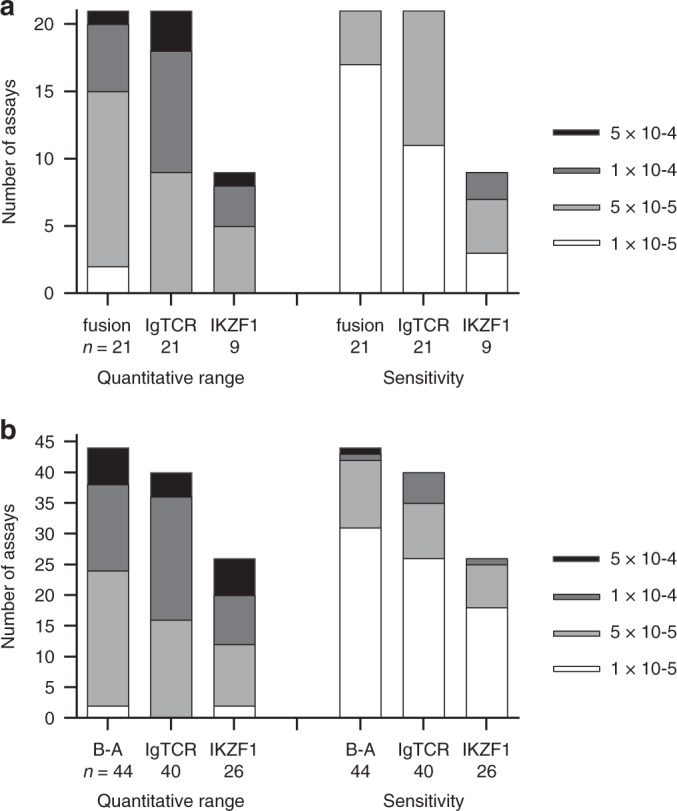
Precise genomic breakpoints were defined from targeted or whole genome next generation sequencing for ABL-fusions and BCR-ABL1. Quantitative PCR assays were designed and used to re-measure MRD in remission bone marrow samples previously tested using Ig/TCR markers. All MRD testing complied with EuroMRD guidelines.
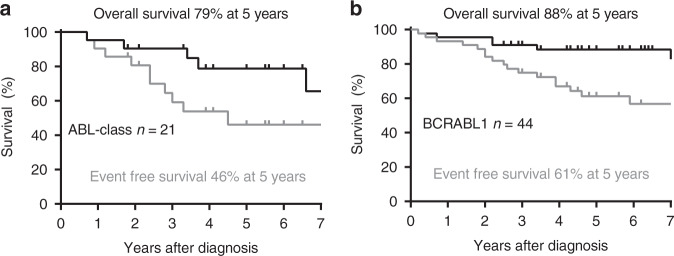
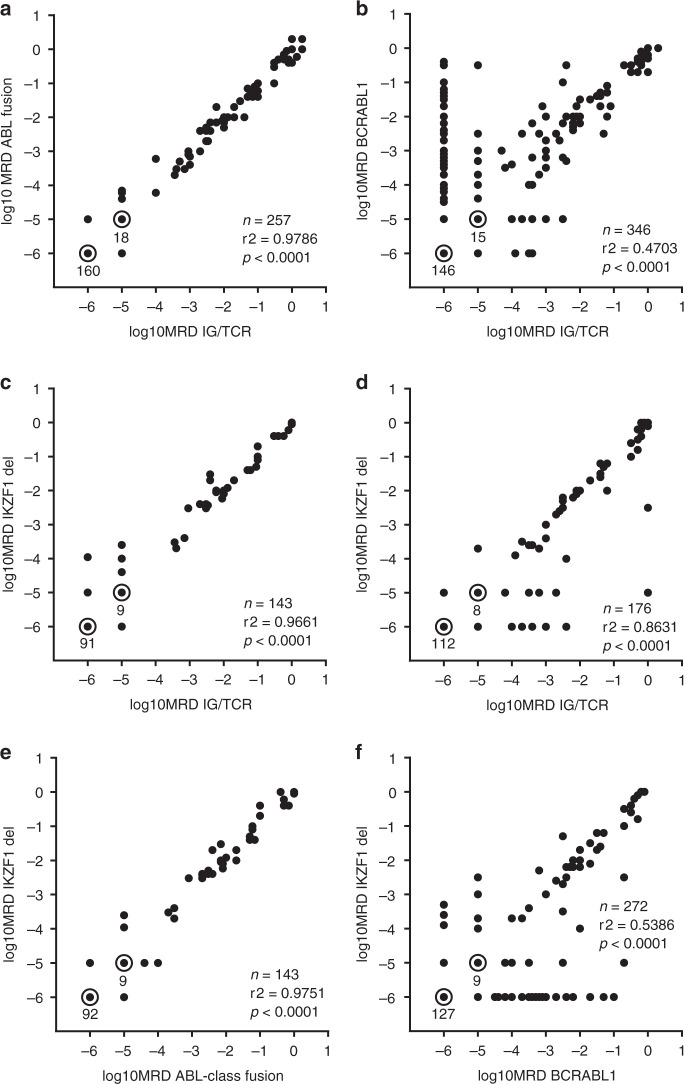
ABL-class patients had 46% 5year event-free survival and 79% 5year overall survival. All had sensitive fusion tests giving high concordance between Ig/TCR and ABL-class fusion results (21 patients, n = 257 samples, r2 = 0.9786, P < 0.0001) and Ig/TCR and IKZF1-deletion results (9 patients, n = 143 samples, r2 = 0.9661, P < 0.0001). In contrast, in BCR-ABL1 patients, Ig/TCR and BCR-ABL1 tests were discordant in 32% (40 patients, n = 346 samples, r2 = 0.4703, P < 0.0001) and IKZF1-deletion results were closer to Ig/TCR (25 patients, n = 176, r2 = 0.8631, P < 0.0001).
MRD monitoring based on patient-specific assays detecting gene fusions or recurrent assays for IKZF1-deletions is feasible and provides good alternatives to Ig/TCR tests to monitor MRD in ABL-class ALL.
NUP214-ABL1 和 EBF1-PDGFRB 等 ABL 类融合基因发生于具有类似 BCR-ABL 阳性 ALL 基因表达模式的高危急性淋巴细胞白血病(ALL)中。我们的目的是评估新的基于 DNA 的可测量残留疾病(MRD)检测方法,这些方法检测这些融合基因和 IKZF1 缺失,与传统的免疫球蛋白/T 细胞受体(Ig/TCR)标志物进行比较。
通过靶向或全基因组下一代测序,对 ABL 融合基因和 BCR-ABL1 进行精确的基因组断裂点定义。设计了定量 PCR 检测方法,并用于重新测量使用 Ig/TCR 标志物检测到的缓解骨髓样本中的 MRD。所有的 MRD 检测均符合 EuroMRD 指南。
ABL 类患者的 5 年无事件生存率为 46%,总生存率为 79%。所有患者均有敏感的融合检测,Ig/TCR 和 ABL 类融合结果之间具有高度一致性(21 例患者,n=257 个样本,r2=0.9786,P<0.0001),以及 Ig/TCR 和 IKZF1 缺失结果之间具有高度一致性(9 例患者,n=143 个样本,r2=0.9661,P<0.0001)。相比之下,在 BCR-ABL1 患者中,Ig/TCR 和 BCR-ABL1 检测结果不一致的比例为 32%(40 例患者,n=346 个样本,r2=0.4703,P<0.0001),而 IKZF1 缺失结果更接近 Ig/TCR(25 例患者,n=176 个样本,r2=0.8631,P<0.0001)。
基于检测基因融合的患者特异性检测或针对 IKZF1 缺失的重复检测的 MRD 监测是可行的,并且是替代 ABL 类 ALL 中 Ig/TCR 检测监测 MRD 的良好方法。